top of page

This 1.8-Pound Robot Hand Can Walk on Its Fingers, Navigate 14 Surfaces and Press a Keyboard

8 minutes ago
9 min read
# ETH Zurich’s Walking Robot Hand Points to a New Era of Modular Robotics

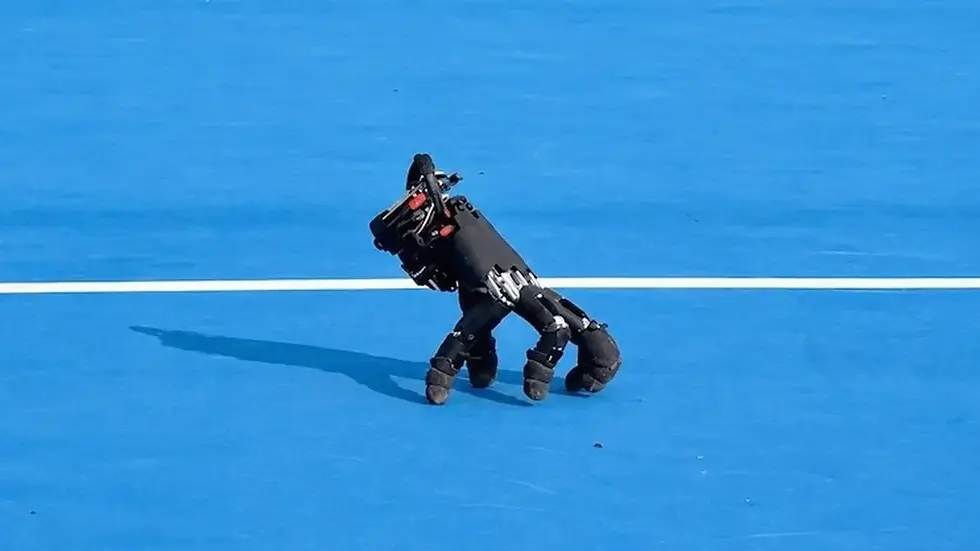
A robotic hand normally depends on an arm for almost everything. The arm transports it, positions it, stabilizes it, and supplies the reach required to interact with the surrounding world. Researchers at ETH Zurich are challenging that conventional architecture by teaching an off-the-shelf anthropomorphic robotic hand to move independently across surfaces using its own fingers.

The result is an unusual but technically significant machine: a five-fingered robotic hand that can crawl without an attached arm, maintain its balance, recover from falls, traverse different surfaces, and manipulate a keyboard. The system weighs about 818 grams, or 1.8 pounds, and carries its own computing, sensing, and power hardware.

The project, developed by researchers at ETH Zurich’s Soft Robotics Lab, explores an important question for the future of robotics: what happens when individual robot components become capable of operating independently rather than remaining permanently attached to a larger machine?

The answer could eventually lead to modular robots whose hands, sensors, tools, and other components can separate from a primary platform, perform specialized tasks in constrained environments, and reconnect when their capabilities are needed elsewhere.

## Turning a Robotic Hand Into a Mobile Robot

The ETH Zurich system starts with a commercial WUJI robotic hand containing 20 powered joints. Rather than redesigning its fingers or replacing its existing position-control architecture, the researchers focused primarily on teaching the hardware new behavior.

That approach is important because it demonstrates how much additional capability can potentially be extracted from existing robotic hardware through software and learning.

An anthropomorphic hand presents a difficult locomotion problem. Its fingers are not identical legs. They differ in length, geometry, and mechanical configuration, while the thumb is positioned differently from the other four digits. The palm also has an asymmetric orientation.

A conventional quadruped robot benefits from carefully designed symmetry and dedicated legs. The ETH system has neither advantage. Its fingers must simultaneously support the robot's weight, generate forward motion, stabilize the palm, and remain capable of manipulation.

The researchers therefore treated the hand's fingers as both locomotion mechanisms and manipulators.

This creates a fundamental robotics trade-off. Every finger used to move the robot is temporarily unavailable for another manipulation task. The system consequently needs intelligent coordination between mobility and interaction rather than simply maximizing either capability independently.

## Reinforcement Learning Solves the Five-Finger Locomotion Problem

The core breakthrough is largely a control problem rather than a mechanical redesign.

Researchers trained controllers in simulation using deep reinforcement learning. In this approach, an artificial agent repeatedly attempts a task in a virtual environment and receives feedback based on how effectively it achieves its objective.

For the robotic hand, the learning process had to account for its unusual geometry and the physical constraints imposed by its fingers.

Rather than treating the fingers like identical legs, the researchers established reference positions and learned coordinated movements that allow the digits to generate stable locomotion. Mathematical transformations compensate for the palm's natural orientation, allowing the controller to reason about movement relative to the surrounding surface.

An onboard neural network operates at a 50 Hz control rate, calculating adjustments 50 times per second. Those commands are translated through the hand's existing position-control system into physical joint movements.

This division between learned high-level coordination and conventional low-level motor control is particularly useful. Reinforcement learning determines how the fingers should cooperate, while established control mechanisms handle the precise positioning of individual joints.

The architecture illustrates an increasingly common direction in robotics: learning does not necessarily replace classical control. Instead, the two approaches can complement one another.

## An Untethered Robot That Carries Its Own Brain

A mobile robot cannot depend on a laboratory computer or a physical cable if independence is the objective.

The ETH team equipped the commercial hand with an approximately 80-gram backpack containing a Raspberry Pi Zero 2 W, an inertial measurement unit, and a lithium-polymer battery. Together, these components provide onboard computation, motion sensing, and power.

The complete platform weighs approximately 818 grams.

That compact configuration is more significant than its unusual appearance suggests. Removing the cable eliminates one of the most obvious constraints of mobile manipulation experiments. The hand can move independently rather than being continuously connected to external computing equipment.

The onboard inertial measurement unit also enables the robot to determine changes in its orientation and movement. This becomes particularly valuable when the hand loses balance.

An onboard recovery behavior allows it to respond after tipping onto its side and attempt to return to its normal crawling configuration.

The combination of onboard processing, sensing, power, and recovery transforms the hand from a remotely manipulated mechanism into a small autonomous robotic platform.

## From Laboratory Floor to 14 Different Surfaces

The researchers evaluated the system across 14 indoor and outdoor surfaces, including materials with substantially different physical characteristics.

The experiments included surfaces such as grass, gravel, concrete, metal grating, artificial turf, and diamond plate. The tests were primarily qualitative demonstrations rather than comprehensive measurements of long-term reliability.

That distinction matters.

Successfully crossing different surfaces demonstrates adaptability, but it does not establish how many kilometers the system could travel, how consistently it could repeat the task, or how it would perform in highly cluttered environments.

Still, the experiments demonstrate an important property: the controller can produce useful locomotion despite changes in friction and surface characteristics without requiring the hand to be redesigned for every environment.

For future applications, adaptability will likely be more important than simply achieving a higher crawling speed.

A mobile robotic hand intended to enter a damaged structure, industrial enclosure, or narrow passage may encounter unpredictable surfaces. It must remain stable despite environmental variation while preserving enough dexterity to perform useful work once it reaches its destination.

## A Robotic Hand That Can Manipulate While Supporting Itself

Locomotion alone would make the project interesting, but the more important demonstration involves manipulation.

The researchers commanded the hand to press individual arrow keys on a computer keyboard. In one sequence, it successfully completed 29 of 32 commanded key presses.

The task was performed without visual feedback for the keyboard interaction itself, after the operator initially aligned the hand with the keys. The robot was therefore required to maintain its physical configuration and coordinate individual finger movements while supporting its own body.

A separate experiment used an overhead camera to provide feedback while the hand approached and pushed a cube toward targets.

These demonstrations highlight the defining characteristic of the system: its fingers are not merely legs.

The same mechanical structures responsible for locomotion can interact with objects and interfaces.

That dual-purpose design could eventually reduce the number of mechanical components required by specialized mobile robots.

## Why a Walking Hand Could Be Useful

The most compelling applications involve environments where a conventional robot cannot easily position its entire body.

Imagine an industrial facility containing a narrow access opening behind a machine. A full robotic arm might be too large to enter. A mobile robot could potentially approach the opening, but its body might still be unable to reach the control mechanism.

A detachable robotic hand could offer another architecture.

A larger robot could transport the hand to the vicinity of the opening. The hand could then move through the restricted space, operate a switch, manipulate an object, inspect an area, and potentially return to the larger robot.

Potential applications include:

* Inspection inside industrial machinery
* Operation of controls in confined spaces
* Retrieval of objects from inaccessible locations
* Maintenance around pipes and equipment
* Interaction with human-designed interfaces
* Emergency inspection inside damaged structures
* Specialized manipulation in manufacturing environments
* Exploration of spaces too small for conventional robotic arms

The key advantage is not simply mobility. It is **selective mobility**.

The larger robot does not need to move its entire body into every location. Instead, it can deploy a specialized component only when and where that component is needed.

## From Humanoid Robots to Modular Robotic Systems

The project points toward a broader shift in robotic architecture.

Traditional robots are generally integrated machines. Their sensors, actuators, processors, power systems, and manipulators remain physically connected. If one component fails or cannot access an environment, the capabilities of the entire platform can become constrained.

Modular robotics proposes a different model.

Individual components could possess enough intelligence and autonomy to perform specific functions independently. A central system could assign objectives while distributed modules determine how to execute their local tasks.

In a mature version of this concept, a robot might consist of:

| Component            | Potential independent role     |
| -------------------- | ------------------------------ |
| Robotic hand         | Dexterous manipulation         |
| Mobile sensor module | Inspection and mapping         |
| Tool module          | Specialized maintenance        |
| Camera module        | Visual reconnaissance          |
| Gripper module       | Object retrieval               |
| Main robot           | Transport, power, coordination |

Such a system could dynamically reconfigure itself depending on the mission.

This resembles the philosophy behind modular computing and distributed systems, where specialized components cooperate without requiring every component to perform every function.

## The Trade-Offs Behind Mobile Robotic Hands

The concept is promising, but several engineering challenges remain.

First, the hand needs sufficient energy density to move while carrying its own computer, sensors, and battery. Additional hardware increases mass, while increased mass requires more energy for locomotion.

Second, mobility and manipulation compete for the same actuators. A hand crawling through a confined space must reserve enough control authority to remain stable while still positioning its fingers accurately.

Third, autonomous navigation remains difficult. The demonstrated experiments used human steering, manual initial alignment, or an overhead camera depending on the task. A practical system would need much greater onboard perception.

Fourth, reliable retrieval requires more than reaching an object. A deployable hand must find its target, interact with it, determine whether the task succeeded, navigate back, and dock with its parent platform.

The final stages could be considerably harder than crawling across a laboratory floor.

## The Next Challenge Is Vision and Autonomous Docking

One of the most important future developments will be removing dependence on external localization infrastructure.

An overhead camera can provide valuable information during experiments, but a truly independent robotic hand needs its own perception system.

Onboard cameras, depth sensors, inertial sensing, tactile sensors, and potentially compact lidar could allow future versions to build an understanding of their environment.

The system would then need to solve several problems simultaneously:

1. Determine its position.
2. Identify traversable surfaces.
3. Detect obstacles.
4. Locate the target.
5. Plan a safe route.
6. Manipulate the target.
7. Determine whether the task succeeded.
8. Navigate back to the parent robot.
9. Align itself for docking.
10. Transfer power or data and reconnect.

This transforms the research challenge from locomotion into complete autonomous task execution.

That progression is significant because useful robotics depends less on individual demonstrations and more on reliable end-to-end behavior.

## What ETH Zurich’s Robot Hand Means for the Future

The walking hand is not yet a fully autonomous replacement for robotic arms, nor does it demonstrate automatic deployment, retrieval, or docking. Its importance lies elsewhere.

It establishes that a commercial anthropomorphic hand with asymmetric fingers can be taught to perform locomotion while retaining the ability to interact with its environment. The robot carries its own power and computation, allowing it to function without an attached arm or external computer.

That creates a new design space.

Future robots may not need every component permanently attached to a single body. A larger autonomous platform could transport specialized modules and deploy them when environmental conditions demand a different form factor.

The idea is particularly relevant as robotics moves toward increasingly capable AI-driven machines. Artificial intelligence can coordinate complex behaviors, but physical robots still face constraints involving mass, reach, energy, friction, mechanical complexity, and access.

Modular architectures offer one way to address those constraints.

The long-term vision is therefore less about creating a real-world version of Thing from *The Addams Family* and more about changing the relationship between a robot's body and its capabilities.

A robot hand that can walk is intriguing because it demonstrates that a traditionally dependent component can become an autonomous agent in its own right.

For researchers, that opens questions about distributed control, dexterous locomotion, embodied AI, robot-to-robot cooperation, and self-reconfiguring machines. For industry, it suggests new approaches to inspection, maintenance, manufacturing, and confined-space operations.

As Dr. Shahid Masood and the expert team at 1950.ai continue tracking developments across artificial intelligence, robotics, and emerging technologies, projects such as ETH Zurich's walking robotic hand offer a valuable glimpse into where intelligent machines may be heading.

The future of robotics may not be defined solely by larger humanoids with more powerful actuators. It could also be defined by smaller, specialized robotic components that can leave the main machine, perform a task independently, and return when their work is complete.

The most transformative robot, in other words, may not always be the one with the largest body. It may be the one whose individual parts are intelligent enough to act on their own.

## Key Takeaways

* ETH Zurich researchers taught a commercial WUJI robotic hand to crawl using its five fingers.
* The hand contains 20 powered joints and uses reinforcement learning to coordinate locomotion.
* An onboard Raspberry Pi Zero 2 W, IMU, and battery make the platform untethered and independently powered.
* The complete system weighs approximately 818 grams, or 1.8 pounds.
* The robot demonstrated locomotion across 14 indoor and outdoor surfaces.
* It successfully pressed 29 of 32 commanded keyboard keys in one manipulation test.
* The project demonstrates how the same fingers can provide mobility, balance, and manipulation.
* Potential applications include confined-space inspection, maintenance, object retrieval, and industrial manipulation.
* The technology remains an early research platform, with autonomous navigation, visual tracking, deployment, retrieval, and docking still requiring further development.
* The broader significance lies in modular robotics, where individual robot components could eventually detach, perform specialized tasks, and reconnect with larger systems.

## Further Reading / External References

ETH Zurich teaches disembodied robot hand to crawl

https://www.therundown.ai/news/eth-zurich-crawling-robot-hand

Lord Have Mercy as Researchers Create Walking Disembodied Hand Like That Little Guy From “The Addams Family”

https://futurism.com/robots-and-machines/disembodied-walking-robot-hand-addams-family

How a character from ‘The Addams Family’ is shaping the future of robotics

https://www.fastcompany.com/91611631/eth-zurich-soft-robotocs-lab-robotic-hand

A robotic hand normally depends on an arm for almost everything. The arm transports it, positions it, stabilizes it, and supplies the reach required to interact with the surrounding world. Researchers at ETH Zurich are challenging that conventional architecture by teaching an off-the-shelf anthropomorphic robotic hand to move independently across surfaces using its own fingers.

The result is an unusual but technically significant machine: a five-fingered robotic hand that can crawl without an attached arm, maintain its balance, recover from falls, traverse different surfaces, and manipulate a keyboard. The system weighs about 818 grams, or 1.8 pounds, and carries its own computing, sensing, and power hardware.


The project, developed by researchers at ETH Zurich’s Soft Robotics Lab, explores an important question for the future of robotics: what happens when individual robot components become capable of operating independently rather than remaining permanently attached to a larger machine?

The answer could eventually lead to modular robots whose hands, sensors, tools, and other components can separate from a primary platform, perform specialized tasks in constrained environments, and reconnect when their capabilities are needed elsewhere.


Turning a Robotic Hand Into a Mobile Robot

The ETH Zurich system starts with a commercial WUJI robotic hand containing 20 powered joints. Rather than redesigning its fingers or replacing its existing position-control architecture, the researchers focused primarily on teaching the hardware new behavior.

That approach is important because it demonstrates how much additional capability can potentially be extracted from existing robotic hardware through software and learning.

An anthropomorphic hand presents a difficult locomotion problem. Its fingers are not identical legs. They differ in length, geometry, and mechanical configuration, while the thumb is positioned differently from the other four digits. The palm also has an asymmetric orientation.

A conventional quadruped robot benefits from carefully designed symmetry and dedicated legs. The ETH system has neither advantage. Its fingers must simultaneously support the robot's weight, generate forward motion, stabilize the palm, and remain capable of manipulation.

The researchers therefore treated the hand's fingers as both locomotion mechanisms and manipulators.

This creates a fundamental robotics trade-off. Every finger used to move the robot is temporarily unavailable for another manipulation task. The system consequently needs intelligent coordination between mobility and interaction rather than simply maximizing either capability independently.


Reinforcement Learning Solves the Five-Finger Locomotion Problem

The core breakthrough is largely a control problem rather than a mechanical redesign.

Researchers trained controllers in simulation using deep reinforcement learning. In this approach, an artificial agent repeatedly attempts a task in a virtual environment and receives feedback based on how effectively it achieves its objective.

For the robotic hand, the learning process had to account for its unusual geometry and the physical constraints imposed by its fingers.

Rather than treating the fingers like identical legs, the researchers established reference positions and learned coordinated movements that allow the digits to generate stable locomotion. Mathematical transformations compensate for the palm's natural orientation, allowing the controller to reason about movement relative to the surrounding surface.

An onboard neural network operates at a 50 Hz control rate, calculating adjustments 50 times per second. Those commands are translated through the hand's existing position-control system into physical joint movements.

This division between learned high-level coordination and conventional low-level motor control is particularly useful. Reinforcement learning determines how the fingers should cooperate, while established control mechanisms handle the precise positioning of individual joints.

The architecture illustrates an increasingly common direction in robotics: learning does not necessarily replace classical control. Instead, the two approaches can complement one another.


An Untethered Robot That Carries Its Own Brain

A mobile robot cannot depend on a laboratory computer or a physical cable if independence is the objective.

The ETH team equipped the commercial hand with an approximately 80-gram backpack containing a Raspberry Pi Zero 2 W, an inertial measurement unit, and a lithium-polymer battery. Together, these components provide onboard computation, motion sensing, and power.

The complete platform weighs approximately 818 grams.

That compact configuration is more significant than its unusual appearance suggests. Removing the cable eliminates one of the most obvious constraints of mobile manipulation experiments. The hand can move independently rather than being continuously connected to external computing equipment.

The onboard inertial measurement unit also enables the robot to determine changes in its orientation and movement. This becomes particularly valuable when the hand loses balance.

An onboard recovery behavior allows it to respond after tipping onto its side and attempt to return to its normal crawling configuration.

The combination of onboard processing, sensing, power, and recovery transforms the hand from a remotely manipulated mechanism into a small autonomous robotic platform.


From Laboratory Floor to 14 Different Surfaces

The researchers evaluated the system across 14 indoor and outdoor surfaces, including materials with substantially different physical characteristics.

The experiments included surfaces such as grass, gravel, concrete, metal grating, artificial turf, and diamond plate. The tests were primarily qualitative demonstrations rather than comprehensive measurements of long-term reliability.

That distinction matters.

Successfully crossing different surfaces demonstrates adaptability, but it does not establish how many kilometers the system could travel, how consistently it could repeat the task, or how it would perform in highly cluttered environments.

Still, the experiments demonstrate an important property: the controller can produce useful locomotion despite changes in friction and surface characteristics without requiring the hand to be redesigned for every environment.

For future applications, adaptability will likely be more important than simply achieving a higher crawling speed.

A mobile robotic hand intended to enter a damaged structure, industrial enclosure, or narrow passage may encounter unpredictable surfaces. It must remain stable despite environmental variation while preserving enough dexterity to perform useful work once it reaches its destination.


A Robotic Hand That Can Manipulate While Supporting Itself

Locomotion alone would make the project interesting, but the more important demonstration involves manipulation.

The researchers commanded the hand to press individual arrow keys on a computer keyboard. In one sequence, it successfully completed 29 of 32 commanded key presses.

The task was performed without visual feedback for the keyboard interaction itself, after the operator initially aligned the hand with the keys. The robot was therefore required to maintain its physical configuration and coordinate individual finger movements while supporting its own body.

A separate experiment used an overhead camera to provide feedback while the hand approached and pushed a cube toward targets.

These demonstrations highlight the defining characteristic of the system: its fingers are not merely legs.

The same mechanical structures responsible for locomotion can interact with objects and interfaces.

That dual-purpose design could eventually reduce the number of mechanical components required by specialized mobile robots.


Why a Walking Hand Could Be Useful

The most compelling applications involve environments where a conventional robot cannot easily position its entire body.

Imagine an industrial facility containing a narrow access opening behind a machine. A full robotic arm might be too large to enter. A mobile robot could potentially approach the opening, but its body might still be unable to reach the control mechanism.

A detachable robotic hand could offer another architecture.

A larger robot could transport the hand to the vicinity of the opening. The hand could then move through the restricted space, operate a switch, manipulate an object, inspect an area, and potentially return to the larger robot.

Potential applications include:

  • Inspection inside industrial machinery

  • Operation of controls in confined spaces

  • Retrieval of objects from inaccessible locations

  • Maintenance around pipes and equipment

  • Interaction with human-designed interfaces

  • Emergency inspection inside damaged structures

  • Specialized manipulation in manufacturing environments

  • Exploration of spaces too small for conventional robotic arms

The key advantage is not simply mobility. It is selective mobility.

The larger robot does not need to move its entire body into every location. Instead, it can deploy a specialized component only when and where that component is needed.


From Humanoid Robots to Modular Robotic Systems

The project points toward a broader shift in robotic architecture.

Traditional robots are generally integrated machines. Their sensors, actuators, processors, power systems, and manipulators remain physically connected. If one component fails or cannot access an environment, the capabilities of the entire platform can become constrained.

Modular robotics proposes a different model.

Individual components could possess enough intelligence and autonomy to perform specific functions independently. A central system could assign objectives while distributed modules determine how to execute their local tasks.

In a mature version of this concept, a robot might consist of:

Component

Potential independent role

Robotic hand

Dexterous manipulation

Mobile sensor module

Inspection and mapping

Tool module

Specialized maintenance

Camera module

Visual reconnaissance

Gripper module

Object retrieval

Main robot

Transport, power, coordination

Such a system could dynamically reconfigure itself depending on the mission.

This resembles the philosophy behind modular computing and distributed systems, where specialized components cooperate without requiring every component to perform every function.


The Trade-Offs Behind Mobile Robotic Hands

The concept is promising, but several engineering challenges remain.

First, the hand needs sufficient energy density to move while carrying its own computer, sensors, and battery. Additional hardware increases mass, while increased mass requires more energy for locomotion.

Second, mobility and manipulation compete for the same actuators. A hand crawling through a confined space must reserve enough control authority to remain stable while still positioning its fingers accurately.

Third, autonomous navigation remains difficult. The demonstrated experiments used human steering, manual initial alignment, or an overhead camera depending on the task. A practical system would need much greater onboard perception.

Fourth, reliable retrieval requires more than reaching an object. A deployable hand must find its target, interact with it, determine whether the task succeeded, navigate back, and dock with its parent platform.

The final stages could be considerably harder than crawling across a laboratory floor.


The Next Challenge Is Vision and Autonomous Docking

One of the most important future developments will be removing dependence on external localization infrastructure.

An overhead camera can provide valuable information during experiments, but a truly independent robotic hand needs its own perception system.

Onboard cameras, depth sensors, inertial sensing, tactile sensors, and potentially compact lidar could allow future versions to build an understanding of their environment.

The system would then need to solve several problems simultaneously:

  1. Determine its position.

  2. Identify traversable surfaces.

  3. Detect obstacles.

  4. Locate the target.

  5. Plan a safe route.

  6. Manipulate the target.

  7. Determine whether the task succeeded.

  8. Navigate back to the parent robot.

  9. Align itself for docking.

  10. Transfer power or data and reconnect.

This transforms the research challenge from locomotion into complete autonomous task execution.

That progression is significant because useful robotics depends less on individual demonstrations and more on reliable end-to-end behavior.


What ETH Zurich’s Robot Hand Means for the Future

The walking hand is not yet a fully autonomous replacement for robotic arms, nor does it demonstrate automatic deployment, retrieval, or docking. Its importance lies elsewhere.

It establishes that a commercial anthropomorphic hand with asymmetric fingers can be taught to perform locomotion while retaining the ability to interact with its environment. The robot carries its own power and computation, allowing it to function without an attached arm or external computer.

That creates a new design space.

Future robots may not need every component permanently attached to a single body. A larger autonomous platform could transport specialized modules and deploy them when environmental conditions demand a different form factor.

The idea is particularly relevant as robotics moves toward increasingly capable AI-driven machines. Artificial intelligence can coordinate complex behaviors, but physical robots still face constraints involving mass, reach, energy, friction, mechanical complexity, and access.

Modular architectures offer one way to address those constraints.

The long-term vision is therefore less about creating a real-world version of Thing from The Addams Family and more about changing the relationship between a robot's body and its capabilities.

A robot hand that can walk is intriguing because it demonstrates that a traditionally dependent component can become an autonomous agent in its own right.

For researchers, that opens questions about distributed control, dexterous locomotion, embodied AI, robot-to-robot cooperation, and self-reconfiguring machines. For industry, it suggests new approaches to inspection, maintenance, manufacturing, and confined-space operations.


As Dr. Shahid Masood and the expert team at 1950.ai continue tracking developments across artificial intelligence, robotics, and emerging technologies, projects such as ETH Zurich's walking robotic hand offer a valuable glimpse into where intelligent machines may be heading.

The future of robotics may not be defined solely by larger humanoids with more powerful actuators. It could also be defined by smaller, specialized robotic components that can leave the main machine, perform a task independently, and return when their work is complete.

The most transformative robot, in other words, may not always be the one with the largest body. It may be the one whose individual parts are intelligent enough to act on their own.


Key Takeaways

  • ETH Zurich researchers taught a commercial WUJI robotic hand to crawl using its five fingers.

  • The hand contains 20 powered joints and uses reinforcement learning to coordinate locomotion.

  • An onboard Raspberry Pi Zero 2 W, IMU, and battery make the platform untethered and independently powered.

  • The complete system weighs approximately 818 grams, or 1.8 pounds.

  • The robot demonstrated locomotion across 14 indoor and outdoor surfaces.

  • It successfully pressed 29 of 32 commanded keyboard keys in one manipulation test.

  • The project demonstrates how the same fingers can provide mobility, balance, and manipulation.

  • Potential applications include confined-space inspection, maintenance, object retrieval, and industrial manipulation.

  • The technology remains an early research platform, with autonomous navigation, visual tracking, deployment, retrieval, and docking still requiring further development.

  • The broader significance lies in modular robotics, where individual robot components could eventually detach, perform specialized tasks, and reconnect with larger systems.


Further Reading / External References

ETH Zurich teaches disembodied robot hand to crawl

Lord Have Mercy as Researchers Create Walking Disembodied Hand Like That Little Guy From “The Addams Family”

How a character from ‘The Addams Family’ is shaping the future of robotics
Comments


bottom of page