
GPT-6 Astra Powers OpenAI Dots, A New Generation of Autonomous AI Agents Is Here

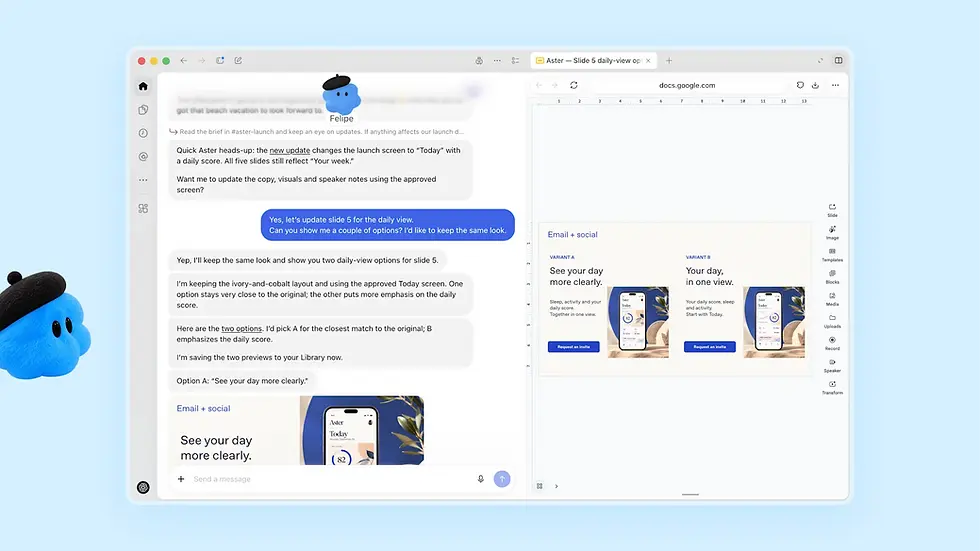
Artificial intelligence is moving beyond the era of systems that wait for instructions. OpenAI’s new Dots represent a broader shift toward AI agents that can operate continuously, manage multi-step tasks, learn user preferences, interact with software, and pursue defined objectives with less day-to-day supervision.
Introduced as part of OpenAI’s latest agent-focused strategy, Dots are powered by GPT-6 Astra and are designed to function as persistent digital assistants with their own cloud computers, browsers, connected applications, memory of working preferences, and the ability to act across multiple environments. Rather than treating every AI interaction as an isolated conversation, the concept positions an agent as an ongoing digital collaborator.
The significance of Dots is therefore not simply their visual identity or branding. The larger development is the transition from conversational AI toward persistent, goal-oriented computing.
From Chatbots to Persistent AI Agents
The first major generation of consumer AI systems primarily answered questions, generated content, summarized information, and helped users reason through problems. More advanced systems introduced tool use, coding environments, browsing, and limited autonomous workflows.
Agents take the next step by connecting those capabilities into a continuous operating model.
A conventional chatbot generally follows a request-response pattern:
A user provides an instruction.
The AI generates an answer or performs a limited task.
The interaction ends or waits for another prompt.
An autonomous agent can instead receive a broader objective and determine a sequence of actions required to pursue it. It can inspect information, use software, perform intermediate tasks, evaluate results, and return for human approval when necessary.
Dots are designed around this model. OpenAI describes them as always-on agents capable of working toward user goals around the clock. Each Dot has access to its own cloud computer and browser, while users can connect additional applications and, where permitted, their own devices.
This distinction changes the role of AI from an application people open when they need assistance into a digital worker that can remain active in the background.
What Makes OpenAI Dots Different?
Dots combine several capabilities that have previously existed across separate AI products and agentic tools.
Their architecture is centered on persistent access, cloud computing, connected applications, user-specific preferences, and autonomous task execution.
A Dot can work on several projects rather than requiring a separate conversation for every task. Users can continue providing new objectives while previous work proceeds independently.
The system can also be reached through multiple interfaces, including ChatGPT, Slack, and Microsoft Teams. This cross-platform availability matters because organizational work rarely happens inside a single application.
A marketing professional, for example, may begin planning inside ChatGPT, coordinate with colleagues through Slack, and manage documents or customer information through connected business software. An agent capable of carrying context between these environments can become substantially more useful than an assistant trapped inside one application.
The concept also introduces a more personalized dimension. Users can name their primary Dot and provide feedback over time. The goal is for the agent to understand individual preferences, standards, working habits, and definitions of quality.
That creates a potential feedback loop:
User goals → agent execution → human feedback → improved understanding → increasingly personalized execution
The quality of that loop could become one of the most important factors determining whether persistent agents become genuinely useful or simply generate more automated work that humans must correct.
Dots Can Perform Work Instead of Just Suggesting It
The strongest use cases are those where the AI can move from analysis into execution.
Consider software development. A developer may receive recurring customer complaints about a particular feature. Instead of merely summarizing those complaints, an agent can identify patterns, scope smaller fixes, implement changes, run tests, and prepare a pull request for human review.
The developer remains responsible for consequential decisions while the repetitive engineering process is delegated.
The same principle can apply to research.
A scientist working with continually changing experimental data could use an agent to rerun analyses when new information arrives, investigate unexpected results, update figures, revise supporting explanations, and identify areas requiring human attention.
For sales organizations, an agent could examine customer requirements, account history, technical documentation, and testing results while helping maintain proposals and proof-of-concept plans.
For content creators, an agent could process interview transcripts, identify material suitable for clips, prepare show notes, and generate social media drafts while preserving the creator's preferred style.
These examples reveal an important characteristic of agentic AI: the unit of automation is no longer an individual task. It can be an evolving workflow.
The Cloud Computer Is a Major Part of the Model
One of the technically important aspects of Dots is that they have their own cloud computing environment.
This allows the agent to operate independently of the user's physical machine for many tasks. A Dot can open its computing environment, use a browser, interact with connected applications, and continue working without requiring the user to keep a local application open throughout the process.
The separation also creates an architectural boundary between the agent's workspace and the user's computer.
Users can optionally allow a Dot to connect to their own laptop or other devices when direct interaction is useful. This creates a hybrid model in which autonomous cloud execution can be combined with human-controlled local resources.
For businesses, this distinction could become particularly important. Organizations increasingly need AI systems that can perform real work while remaining subject to identity management, access controls, audit mechanisms, and approval procedures.
The Biggest Challenge Is Trust, Not Intelligence
As AI systems become more autonomous, the central question changes.
It is no longer simply, "Can the model generate a good answer?"
The more important question becomes, "Can the system be trusted to take the correct action?"
An agent with access to email, documents, financial systems, source code, customer records, and other business applications has significantly more power than a chatbot that only produces text.
OpenAI says Dots include additional safety and privacy controls intended to address this problem.
Users determine which applications a Dot can access. Permissions can be managed through existing ChatGPT controls, while custom rules can specify which actions an agent can take independently, which require approval, and which are prohibited.
The system also includes monitoring and an activity view intended to allow users to follow ongoing work and redirect an agent when necessary.
For sensitive operations, approval mechanisms remain important. Certain actions, such as changing a password, remain under direct user control.
This creates a useful principle for agentic computing: autonomy should be proportional to the consequences of an action.
Low-risk activities can potentially be automated completely. Higher-impact actions should require increasingly strong verification and human approval.
Proactive Research Changes the AI Interaction Model
Another important feature is what OpenAI calls "proactive research."
Instead of waiting for a new command, a Dot can look for ways to assist while operating in the background. During this process, connected tools can be restricted to read-only access, preventing the agent from independently changing application content or sending communications.
This approach could make AI substantially more useful for monitoring-intensive work.
A business executive could have an agent track information relevant to an ongoing project. A researcher could receive updates when new evidence affects an analysis. A software team could have an agent monitor feedback and identify recurring issues.
The benefit is reduced cognitive overhead. People do not need to repeatedly remember which information needs checking.
However, proactive systems also create a new design challenge: avoiding unnecessary activity. An agent that continuously searches, analyzes, and reports without understanding what matters can create information overload rather than reducing it.
Personalization therefore becomes essential.
Specialist Dots Could Reshape Enterprise Automation
OpenAI's longer-term vision goes beyond personal assistants.
Specialist Dots are designed to handle defined organizational responsibilities with dedicated identities, credentials, tools, and access to enterprise systems.
This resembles the evolution of software from individual applications toward digital employees with clearly defined roles.
A specialist Dot could potentially be assigned to procurement, invoice processing, customer support, commercial contracting, marketing operations, or another structured workflow.
The distinction between general-purpose and specialist agents is important.
A general Dot needs broad flexibility because it works across many types of user requests. A specialist agent can instead be optimized around a narrower responsibility, specific data sources, defined permissions, and explicit approval procedures.
That narrower scope can make governance easier.
OpenAI is also working with Microsoft to integrate specialist Dots with Microsoft Agent 365 governance and security controls. For enterprises already operating within Microsoft's ecosystem, such integration could provide a pathway for managing agent identities, permissions, and oversight through existing administrative infrastructure.
The Business Impact Could Extend Beyond Productivity
The commercial significance of Dots lies in the possibility of converting AI from a productivity tool into an operational layer.
Traditional automation usually depends on predefined rules. If a process changes, engineers often need to modify the automation.
AI agents can potentially handle more variability because they can interpret natural-language instructions, examine context, adapt to changing information, and determine intermediate steps.
That could make previously uneconomical forms of automation viable.
Small businesses may eventually use agents to perform administrative workflows that previously required several software subscriptions or manual processes. Large companies could deploy specialized agents across departments while maintaining centralized governance.
The economic impact will depend on reliability, inference costs, security, integration quality, and how much human oversight remains necessary.
Automation does not automatically eliminate labor. In many cases, it changes the composition of work, moving people away from repetitive execution toward supervision, judgment, exception handling, relationship management, and strategic decision-making.

Dots Also Introduce New Risks
Greater autonomy increases both the potential benefits and the potential consequences of mistakes.
An AI agent can misunderstand instructions, act on incomplete information, encounter malicious content, or make an incorrect assumption about the user's intentions.
Connected applications introduce another security dimension. A compromised website, malicious document, or deceptive instruction could potentially attempt to influence an agent.
This makes permission boundaries, sandboxing, monitoring, authentication, approval systems, and clear audit trails fundamental components of agentic infrastructure rather than optional features.
There is also a broader privacy question. The more an agent understands about a person's projects, preferences, communications, and working habits, the more valuable its contextual information becomes.
OpenAI states that personal users can control whether conversations and work are used to improve models, while Business, Enterprise, and Edu workspace content is not used for model improvement by default. The company also states that proactive research and an agent's private notes are not directly used for training, although information can become part of an eligible conversation or task depending on applicable settings.
Users and organizations therefore need to understand not only what an agent can do, but what information it can access and under which conditions.
From One Dot to Teams of AI Agents
The most consequential part of the Dots vision may be what comes next.
OpenAI says users begin with a primary Dot, while its longer-term direction involves teams of Dots working together.
That could lead to multi-agent systems in which different agents perform specialized functions.
For example, one agent could conduct research, another could analyze financial implications, another could prepare content, and another could monitor execution. A human could remain responsible for setting objectives and approving major decisions.
Such systems could resemble organizational structures in software.
But coordination introduces another challenge. Multiple agents can amplify errors as easily as they amplify productivity. If one agent produces an incorrect assumption and another treats it as reliable information, the error can propagate across an entire workflow.
Future agentic systems will therefore need strong provenance, verification, role separation, permission management, and mechanisms for detecting conflicting conclusions.
The Beginning of an Agentic Computing Era
Dots represent a significant conceptual transition in AI.
The important development is not simply that an AI assistant can write code, analyze information, or interact with applications. Those capabilities already exist in various forms. The larger shift is combining them into a persistent system that can remember working preferences, operate independently, monitor evolving tasks, communicate across platforms, and execute multi-step objectives.
For users, this could mean spending less time managing software and more time defining goals.
For businesses, it could mean building a new layer of digital labor around AI agents.
For developers, it could create an entirely new software category in which applications are increasingly designed not only for humans but also for autonomous agents.
The transition will not be frictionless. Reliability, security, privacy, governance, cost, and human oversight will determine how quickly autonomous agents become trusted parts of everyday work.
But the direction is increasingly clear. AI is moving from systems that answer questions toward systems that pursue objectives.
OpenAI Dots provide an early example of what that future could look like, where the computer is no longer simply a tool waiting for commands, but an intelligent collaborator capable of continuing the work after the human steps away.
As Dr. Shahid Masood and the expert team at 1950.ai continue examining the evolution of artificial intelligence, developments such as Dots highlight a broader transformation underway across computing. The next generation of AI may be defined less by how well machines generate information and more by how effectively they can turn human goals into sustained, supervised action.
Key Takeaways
OpenAI Dots are persistent AI agents powered by GPT-6 Astra and designed to work continuously toward user-defined goals.
Each Dot has access to its own cloud computer and browser and can connect with applications and, when authorized, user devices.
Dots can operate across ChatGPT, Slack, Teams, and other environments while maintaining working context.
Potential applications span software development, scientific research, sales, content production, and enterprise operations.
Specialist Dots are designed for defined organizational responsibilities with dedicated identities, credentials, and permissions.
Microsoft Agent 365 integration could provide enterprise governance and security infrastructure for specialist agents.
Human approval, permissions, monitoring, and security controls remain critical as AI systems gain greater autonomy.
The long-term direction points toward teams of specialized AI agents collaborating on complex workflows.
Further Reading / External References
OpenAI launches Dots, its bubbly agentic avatar
Introducing dots


Comments