top of page

RobCo Expands to the US With a $1 Billion Valuation, Betting Big on Autonomous Industrial Robots

9 minutes ago
8 min read
Industrial robotics is entering a new phase. For decades, factory automation largely depended on machines performing highly structured, repetitive tasks in carefully controlled environments. The emerging generation of AI-powered robots is designed to operate with greater flexibility, interpret changing conditions, and adapt to tasks that were previously difficult to automate.

German robotics startup RobCo is positioning itself at the center of this transition. The Munich-based company has reached a $1 billion valuation, making it one of a growing group of European robotics startups to achieve unicorn status, while simultaneously accelerating its expansion into the United States.

The milestone is significant not simply because of the valuation. It reflects growing investor and industrial interest in physical AI, where artificial intelligence moves beyond generating digital content and begins interacting directly with machines, factories, tools, and physical environments.

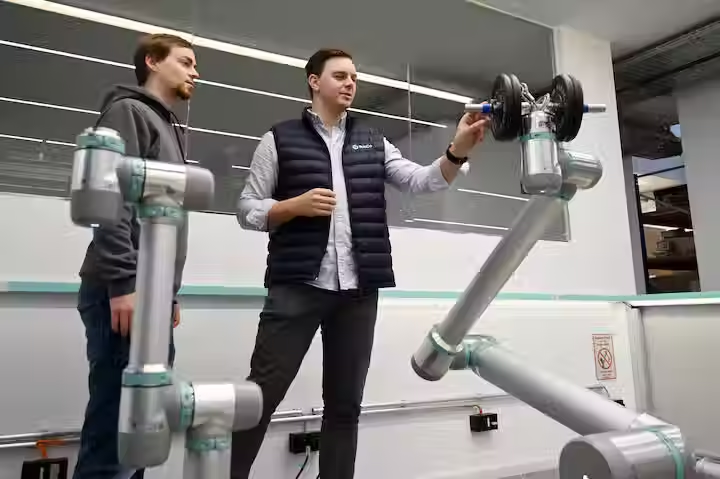
RobCo's next major step is the planned commercial launch of Alfie, a two-armed, self-learning industrial robot designed to address manufacturing tasks that conventional automation has struggled to handle efficiently.

RobCo’s $1 Billion Milestone Signals Growing Confidence in Physical AI

Founded in 2020 out of the Technical University of Munich, RobCo has developed around the idea that industrial automation needs to become more adaptable.

The company announced that its valuation has surpassed €892.4 million, equivalent to approximately $1 billion, following a transaction involving new investment and an employee secondary share sale. The company said its valuation has doubled within nine months.

The transaction included existing investors such as Sequoia, Lightspeed, Greenfield, Kindred, Lingotto, and Promus Ventures, alongside new investors including Cherry Ventures and the European Tech Collective.

The transaction follows RobCo's $100 million Series C financing announced in January, bringing the company's total capital raised to close to $200 million, according to CEO Roman Hölzl.

Importantly, the latest transaction was not simply another conventional funding round. It also enabled employees to sell shares, allowing some of the people who helped build the company to realize part of the value created while bringing additional investment into the business.

For the European robotics sector, the valuation represents a broader shift in investor expectations. Robotics is increasingly being treated not merely as an industrial hardware category, but as a convergence of artificial intelligence, software, sensors, advanced manufacturing, and autonomous decision-making.

From Traditional Automation to Physical AI

Traditional industrial automation works best when the environment is predictable.

A robotic arm on a production line can repeatedly perform a task with extraordinary precision when the position of every component is known, the tooling is standardized, and the workflow rarely changes. This model has powered manufacturing for decades.

The problem emerges when factories become more variable.

Modern manufacturers increasingly need to handle smaller production batches, different product configurations, changing component positions, and less predictable environments. Reprogramming conventional robotic systems for every variation can reduce the economic advantages of automation.

Physical AI approaches the problem differently.

Instead of treating a robot as a fixed machine executing a predefined sequence, an AI-enabled system can combine perception, reasoning, planning, and physical action. Sensors provide information about the environment, AI systems interpret that information, planning mechanisms determine an appropriate response, and robotic hardware executes the action.

This creates a fundamentally different automation architecture.

The machine is no longer simply repeating instructions. It is attempting to understand enough about its environment to make decisions within defined operational constraints.

RobCo describes its platform in this direction, combining perception, motion planning, and self-learning approaches to reduce the barriers between existing industrial processes and more autonomous operations.

Alfie Represents RobCo’s Next Major Bet

At the center of RobCo's strategy is Alfie, a two-armed robot designed for industrial environments.

The company says Alfie is intended to combine perception, reasoning, and execution to address high-mix and less structured factory work. Several customers have already installed prototypes, according to Hölzl.

The commercial launch is scheduled for March 4, 2027, at RobCoN, the company's first annual summit in Munich.

The significance of Alfie lies in the type of work it is targeting. Industrial robots have traditionally excelled at repetitive operations with carefully defined inputs. The next opportunity is automating tasks where variability makes conventional approaches expensive or impractical.

Potential applications across RobCo's broader platform include:

Machine tending
Palletising
Dispensing
Welding
Other industrial workflows requiring greater adaptability

The economic proposition is therefore not simply replacing a human worker with a machine. It is creating an automation system capable of handling more complex workflows without requiring extensive manual reprogramming every time conditions change.

Why Self-Learning Robotics Could Transform Manufacturing

The combination of machine learning and robotics introduces an important advantage: systems can potentially improve their performance through data and experience rather than relying exclusively on manually authored rules.

However, self-learning does not mean robots can operate without constraints.

Industrial environments contain heavy machinery, moving equipment, electrical systems, tools, humans, and potentially hazardous materials. An autonomous robot must therefore combine intelligence with strict safety boundaries.

The most effective physical AI systems are likely to use multiple layers of control.

A high-level AI system may interpret a task, while lower-level controllers enforce physical constraints, collision avoidance, speed limits, force limits, and emergency procedures. This separation between reasoning and deterministic safety mechanisms is crucial because probabilistic AI systems are not inherently equivalent to certified safety controllers.

RobCo's challenge is consequently much larger than building a capable AI model. It must create a complete system that performs reliably under real factory conditions.

That is where industrial robotics differs sharply from consumer-facing AI.

A chatbot can produce an imperfect response and recover in the next interaction. A physical robot operating beside workers cannot be granted the same margin for error.

Robotics-as-a-Service Changes the Economics of Automation

Another important component of RobCo's strategy is its robotics-as-a-service model.

Traditional automation projects can require significant upfront capital. Businesses may need to purchase robotic equipment, integrate it into existing production systems, develop specialized software, train employees, and maintain the installation.

A robotics-as-a-service model shifts more of that burden toward an ongoing service relationship.

RobCo says its model allows industrial companies to automate manual processes without upfront investment. This can make automation more accessible to manufacturers that are unwilling or unable to commit substantial capital before proving the economic value of a deployment.

The model also changes the relationship between robotics companies and customers.

Instead of selling a machine and completing the transaction, the robotics provider has an incentive to maintain system performance over time. Software updates, model improvements, monitoring, maintenance, and operational support can become part of the broader value proposition.

This recurring model resembles the transformation that occurred in enterprise software, where customers increasingly moved from large upfront purchases toward subscription and service-based arrangements.

For robotics, the transition could be equally important.

Why the United States Has Become Critical to RobCo

RobCo's expansion strategy also reveals where the company sees the largest commercial opportunity.

The company entered the United States in 2025 and now operates across more than a dozen states. It has manufacturing and assembly operations in Austin, Texas, and a laboratory in San Francisco.

Hölzl has relocated to the United States to personally lead the company's expansion.

The strategic rationale is straightforward. According to the CEO, the U.S. market is larger in absolute terms and growing faster than Europe, even though roughly 70% of RobCo's business remains in Europe.

Maintaining German manufacturing while establishing U.S. production capabilities gives the company a potentially useful transatlantic structure.

Germany provides deep industrial and engineering expertise, while the United States offers a massive manufacturing market, significant technology investment, and a large ecosystem of AI and robotics companies.

The combination could become a competitive advantage if RobCo can successfully scale operations across both regions.

Europe’s Robotics Unicorn Race Is Accelerating

RobCo's valuation also places it among a growing collection of European robotics companies reaching billion-dollar valuations.

Germany has developed particular strength in industrial robotics and automation, while companies across Europe are increasingly targeting more general-purpose and humanoid-style machines.

RobCo's European rivals include NEURA Robotics and Agile Robots in Germany, while Humanoid in the United Kingdom is also targeting emerging markets for advanced robotics.

The competitive landscape illustrates how robotics is moving toward a convergence between traditional industrial automation and newer AI-driven machines.

The distinction between an industrial robot and an intelligent autonomous machine is becoming less clear.

Future systems are likely to combine mechanical precision with increasingly sophisticated software, allowing a single robotic platform to perform multiple tasks and adapt to changing production requirements.

The Real Challenge Is Scaling From Prototype to Factory

Despite the excitement surrounding physical AI, reaching a billion-dollar valuation does not eliminate the technical and commercial challenges ahead.

Industrial robotics is unforgiving. Systems must operate for long periods, withstand physical stress, integrate with existing machinery, and maintain predictable performance.

AI introduces additional complexity.

Models can behave differently under unfamiliar conditions, sensors can fail or become degraded, and changing factory environments can produce situations that were not represented adequately in training data.

Robotic companies therefore need to solve several problems simultaneously:

Perception: Robots must accurately interpret their surroundings.
Planning: Systems must determine appropriate sequences of actions.
Control: Physical movements must remain precise and stable.
Safety: Robots must operate within strict physical and operational boundaries.
Reliability: Systems must maintain performance over extended periods.
Integration: Robots must work with existing factory equipment and software.
Economics: The automation must generate enough value to justify deployment and ongoing service costs.

The companies that solve this complete stack, rather than simply demonstrating impressive robotic capabilities, will be better positioned to define the next generation of industrial automation.

Why RobCo’s Rise Matters for the Future of Manufacturing

RobCo's trajectory reflects a larger shift in the economics of artificial intelligence.

The first generation of generative AI demonstrated that software could reason, generate content, write code, and interact with users. Physical AI extends that concept into the real world.

Instead of asking what an AI model can generate, manufacturers increasingly need to ask what an AI-powered machine can safely accomplish.

That changes the value chain.

AI models become components within larger physical systems. Sensors generate data, models interpret environments, planning systems select actions, robotic controllers execute those actions, and factories generate new operational data that can potentially improve future performance.

The result is a feedback loop between digital intelligence and physical operations.

For manufacturers facing labor shortages, rising operational costs, demand for greater flexibility, and pressure to improve productivity, this could make adaptable robotics increasingly attractive.

But adoption will depend on more than technical capability. Robots must deliver measurable improvements in throughput, reliability, safety, quality, or cost.

Conclusion

RobCo's move beyond the $1 billion valuation is an important signal for the rapidly developing physical AI industry. The Munich-based company is combining industrial robotics, machine perception, motion planning, self-learning systems, and a robotics-as-a-service business model to pursue a more adaptable form of factory automation.

Its planned Alfie robot represents the next major test of that strategy. If the system can reliably perform complex industrial tasks that conventional automation struggles to address, it could demonstrate why AI-native robotics represents a fundamentally different opportunity from traditional robotic automation.

The company's expansion into the United States adds another strategic dimension. With the U.S. identified as its fastest-growing market, continued investment in American operations could determine how quickly RobCo evolves from a European robotics success story into a global industrial technology company.

The broader implications extend well beyond RobCo. As artificial intelligence moves from screens into machines, factories, vehicles, and other physical environments, the combination of AI reasoning and robotic execution could become one of the defining technology trends of the next decade.

For Dr. Shahid Masood and the expert team at 1950.ai, RobCo's rise illustrates a crucial development in the AI landscape: intelligence is increasingly becoming physical. The next generation of AI competition will not be fought exclusively over larger models and faster computing. It will also be fought over who can safely, reliably, and economically turn machine intelligence into useful action in the real world.

Further Reading / External References

German robot startup RobCo hits $1 billion valuation, CEO moves to US

https://www.reuters.com/legal/transactional/german-robot-startup-robco-hits-1-billion-valuation-ceo-moves-us-2026-10-05/

Munich-based RobCo becomes a robotics unicorn as valuation doubles in nine months

https://www.eu-startups.com/2026/10/munich-based-robco-becomes-a-robotics-unicorn-as-valuation-doubles-in-nine-months/

Industrial robotics is entering a new phase. For decades, factory automation largely depended on machines performing highly structured, repetitive tasks in carefully controlled environments. The emerging generation of AI-powered robots is designed to operate with greater flexibility, interpret changing conditions, and adapt to tasks that were previously difficult to automate.


German robotics startup RobCo is positioning itself at the center of this transition. The Munich-based company has reached a $1 billion valuation, making it one of a growing group of European robotics startups to achieve unicorn status, while simultaneously accelerating its expansion into the United States.

The milestone is significant not simply because of the valuation. It reflects growing investor and industrial interest in physical AI, where artificial intelligence moves beyond generating digital content and begins interacting directly with machines, factories, tools, and physical environments.

RobCo's next major step is the planned commercial launch of Alfie, a two-armed, self-learning industrial robot designed to address manufacturing tasks that conventional automation has struggled to handle efficiently.


RobCo’s $1 Billion Milestone Signals Growing Confidence in Physical AI

Founded in 2020 out of the Technical University of Munich, RobCo has developed around the idea that industrial automation needs to become more adaptable.

The company announced that its valuation has surpassed €892.4 million, equivalent to approximately $1 billion, following a transaction involving new investment and an employee secondary share sale. The company said its valuation has doubled within nine months.

The transaction included existing investors such as Sequoia, Lightspeed, Greenfield, Kindred, Lingotto, and Promus Ventures, alongside new investors including Cherry Ventures and the European Tech Collective.

The transaction follows RobCo's $100 million Series C financing announced in January, bringing the company's total capital raised to close to $200 million, according to CEO Roman Hölzl.

Importantly, the latest transaction was not simply another conventional funding round. It also enabled employees to sell shares, allowing some of the people who helped build the company to realize part of the value created while bringing additional investment into the business.

For the European robotics sector, the valuation represents a broader shift in investor expectations. Robotics is increasingly being treated not merely as an industrial hardware category, but as a convergence of artificial intelligence, software, sensors, advanced manufacturing, and autonomous decision-making.


From Traditional Automation to Physical AI

Traditional industrial automation works best when the environment is predictable.

A robotic arm on a production line can repeatedly perform a task with extraordinary precision when the position of every component is known, the tooling is standardized, and the workflow rarely changes. This model has powered manufacturing for decades.

The problem emerges when factories become more variable.

Modern manufacturers increasingly need to handle smaller production batches, different product configurations, changing component positions, and less predictable environments. Reprogramming conventional robotic systems for every variation can reduce the economic advantages of automation.

Physical AI approaches the problem differently.


Instead of treating a robot as a fixed machine executing a predefined sequence, an AI-enabled system can combine perception, reasoning, planning, and physical action. Sensors provide information about the environment, AI systems interpret that information, planning mechanisms determine an appropriate response, and robotic hardware executes the action.

This creates a fundamentally different automation architecture.

The machine is no longer simply repeating instructions. It is attempting to understand enough about its environment to make decisions within defined operational constraints.

RobCo describes its platform in this direction, combining perception, motion planning, and self-learning approaches to reduce the barriers between existing industrial processes and more autonomous operations.


Alfie Represents RobCo’s Next Major Bet

At the center of RobCo's strategy is Alfie, a two-armed robot designed for industrial environments.

The company says Alfie is intended to combine perception, reasoning, and execution to address high-mix and less structured factory work. Several customers have already installed prototypes, according to Hölzl.

The commercial launch is scheduled for March 4, 2027, at RobCoN, the company's first annual summit in Munich.

The significance of Alfie lies in the type of work it is targeting. Industrial robots have traditionally excelled at repetitive operations with carefully defined inputs. The next opportunity is automating tasks where variability makes conventional approaches expensive or impractical.

Potential applications across RobCo's broader platform include:

  • Machine tending

  • Palletising

  • Dispensing

  • Welding

  • Other industrial workflows requiring greater adaptability

The economic proposition is therefore not simply replacing a human worker with a machine. It is creating an automation system capable of handling more complex workflows without requiring extensive manual reprogramming every time conditions change.


Why Self-Learning Robotics Could Transform Manufacturing

The combination of machine learning and robotics introduces an important advantage: systems can potentially improve their performance through data and experience rather than relying exclusively on manually authored rules.

However, self-learning does not mean robots can operate without constraints.

Industrial environments contain heavy machinery, moving equipment, electrical systems, tools, humans, and potentially hazardous materials. An autonomous robot must therefore combine intelligence with strict safety boundaries.

The most effective physical AI systems are likely to use multiple layers of control.


A high-level AI system may interpret a task, while lower-level controllers enforce physical constraints, collision avoidance, speed limits, force limits, and emergency procedures. This separation between reasoning and deterministic safety mechanisms is crucial because probabilistic AI systems are not inherently equivalent to certified safety controllers.

RobCo's challenge is consequently much larger than building a capable AI model. It must create a complete system that performs reliably under real factory conditions.

That is where industrial robotics differs sharply from consumer-facing AI.

A chatbot can produce an imperfect response and recover in the next interaction. A physical robot operating beside workers cannot be granted the same margin for error.


Robotics-as-a-Service Changes the Economics of Automation

Another important component of RobCo's strategy is its robotics-as-a-service model.

Traditional automation projects can require significant upfront capital. Businesses may need to purchase robotic equipment, integrate it into existing production systems, develop specialized software, train employees, and maintain the installation.

A robotics-as-a-service model shifts more of that burden toward an ongoing service relationship.

RobCo says its model allows industrial companies to automate manual processes without upfront investment. This can make automation more accessible to manufacturers that are unwilling or unable to commit substantial capital before proving the economic value of a deployment.

The model also changes the relationship between robotics companies and customers.

Instead of selling a machine and completing the transaction, the robotics provider has an incentive to maintain system performance over time. Software updates, model improvements, monitoring, maintenance, and operational support can become part of the broader value proposition.

This recurring model resembles the transformation that occurred in enterprise software, where customers increasingly moved from large upfront purchases toward subscription and service-based arrangements.

For robotics, the transition could be equally important.


Why the United States Has Become Critical to RobCo

RobCo's expansion strategy also reveals where the company sees the largest commercial opportunity.

The company entered the United States in 2025 and now operates across more than a dozen states. It has manufacturing and assembly operations in Austin, Texas, and a laboratory in San Francisco.

Hölzl has relocated to the United States to personally lead the company's expansion.

The strategic rationale is straightforward. According to the CEO, the U.S. market is larger in absolute terms and growing faster than Europe, even though roughly 70% of RobCo's business remains in Europe.

Maintaining German manufacturing while establishing U.S. production capabilities gives the company a potentially useful transatlantic structure.

Germany provides deep industrial and engineering expertise, while the United States offers a massive manufacturing market, significant technology investment, and a large ecosystem of AI and robotics companies.

The combination could become a competitive advantage if RobCo can successfully scale operations across both regions.


Europe’s Robotics Unicorn Race Is Accelerating

RobCo's valuation also places it among a growing collection of European robotics companies reaching billion-dollar valuations.

Germany has developed particular strength in industrial robotics and automation, while companies across Europe are increasingly targeting more general-purpose and humanoid-style machines.

RobCo's European rivals include NEURA Robotics and Agile Robots in Germany, while Humanoid in the United Kingdom is also targeting emerging markets for advanced robotics.

The competitive landscape illustrates how robotics is moving toward a convergence between traditional industrial automation and newer AI-driven machines.

The distinction between an industrial robot and an intelligent autonomous machine is becoming less clear.

Future systems are likely to combine mechanical precision with increasingly sophisticated software, allowing a single robotic platform to perform multiple tasks and adapt to changing production requirements.


The Real Challenge Is Scaling From Prototype to Factory

Despite the excitement surrounding physical AI, reaching a billion-dollar valuation does not eliminate the technical and commercial challenges ahead.

Industrial robotics is unforgiving. Systems must operate for long periods, withstand physical stress, integrate with existing machinery, and maintain predictable performance.

AI introduces additional complexity.

Models can behave differently under unfamiliar conditions, sensors can fail or become degraded, and changing factory environments can produce situations that were not represented adequately in training data.

Robotic companies therefore need to solve several problems simultaneously:

  1. Perception: Robots must accurately interpret their surroundings.

  2. Planning: Systems must determine appropriate sequences of actions.

  3. Control: Physical movements must remain precise and stable.

  4. Safety: Robots must operate within strict physical and operational boundaries.

  5. Reliability: Systems must maintain performance over extended periods.

  6. Integration: Robots must work with existing factory equipment and software.

  7. Economics: The automation must generate enough value to justify deployment and ongoing service costs.

The companies that solve this complete stack, rather than simply demonstrating impressive robotic capabilities, will be better positioned to define the next generation of industrial automation.


Why RobCo’s Rise Matters for the Future of Manufacturing

RobCo's trajectory reflects a larger shift in the economics of artificial intelligence.

The first generation of generative AI demonstrated that software could reason, generate content, write code, and interact with users. Physical AI extends that concept into the real world.

Instead of asking what an AI model can generate, manufacturers increasingly need to ask what an AI-powered machine can safely accomplish.

That changes the value chain.

AI models become components within larger physical systems. Sensors generate data, models interpret environments, planning systems select actions, robotic controllers execute those actions, and factories generate new operational data that can potentially improve future performance.

The result is a feedback loop between digital intelligence and physical operations.

For manufacturers facing labor shortages, rising operational costs, demand for greater flexibility, and pressure to improve productivity, this could make adaptable robotics increasingly attractive.

But adoption will depend on more than technical capability. Robots must deliver measurable improvements in throughput, reliability, safety, quality, or cost.


Conclusion

RobCo's move beyond the $1 billion valuation is an important signal for the rapidly developing physical AI industry. The Munich-based company is combining industrial robotics, machine perception, motion planning, self-learning systems, and a robotics-as-a-service business model to pursue a more adaptable form of factory automation.

Its planned Alfie robot represents the next major test of that strategy. If the system can reliably perform complex industrial tasks that conventional automation struggles to address, it could demonstrate why AI-native robotics represents a fundamentally different opportunity from traditional robotic automation.


The company's expansion into the United States adds another strategic dimension. With the U.S. identified as its fastest-growing market, continued investment in American operations could determine how quickly RobCo evolves from a European robotics success story into a global industrial technology company.

The broader implications extend well beyond RobCo. As artificial intelligence moves from screens into machines, factories, vehicles, and other physical environments, the combination of AI reasoning and robotic execution could become one of the defining technology trends of the next decade.


For Dr. Shahid Masood and the expert team at 1950.ai, RobCo's rise illustrates a crucial development in the AI landscape: intelligence is increasingly becoming physical. The next generation of AI competition will not be fought exclusively over larger models and faster computing. It will also be fought over who can safely, reliably, and economically turn machine intelligence into useful action in the real world.


Further Reading / External References

German robot startup RobCo hits $1 billion valuation, CEO moves to US

Munich-based RobCo becomes a robotics unicorn as valuation doubles in nine months

Comments


bottom of page