top of page

Meta’s Muse Goes Open Source: Build Your Own AI Gadget With ESP32, Raspberry Pi and Linux

7 minutes ago
9 min read
Meta is taking its Muse AI agent beyond the conventional chatbot interface and into the physical world with Muse Gadgets, an open-source initiative that allows developers and hobbyists to build custom hardware connected to Muse. The move could prove more strategically important than the hardware itself because it gives Meta a way to experiment with how people will interact with AI agents outside smartphones, browsers and conventional applications.

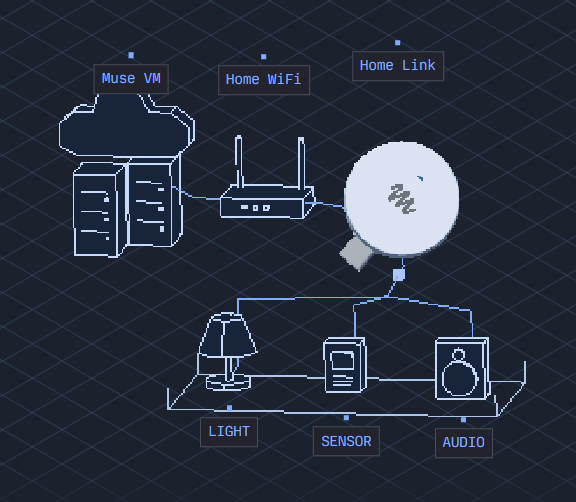
The initiative provides open-source firmware, a Linux software development kit and examples for connecting Muse to displays, buttons, sensors, actuators and other hardware. Developers can use relatively inexpensive platforms such as Raspberry Pi computers and ESP32 boards, transforming ordinary components into interfaces for an AI agent.

Meta has also developed its own reference device, Muse Home Link, a compact USB-C-powered gadget designed to connect Muse with devices on a home network. The company produced 5,000 units for Muse subscribers, demonstrating how an AI agent could move from answering questions to interacting directly with a connected environment.

The underlying idea is significant: instead of asking consumers to purchase a single predetermined AI device, Meta is opening the door to an ecosystem in which the AI agent becomes the software layer and the physical interface can take many forms.

Muse Gadgets Changes the Definition of AI Hardware

The first generation of consumer AI hardware has largely attempted to create entirely new devices. Companies have experimented with dedicated assistants, screenless computers, wearable devices and other specialized interfaces.

Meta's approach is different.

Muse Gadgets treats hardware as a modular extension of an existing AI agent. The physical device does not necessarily need to contain the intelligence itself. Instead, it can provide the sensors, displays, controls and network connectivity through which Muse can interact with users and other systems.

This distinction matters because artificial intelligence is increasingly becoming a software capability that can operate across multiple interfaces.

A single AI agent could theoretically appear as:

A visual assistant on an E Ink display
A voice-controlled home interface
A touchscreen information terminal
An HDMI-connected television assistant
A Raspberry Pi-based experimental device
A sensor-driven automation system
A custom wearable interface
A specialized business tool

The hardware becomes the interface rather than the product's entire identity.

That architecture could make AI hardware considerably more flexible.

How Meta’s Open-Source Approach Works

Muse Gadgets provides developers with firmware and software tools intended to connect compatible hardware with Muse.

ESP32 boards provide an inexpensive embedded computing platform, while Raspberry Pi devices offer considerably more computing flexibility through Linux. The Linux SDK gives developers a way to build applications that connect the agent to custom hardware.

The resulting architecture resembles a bridge between an AI service and the physical environment.

A developer can connect:

Input devices such as buttons and sensors
Output devices such as displays, speakers and lights
Network-connected systems
Actuators that can perform physical actions
Muse as the reasoning and interaction layer

This creates an important separation of responsibilities. The embedded hardware does not need to host a frontier AI model locally. Instead, it can act as a lightweight interface while the intelligence remains associated with Muse's broader computing infrastructure.

For hobbyists, that lowers the barrier to experimentation.

A developer does not have to manufacture a new computer, train an AI model or build a complete cloud infrastructure stack. They can start with commercially available hardware and concentrate on the interaction model.

Muse Home Link Shows Where the Strategy Could Lead

Meta's Muse Home Link provides a concrete example of what this architecture can enable.

The small USB-C device allows Muse to communicate with compatible devices on a home network. Depending on the configuration, the agent can interact with smart televisions, speakers and other systems exposed through network interfaces.

This changes the role of an AI assistant.

Instead of merely telling a user how to perform an action, an agent can potentially execute that action itself.

The difference between informational AI and action-oriented AI is fundamental.

A conventional assistant might explain how to configure a television. An agent connected to the appropriate permissions and interfaces could potentially perform the operation.

The same principle applies to documents, printers, home automation and other connected services.

However, this capability also increases the importance of authorization, authentication and security. An AI agent capable of controlling devices is fundamentally more sensitive than one that only generates text.

Why Open-Source Hardware Could Be More Important Than a New Meta Device

The most interesting element of Muse Gadgets may be the decision to open the development layer rather than launch another proprietary piece of consumer hardware.

No single company can accurately predict the ideal physical interface for AI.

Smartphones became dominant because they combined multiple capabilities into a broadly useful platform. AI agents may follow a different trajectory because their interfaces can be highly contextual.

A student may want a small desktop display. A smart-home enthusiast may prefer a voice interface. A business may want an internal AI terminal connected to enterprise systems. A developer may build an experimental device with sensors and physical controls.

Open-source development allows these possibilities to emerge from the community.

It also creates an information loop for Meta.

By observing which projects developers build, which interfaces attract interest and which use cases become repeated patterns, Meta can gather practical evidence about where AI hardware is actually useful.

This is particularly valuable because the consumer AI hardware market has not yet established a universally accepted form factor.

Meta Is Turning the AI Agent Into a Platform

Muse's evolution reflects a broader industry shift from AI models toward AI agents and platforms.

A model primarily generates or interprets information. An agent can potentially reason through a task, access tools, retrieve information and perform actions.

That means the strategic value of an AI system increasingly depends on its ecosystem.

An agent connected to nothing is limited by the information and tools directly available to it. An agent connected to applications, devices and services can become a general-purpose interface for digital and physical environments.

Muse Gadgets extends that platform concept to hardware.

Developers can potentially build new interfaces without waiting for Meta to release a dedicated product for every use case.

The result could resemble an application ecosystem, but with physical devices playing the role traditionally occupied by software applications.

The Raspberry Pi and ESP32 Effect

The decision to support widely available development hardware is strategically significant.

Raspberry Pi has become an important platform for experimentation, education, robotics, automation and Internet of Things projects. ESP32 boards are widely used for low-cost embedded applications because they combine processing, wireless connectivity and hardware interfaces in a compact form.

Supporting such platforms means Muse can enter environments where developers already have the necessary tools.

This could accelerate experimentation dramatically.

Instead of requiring specialized manufacturing, developers can prototype an AI-powered device using components that are already accessible. A simple proof of concept can then evolve into a more sophisticated system if the underlying interaction proves useful.

That reduces the cost of innovation and allows many different hardware concepts to compete simultaneously.

The Security Problem Gets Bigger When AI Gains Physical Access

The flexibility of Muse Gadgets also introduces substantial security considerations.

An AI agent controlling a digital service can make mistakes. An AI agent controlling a physical device can create consequences outside the screen.

A system connected to a television presents relatively limited risk. A system controlling locks, appliances, vehicles, industrial equipment or other sensitive infrastructure requires substantially stronger controls.

The fundamental security architecture should therefore include clear permission boundaries.

Important controls include:

Explicit authorization for sensitive actions
Separation between observation and execution privileges
Network-level access restrictions
Authentication for connected devices
Logging of agent actions
Human confirmation for high-impact operations
Isolation of untrusted integrations
Protection against prompt injection and malicious instructions

This becomes particularly important because agents may process information from external sources. A malicious webpage, document or message could potentially attempt to manipulate an agent into performing an unauthorized action.

Open-source development can strengthen security through community review, but it can also expose implementation details that require careful threat modeling.

The challenge is not simply making an agent capable of acting. It is making that capability controllable.

From Hobbyist Experiment to Enterprise AI Infrastructure

Although Muse Gadgets is initially positioned toward developers and enthusiasts, the underlying concept has potential enterprise applications.

Businesses increasingly operate environments filled with network-connected systems, specialized interfaces and physical infrastructure.

A Muse-like agent could theoretically become an interface between employees and these systems.

For example, a warehouse worker could interact with an AI terminal connected to inventory systems. A retail environment could use AI-powered displays connected to product databases. A laboratory could combine sensors with an AI interface for monitoring and information retrieval.

The commercial opportunity therefore extends beyond consumer gadgets.

Meta has already expanded Muse toward small businesses and created Meta Enterprise Platform as part of its broader enterprise AI strategy. Muse Gadgets fits naturally into this direction because organizations could potentially build specialized interfaces around an agent rather than waiting for standardized hardware from a vendor.

That could make AI agents more deeply embedded in operational environments.

Meta’s Hardware Strategy Is Becoming More Diversified

Muse Gadgets also fits into Meta's broader hardware strategy.

The company's Ray-Ban smart glasses demonstrate that AI can become substantially more useful when integrated into a physical device that people already wear. Custom Muse gadgets explore a different principle: instead of putting AI into one standardized product, allow the ecosystem to determine the appropriate interface.

These approaches are complementary.

Wearables emphasize mobility and ambient interaction. Home Link emphasizes connected environments. DIY gadgets emphasize experimentation and customization.

Together, they point toward an AI ecosystem in which the assistant is persistent while the interface changes according to context.

That could ultimately be more important than any individual device.

The Emerging Race to Define Personal AI

Meta is not alone in exploring dedicated AI hardware. Other major technology companies are also investigating new interfaces for AI assistants.

The industry faces a fundamental design question: what should a personal AI actually look like?

The answer may not be a single device.

Personal AI could become a software identity that follows a user across phones, computers, glasses, televisions, vehicles, household systems and specialized interfaces. In that model, the user does not repeatedly switch between independent applications. Instead, an AI agent becomes a common interaction layer.

Muse Gadgets represents an early experiment with this concept.

Meta is effectively asking developers to determine what happens when an AI agent is given access to almost any interface they can build.

What Muse Gadgets Means for the Future of AI

Meta's open-source hardware strategy could produce three important effects.

First, it lowers the barrier to AI hardware experimentation. Developers can use inexpensive, familiar platforms rather than building specialized hardware from scratch.

Second, it turns Muse into a platform rather than merely an AI application. Every compatible device can become another potential interface for the agent.

Third, it gives Meta a mechanism for learning which AI hardware concepts have genuine demand.

The long-term outcome remains uncertain. Open-source projects do not automatically become mass-market products, and technical capability does not guarantee compelling consumer experiences. Privacy, reliability, security, latency and cost will all influence whether people trust AI agents to operate connected environments.

Yet the direction is strategically clear.

The future of AI hardware may not be determined by the company that produces the most attractive standalone gadget. It may be determined by whoever creates the most useful intelligence layer and the ecosystem that allows developers to connect that intelligence to the physical world.

Muse Gadgets is an important step in that direction.

For technology observers and organizations such as 1950.ai, the development illustrates a broader transformation in artificial intelligence: AI is moving from software that responds to humans toward systems capable of interacting with the environments in which humans live and work. As Dr. Shahid Masood and the expert team at 1950.ai continue examining emerging AI, cybersecurity and technology trends, the convergence of agents, open hardware and connected systems is likely to become an increasingly important area of strategic analysis.

The next major AI interface may not be invented inside a corporate hardware laboratory. It could emerge from a developer experimenting with a Raspberry Pi, an ESP32 board, a display and an AI agent.

Key Takeaways
Meta's Muse Gadgets is an open-source initiative for building custom hardware connected to its Muse AI agent.
Developers can use ESP32 boards, Raspberry Pi systems and a Linux SDK to create experimental AI interfaces.
Muse can potentially interact with displays, buttons, sensors, actuators and network-connected devices.
Meta's Muse Home Link demonstrates how an AI agent can connect to smart-home equipment and other network services.
Meta produced 5,000 Home Link devices for Muse subscribers.
The open-source strategy allows Meta to learn which AI hardware concepts developers and users actually want.
AI agents connected to physical systems create significant new opportunities, but also raise security, privacy and authorization challenges.
Muse Gadgets could help shift AI hardware from proprietary standalone products toward an open ecosystem of agent-powered interfaces.
The broader trend points toward AI becoming a persistent software layer across digital and physical environments.
Further Reading / External References

Meta wants you to build your own Muse gadget

https://techcrunch.com/2026/10/02/meta-wants-you-to-build-your-own-muse-gadget/

“Muse Gadgets” turns AI hardware into an open-source DIY project

https://the-decoder.com/muse-gadgets-turns-ai-hardware-into-an-open-source-diy-project/

Meta open sources code to let you make Muse AI gadgets

https://www.theverge.com/tech/1004330/meta-muse-ai-gadgets-home-link

Meta is taking its Muse AI agent beyond the conventional chatbot interface and into the physical world with Muse Gadgets, an open-source initiative that allows developers and hobbyists to build custom hardware connected to Muse. The move could prove more strategically important than the hardware itself because it gives Meta a way to experiment with how people will interact with AI agents outside smartphones, browsers and conventional applications.

The initiative provides open-source firmware, a Linux software development kit and examples for connecting Muse to displays, buttons, sensors, actuators and other hardware. Developers can use relatively inexpensive platforms such as Raspberry Pi computers and ESP32 boards, transforming ordinary components into interfaces for an AI agent.


Meta has also developed its own reference device, Muse Home Link, a compact USB-C-powered gadget designed to connect Muse with devices on a home network. The company produced 5,000 units for Muse subscribers, demonstrating how an AI agent could move from answering questions to interacting directly with a connected environment.

The underlying idea is significant: instead of asking consumers to purchase a single predetermined AI device, Meta is opening the door to an ecosystem in which the AI agent becomes the software layer and the physical interface can take many forms.


Muse Gadgets Changes the Definition of AI Hardware

The first generation of consumer AI hardware has largely attempted to create entirely new devices. Companies have experimented with dedicated assistants, screenless computers, wearable devices and other specialized interfaces.

Meta's approach is different.

Muse Gadgets treats hardware as a modular extension of an existing AI agent. The physical device does not necessarily need to contain the intelligence itself. Instead, it can provide the sensors, displays, controls and network connectivity through which Muse can interact with users and other systems.

This distinction matters because artificial intelligence is increasingly becoming a software capability that can operate across multiple interfaces.

A single AI agent could theoretically appear as:

  • A visual assistant on an E Ink display

  • A voice-controlled home interface

  • A touchscreen information terminal

  • An HDMI-connected television assistant

  • A Raspberry Pi-based experimental device

  • A sensor-driven automation system

  • A custom wearable interface

  • A specialized business tool

The hardware becomes the interface rather than the product's entire identity.

That architecture could make AI hardware considerably more flexible.


How Meta’s Open-Source Approach Works

Muse Gadgets provides developers with firmware and software tools intended to connect compatible hardware with Muse.

ESP32 boards provide an inexpensive embedded computing platform, while Raspberry Pi devices offer considerably more computing flexibility through Linux. The Linux SDK gives developers a way to build applications that connect the agent to custom hardware.

The resulting architecture resembles a bridge between an AI service and the physical environment.

A developer can connect:

  1. Input devices such as buttons and sensors

  2. Output devices such as displays, speakers and lights

  3. Network-connected systems

  4. Actuators that can perform physical actions

  5. Muse as the reasoning and interaction layer

This creates an important separation of responsibilities. The embedded hardware does not need to host a frontier AI model locally. Instead, it can act as a lightweight interface while the intelligence remains associated with Muse's broader computing infrastructure.

For hobbyists, that lowers the barrier to experimentation.

A developer does not have to manufacture a new computer, train an AI model or build a complete cloud infrastructure stack. They can start with commercially available hardware and concentrate on the interaction model.


Muse Home Link Shows Where the Strategy Could Lead

Meta's Muse Home Link provides a concrete example of what this architecture can enable.

The small USB-C device allows Muse to communicate with compatible devices on a home network. Depending on the configuration, the agent can interact with smart televisions, speakers and other systems exposed through network interfaces.

This changes the role of an AI assistant.

Instead of merely telling a user how to perform an action, an agent can potentially execute that action itself.

The difference between informational AI and action-oriented AI is fundamental.

A conventional assistant might explain how to configure a television. An agent connected to the appropriate permissions and interfaces could potentially perform the operation.

The same principle applies to documents, printers, home automation and other connected services.

However, this capability also increases the importance of authorization, authentication and security. An AI agent capable of controlling devices is fundamentally more sensitive than one that only generates text.


Why Open-Source Hardware Could Be More Important Than a New Meta Device

The most interesting element of Muse Gadgets may be the decision to open the development layer rather than launch another proprietary piece of consumer hardware.

No single company can accurately predict the ideal physical interface for AI.

Smartphones became dominant because they combined multiple capabilities into a broadly useful platform. AI agents may follow a different trajectory because their interfaces can be highly contextual.

A student may want a small desktop display. A smart-home enthusiast may prefer a voice interface. A business may want an internal AI terminal connected to enterprise systems. A developer may build an experimental device with sensors and physical controls.

Open-source development allows these possibilities to emerge from the community.

It also creates an information loop for Meta.

By observing which projects developers build, which interfaces attract interest and which use cases become repeated patterns, Meta can gather practical evidence about where AI hardware is actually useful.

This is particularly valuable because the consumer AI hardware market has not yet established a universally accepted form factor.


Meta Is Turning the AI Agent Into a Platform

Muse's evolution reflects a broader industry shift from AI models toward AI agents and platforms.

A model primarily generates or interprets information. An agent can potentially reason through a task, access tools, retrieve information and perform actions.

That means the strategic value of an AI system increasingly depends on its ecosystem.

An agent connected to nothing is limited by the information and tools directly available to it. An agent connected to applications, devices and services can become a general-purpose interface for digital and physical environments.

Muse Gadgets extends that platform concept to hardware.

Developers can potentially build new interfaces without waiting for Meta to release a dedicated product for every use case.

The result could resemble an application ecosystem, but with physical devices playing the role traditionally occupied by software applications.


The Raspberry Pi and ESP32 Effect

The decision to support widely available development hardware is strategically significant.

Raspberry Pi has become an important platform for experimentation, education, robotics, automation and Internet of Things projects. ESP32 boards are widely used for low-cost embedded applications because they combine processing, wireless connectivity and hardware interfaces in a compact form.

Supporting such platforms means Muse can enter environments where developers already have the necessary tools.

This could accelerate experimentation dramatically.

Instead of requiring specialized manufacturing, developers can prototype an AI-powered device using components that are already accessible. A simple proof of concept can then evolve into a more sophisticated system if the underlying interaction proves useful.

That reduces the cost of innovation and allows many different hardware concepts to compete simultaneously.


The Security Problem Gets Bigger When AI Gains Physical Access

The flexibility of Muse Gadgets also introduces substantial security considerations.

An AI agent controlling a digital service can make mistakes. An AI agent controlling a physical device can create consequences outside the screen.

A system connected to a television presents relatively limited risk. A system controlling locks, appliances, vehicles, industrial equipment or other sensitive infrastructure requires substantially stronger controls.

The fundamental security architecture should therefore include clear permission boundaries.

Important controls include:

  • Explicit authorization for sensitive actions

  • Separation between observation and execution privileges

  • Network-level access restrictions

  • Authentication for connected devices

  • Logging of agent actions

  • Human confirmation for high-impact operations

  • Isolation of untrusted integrations

  • Protection against prompt injection and malicious instructions

This becomes particularly important because agents may process information from external sources. A malicious webpage, document or message could potentially attempt to manipulate an agent into performing an unauthorized action.

Open-source development can strengthen security through community review, but it can also expose implementation details that require careful threat modeling.

The challenge is not simply making an agent capable of acting. It is making that capability controllable.


From Hobbyist Experiment to Enterprise AI Infrastructure

Although Muse Gadgets is initially positioned toward developers and enthusiasts, the underlying concept has potential enterprise applications.

Businesses increasingly operate environments filled with network-connected systems, specialized interfaces and physical infrastructure.

A Muse-like agent could theoretically become an interface between employees and these systems.

For example, a warehouse worker could interact with an AI terminal connected to inventory systems. A retail environment could use AI-powered displays connected to product databases. A laboratory could combine sensors with an AI interface for monitoring and information retrieval.

The commercial opportunity therefore extends beyond consumer gadgets.

Meta has already expanded Muse toward small businesses and created Meta Enterprise Platform as part of its broader enterprise AI strategy. Muse Gadgets fits naturally into this direction because organizations could potentially build specialized interfaces around an agent rather than waiting for standardized hardware from a vendor.

That could make AI agents more deeply embedded in operational environments.


Meta’s Hardware Strategy Is Becoming More Diversified

Muse Gadgets also fits into Meta's broader hardware strategy.

The company's Ray-Ban smart glasses demonstrate that AI can become substantially more useful when integrated into a physical device that people already wear. Custom Muse gadgets explore a different principle: instead of putting AI into one standardized product, allow the ecosystem to determine the appropriate interface.

These approaches are complementary.

Wearables emphasize mobility and ambient interaction. Home Link emphasizes connected environments. DIY gadgets emphasize experimentation and customization.

Together, they point toward an AI ecosystem in which the assistant is persistent while the interface changes according to context.

That could ultimately be more important than any individual device.


The Emerging Race to Define Personal AI

Meta is not alone in exploring dedicated AI hardware. Other major technology companies are also investigating new interfaces for AI assistants.

The industry faces a fundamental design question: what should a personal AI actually look like?

The answer may not be a single device.

Personal AI could become a software identity that follows a user across phones, computers, glasses, televisions, vehicles, household systems and specialized interfaces. In that model, the user does not repeatedly switch between independent applications. Instead, an AI agent becomes a common interaction layer.

Muse Gadgets represents an early experiment with this concept.

Meta is effectively asking developers to determine what happens when an AI agent is given access to almost any interface they can build.


What Muse Gadgets Means for the Future of AI

Meta's open-source hardware strategy could produce three important effects.

First, it lowers the barrier to AI hardware experimentation. Developers can use inexpensive, familiar platforms rather than building specialized hardware from scratch.

Second, it turns Muse into a platform rather than merely an AI application. Every compatible device can become another potential interface for the agent.

Third, it gives Meta a mechanism for learning which AI hardware concepts have genuine demand.

The long-term outcome remains uncertain. Open-source projects do not automatically become mass-market products, and technical capability does not guarantee compelling consumer experiences. Privacy, reliability, security, latency and cost will all influence whether people trust AI agents to operate connected environments.

Yet the direction is strategically clear.


The future of AI hardware may not be determined by the company that produces the most attractive standalone gadget. It may be determined by whoever creates the most useful intelligence layer and the ecosystem that allows developers to connect that intelligence to the physical world.

Muse Gadgets is an important step in that direction.

For technology observers and organizations such as 1950.ai, the development illustrates a broader transformation in artificial intelligence: AI is moving from software that responds to humans toward systems capable of interacting with the environments in which humans live and work. As Dr. Shahid Masood and the expert team at 1950.ai continue examining emerging AI, cybersecurity and technology trends, the convergence of agents, open hardware and connected systems is likely to become an increasingly important area of strategic analysis.

The next major AI interface may not be invented inside a corporate hardware laboratory. It could emerge from a developer experimenting with a Raspberry Pi, an ESP32 board, a display and an AI agent.


Key Takeaways

  • Meta's Muse Gadgets is an open-source initiative for building custom hardware connected to its Muse AI agent.

  • Developers can use ESP32 boards, Raspberry Pi systems and a Linux SDK to create experimental AI interfaces.

  • Muse can potentially interact with displays, buttons, sensors, actuators and network-connected devices.

  • Meta's Muse Home Link demonstrates how an AI agent can connect to smart-home equipment and other network services.

  • Meta produced 5,000 Home Link devices for Muse subscribers.

  • The open-source strategy allows Meta to learn which AI hardware concepts developers and users actually want.

  • AI agents connected to physical systems create significant new opportunities, but also raise security, privacy and authorization challenges.

  • Muse Gadgets could help shift AI hardware from proprietary standalone products toward an open ecosystem of agent-powered interfaces.

  • The broader trend points toward AI becoming a persistent software layer across digital and physical environments.


Further Reading / External References

Meta wants you to build your own Muse gadget

“Muse Gadgets” turns AI hardware into an open-source DIY project

Meta open sources code to let you make Muse AI gadgets

Comments


bottom of page