top of page

AI Could Create 1 Million Blue-Collar Jobs, Jensen Huang Explains the Hidden Economy Behind the AI Boom

4 days ago
9 min read
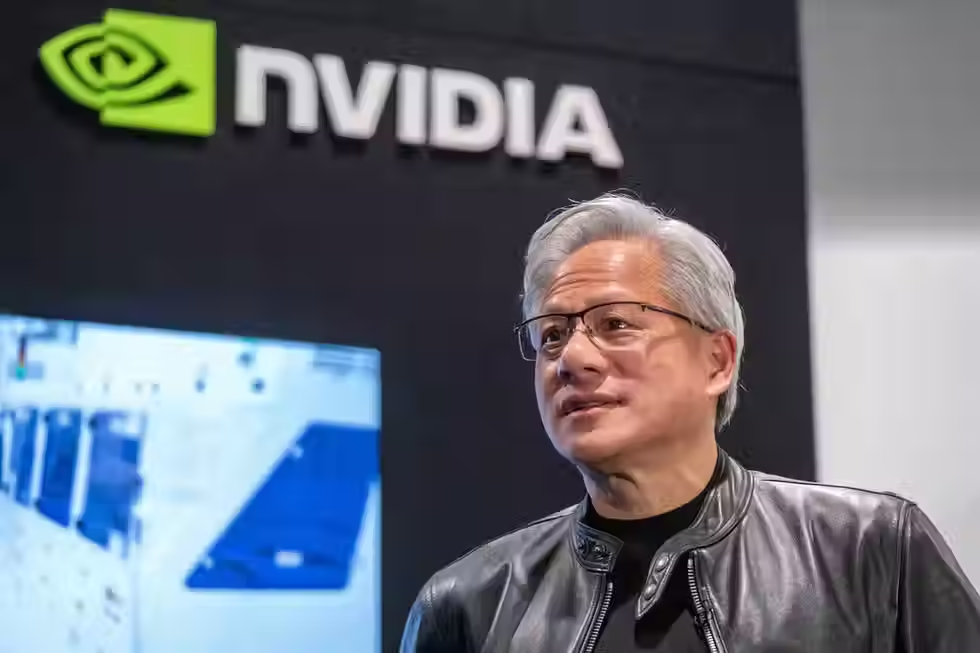
Artificial intelligence is often discussed as a force that will automate human labor, reduce the need for workers, and transform office-based professions. NVIDIA CEO Jensen Huang is highlighting another side of the AI revolution: the enormous physical economy required to build and operate the infrastructure behind increasingly powerful AI systems.

Speaking alongside Elon Musk at a White House technology gathering in September 2026, Huang said the construction of AI data centers and their supporting infrastructure could create “probably about a million jobs.” He described the investment wave as a potential reindustrialization of the United States, with demand extending far beyond software engineers and computer scientists to electricians, construction workers, plumbers, pipe fitters, technicians, mechanics, and other skilled trades.

The argument points to a fundamental feature of the AI economy that is sometimes obscured by the industry's software-centric image. Artificial intelligence may operate through algorithms and cloud platforms, but those systems depend on physical infrastructure involving land, buildings, semiconductor equipment, electrical grids, power generation, cooling systems, networking hardware, construction materials, and highly specialized labor.

The result could be a significant shift in how AI affects employment. Instead of viewing AI only through the question of which existing jobs it may automate, the broader economic picture also requires examining the new industrial ecosystem being constructed to make large-scale AI possible.

The Physical Infrastructure Behind the AI Boom

Modern AI systems require extraordinary amounts of computing capacity. Training and serving advanced models depends on large clusters of accelerators, high-speed networking, storage systems, cooling equipment, and reliable electricity.

These systems are typically housed in data centers designed around continuous operation. As AI workloads expand, operators need additional computing facilities and increasingly sophisticated power and cooling infrastructure.

Huang said the United States is adding somewhere between 10 and 20 gigawatts of infrastructure annually in connection with this expansion. Importantly, the infrastructure requirement does not end at the walls of a data center.

New computing facilities can require substantial additions to electricity generation, transmission, substations, cooling systems, construction capacity, and industrial equipment. Every layer creates demand for workers with different technical skills.

The AI infrastructure chain can therefore be understood as a broad industrial system:

Semiconductor manufacturing and advanced packaging
Data center construction
Electrical installation and power distribution
Power generation and transmission
Cooling and thermal-management systems
Networking and telecommunications
Equipment manufacturing and maintenance
Construction materials and industrial supply chains
Facility operations and technical support
Engineering, project management, and specialized services

This is why the employment effects of AI infrastructure can extend well beyond the companies developing AI models.

Why Skilled Trades Are Becoming Central to AI

The emerging AI economy is creating an unusual connection between frontier computing and traditional skilled labor.

A large AI data center requires sophisticated computing equipment, but it also needs physical systems capable of supporting that equipment. Electrical infrastructure must deliver enormous quantities of reliable power. Cooling systems must remove heat generated by densely packed computing hardware. Buildings must be constructed to support the equipment, cabling, ventilation, security, and operational requirements.

That creates demand for occupations such as electricians, plumbers, pipe fitters, construction workers, mechanics, equipment technicians, and specialized contractors.

The Alliance for America's Skilled Trades, or AAST, estimates that the United States will need to fill 1.7 million skilled-trade job openings annually through 2035. The organization defines skilled trades broadly across 124 occupations involved in building, installing, operating, maintaining, repairing, fabricating, or extracting the physical infrastructure on which the economy depends.

The same organization estimates that current training programs produce only 55 workers for every 100 skilled workers needed.

That shortage matters for AI because infrastructure expansion cannot proceed simply by purchasing more chips. Physical deployment requires people who can construct, connect, operate, repair, and maintain the systems around those chips.

The AI boom is therefore intersecting with a labor-market challenge that existed before generative AI became mainstream.

The Data Center Economy Is Larger Than the Data Center

The economics become clearer when the entire infrastructure chain is considered.

A new AI facility begins with construction and land development. It then requires electrical equipment, transformers, power distribution, cooling systems, networking infrastructure, security systems, backup power, and computing hardware.

The facility must subsequently be operated around the clock.

That creates multiple layers of economic activity:

Infrastructure Layer	Examples of Economic Activity
Construction	Buildings, structural systems, site preparation
Power	Generation, transmission, substations, electrical installation
Cooling	Chillers, liquid cooling, pumps, heat management
Computing	AI accelerators, servers, storage, networking
Operations	Technicians, maintenance, monitoring, security
Supply Chain	Steel, copper, equipment, components, logistics
Professional Services	Engineering, design, project management, compliance

This distinction is important when evaluating employment claims.

The number of jobs associated with AI infrastructure is not necessarily equivalent to the number of permanent employees working inside data centers. Some positions are temporary construction jobs, others support manufacturing and supply chains, while still others are long-term operational roles.

Consequently, Huang's million-job figure should be understood as a projection about the broader infrastructure build-out rather than as a count of permanent data center employees.

The Numbers Behind the Employment Debate

The available indicators show why the labor discussion is becoming increasingly complicated.

According to the supplied reporting, data-center construction spending has increased by more than 57% over the previous year, while employment among nonresidential specialty trade contractors has risen by approximately 86,000 workers.

NVIDIA has also cited an analysis commissioned by the company estimating that NVIDIA-attributable AI infrastructure activity could contribute $485 billion to U.S. GDP in 2026 and support more than 100,000 direct and indirect jobs during the year.

These figures should not be treated as interchangeable measures. The NVIDIA estimate concerns economic activity attributable to its AI infrastructure ecosystem, while the broader skilled-trades figures address labor demand across the economy.

Together, however, they illustrate the scale of the investment cycle.

AI infrastructure is becoming an industrial investment category in its own right, with economic effects reaching into construction, energy, manufacturing, engineering, transportation, and other sectors.

AI Automation and AI Job Creation Can Happen at the Same Time

The most important economic question may not be whether AI creates jobs or destroys them. Both processes can occur simultaneously.

AI can automate tasks performed by accountants, software developers, customer-service representatives, analysts, researchers, and other professionals while simultaneously generating demand for workers building the infrastructure needed to run those systems.

This creates a crucial distinction between job displacement and employment creation.

Suppose an AI system reduces the amount of human labor required for a particular administrative function. That does not automatically mean the displaced worker will transition into a newly created infrastructure position.

An electrician working on a data center cannot directly substitute for an analyst whose occupation has been transformed by automation. The required skills, location, education, experience, compensation structures, and timing may all be different.

This creates what economists often describe as a transition problem. Aggregate employment can rise while particular workers and communities still experience disruption.

For policymakers, businesses, and educators, the question therefore becomes how efficiently workers can move between declining occupations and expanding ones.

Reindustrialization Through Artificial Intelligence

Huang's description of AI infrastructure as a form of American reindustrialization reflects a broader change in the geography of technology.

For decades, much of the technology economy became increasingly concentrated around software, intellectual property, finance, and highly specialized professional services. Manufacturing and other physical production activities moved through complex global supply chains.

AI is placing new emphasis on physical capacity.

The computational demands of advanced AI require semiconductor manufacturing, advanced packaging, high-density computing facilities, power infrastructure, and sophisticated industrial equipment. As countries compete over AI capacity, access to physical infrastructure becomes strategically important.

This means AI policy increasingly overlaps with industrial policy.

A country seeking leadership in artificial intelligence must consider not only algorithms and research laboratories but also electricity generation, semiconductor production, data centers, telecommunications, skilled labor, and supply-chain resilience.

The result is an AI economy that looks increasingly like a combination of software industry and heavy infrastructure investment.

The Energy Constraint

Electricity may ultimately become one of the most important constraints on AI expansion.

AI accelerators consume substantial amounts of power, and large computing facilities operate continuously. As data center capacity expands, the electricity required to support it also increases.

Huang specifically emphasized that new AI infrastructure requires additional power-generation capacity. Elon Musk similarly highlighted the need to expand energy production and semiconductor manufacturing, while pointing to the much larger electricity-generation capacity of China compared with the United States.

The energy issue creates both opportunities and challenges.

It can generate employment in power generation, electrical construction, grid modernization, engineering, equipment manufacturing, and maintenance. At the same time, rapidly increasing electricity demand can create pressure on grids, permitting systems, infrastructure investment, and local communities.

This makes energy infrastructure a foundational component of the AI economy rather than a secondary consideration.

The New AI Labor Market Will Have Multiple Layers

The employment impact of AI infrastructure is likely to develop across several timescales.

During construction, demand can rise for contractors, electricians, engineers, equipment operators, and construction workers. Once facilities become operational, demand shifts toward technicians, maintenance personnel, security professionals, network specialists, and facility operators.

Meanwhile, the expansion of AI computing can stimulate additional activity elsewhere in the economy.

More computing capacity can enable companies to deploy AI applications, which can create demand for AI integration, cybersecurity, data management, cloud infrastructure, model operations, and specialized professional services.

This produces a layered labor ecosystem:

Build the infrastructure
Operate the infrastructure
Develop AI systems
Deploy AI into businesses
Create new products and services around AI
Develop new occupations around the resulting economy

The long-term employment impact will therefore depend on what businesses and consumers do with the increased AI capacity once it becomes available.

The Training Challenge Could Determine Who Benefits

Infrastructure investment alone does not guarantee that workers will be available when companies need them.

The skilled-trades shortage identified by AAST illustrates the potential bottleneck. If demand for electricians, mechanics, construction specialists, technicians, and related occupations grows faster than training capacity, projects can face delays and higher costs.

Workforce development therefore becomes a strategic component of AI infrastructure.

Potential solutions include expanded apprenticeships, vocational education, employer-sponsored training, community-college programs, technical certification pathways, and closer coordination between infrastructure developers and education providers.

The challenge is not simply increasing the number of workers. Training must match the technical requirements of modern infrastructure.

AI data centers combine conventional construction with increasingly sophisticated electrical, networking, thermal, and computing systems. Workers may need hybrid skills that cross traditional occupational boundaries.

What This Means for the Future of AI

The next phase of artificial intelligence may be defined as much by infrastructure as by models.

The AI industry has spent years competing over model capabilities, training techniques, chips, benchmarks, and applications. Increasingly, another competition is emerging around who can build enough computing capacity, secure sufficient energy, establish reliable supply chains, and develop the workforce required to operate it.

That changes the economics of AI.

The winners in the next stage may not be limited to organizations developing the most advanced models. Companies involved in power systems, cooling, semiconductor manufacturing, networking, construction, data center operations, and specialized engineering can also become essential participants in the AI ecosystem.

For workers, the shift suggests that the AI economy will not be confined to coding and digital occupations. Highly technical physical professions may become increasingly important to the expansion of computing.

For governments, the challenge is broader still. AI infrastructure requires coordination among energy policy, workforce development, industrial capacity, technology investment, environmental considerations, and regional economic planning.

AI's Industrial Revolution Is Already Becoming Physical

Jensen Huang's million-job projection should ultimately be viewed as part of a much larger economic transformation.

AI can automate tasks, but AI itself requires machines, buildings, electricity, cooling, networks, factories, supply chains, and human expertise. The infrastructure supporting these systems is becoming one of the defining industrial investments of the decade.

That creates a paradox at the heart of the AI transition. The technology may reduce the amount of human labor required for some activities while simultaneously increasing demand for people capable of building the physical foundation on which that technology operates.

The most consequential question is therefore not simply whether AI will create or destroy jobs. It is whether economies can build the infrastructure, education systems, training pathways, and institutions required to manage the transition between them.

As Dr. Shahid Masood and the expert team at 1950.ai continue examining the intersection of artificial intelligence, emerging technology, economics, and society, the expanding AI infrastructure economy offers an important reminder: the future of computing is not taking place entirely inside software. It is being constructed in power plants, semiconductor facilities, construction sites, electrical systems, and data centers around the world.

The AI revolution may ultimately reshape the economy not only through what intelligent machines can do, but through the enormous industrial ecosystem required to make those machines possible.

Key Takeaways
Jensen Huang estimates that the AI data center build-out could create roughly 1 million jobs in the United States.
AI infrastructure is generating demand across construction, electrical work, power generation, cooling, manufacturing, engineering, and technical maintenance.
The U.S. skilled-trades workforce already faces a significant supply gap, creating a potential constraint on infrastructure expansion.
AI job creation and AI-driven job displacement can occur simultaneously, but the workers affected may not be the same people.
Electricity generation and grid capacity are becoming strategic constraints for large-scale AI deployment.
The AI economy increasingly combines software innovation with physical industrial investment.
Workforce training and skilled-trades development could determine how effectively communities capture the economic benefits of the AI infrastructure boom.
The long-term impact of AI will depend not only on model capabilities, but also on the physical infrastructure and human expertise required to deploy them.
Further Reading / External References

Jensen Huang Says AI Could Create 1 Million Blue-Collar Jobs

https://www.thewealthadvisor.com/article/jensen-huang-says-ai-could-create-1-million-blue-collar-jobs

America's Skilled Labor Problem: There's a Huge Shortage

https://finance.yahoo.com/video/america-skilled-labor-problem-theres-143000446.html

Artificial intelligence is often discussed as a force that will automate human labor, reduce the need for workers, and transform office-based professions. NVIDIA CEO Jensen Huang is highlighting another side of the AI revolution: the enormous physical economy required to build and operate the infrastructure behind increasingly powerful AI systems.

Speaking alongside Elon Musk at a White House technology gathering in September 2026, Huang said the construction of AI data centers and their supporting infrastructure could create “probably about a million jobs.” He described the investment wave as a potential reindustrialization of the United States, with demand extending far beyond software engineers and computer scientists to electricians, construction workers, plumbers, pipe fitters, technicians, mechanics, and other skilled trades.


The argument points to a fundamental feature of the AI economy that is sometimes obscured by the industry's software-centric image. Artificial intelligence may operate through algorithms and cloud platforms, but those systems depend on physical infrastructure involving land, buildings, semiconductor equipment, electrical grids, power generation, cooling systems, networking hardware, construction materials, and highly specialized labor.

The result could be a significant shift in how AI affects employment. Instead of viewing AI only through the question of which existing jobs it may automate, the broader economic picture also requires examining the new industrial ecosystem being constructed to make large-scale AI possible.


The Physical Infrastructure Behind the AI Boom

Modern AI systems require extraordinary amounts of computing capacity. Training and serving advanced models depends on large clusters of accelerators, high-speed networking, storage systems, cooling equipment, and reliable electricity.

These systems are typically housed in data centers designed around continuous operation. As AI workloads expand, operators need additional computing facilities and increasingly sophisticated power and cooling infrastructure.

Huang said the United States is adding somewhere between 10 and 20 gigawatts of infrastructure annually in connection with this expansion. Importantly, the infrastructure requirement does not end at the walls of a data center.


New computing facilities can require substantial additions to electricity generation, transmission, substations, cooling systems, construction capacity, and industrial equipment. Every layer creates demand for workers with different technical skills.

The AI infrastructure chain can therefore be understood as a broad industrial system:

  • Semiconductor manufacturing and advanced packaging

  • Data center construction

  • Electrical installation and power distribution

  • Power generation and transmission

  • Cooling and thermal-management systems

  • Networking and telecommunications

  • Equipment manufacturing and maintenance

  • Construction materials and industrial supply chains

  • Facility operations and technical support

  • Engineering, project management, and specialized services

This is why the employment effects of AI infrastructure can extend well beyond the companies developing AI models.


Why Skilled Trades Are Becoming Central to AI

The emerging AI economy is creating an unusual connection between frontier computing and traditional skilled labor.

A large AI data center requires sophisticated computing equipment, but it also needs physical systems capable of supporting that equipment. Electrical infrastructure must deliver enormous quantities of reliable power. Cooling systems must remove heat generated by densely packed computing hardware. Buildings must be constructed to support the equipment, cabling, ventilation, security, and operational requirements.

That creates demand for occupations such as electricians, plumbers, pipe fitters, construction workers, mechanics, equipment technicians, and specialized contractors.

T

he Alliance for America's Skilled Trades, or AAST, estimates that the United States will need to fill 1.7 million skilled-trade job openings annually through 2035. The organization defines skilled trades broadly across 124 occupations involved in building, installing, operating, maintaining, repairing, fabricating, or extracting the physical infrastructure on which the economy depends.

The same organization estimates that current training programs produce only 55 workers for every 100 skilled workers needed.

That shortage matters for AI because infrastructure expansion cannot proceed simply by purchasing more chips. Physical deployment requires people who can construct, connect, operate, repair, and maintain the systems around those chips.

The AI boom is therefore intersecting with a labor-market challenge that existed before generative AI became mainstream.


The Data Center Economy Is Larger Than the Data Center

The economics become clearer when the entire infrastructure chain is considered.

A new AI facility begins with construction and land development. It then requires electrical equipment, transformers, power distribution, cooling systems, networking infrastructure, security systems, backup power, and computing hardware.

The facility must subsequently be operated around the clock.

That creates multiple layers of economic activity:

Infrastructure Layer

Examples of Economic Activity

Construction

Buildings, structural systems, site preparation

Power

Generation, transmission, substations, electrical installation

Cooling

Chillers, liquid cooling, pumps, heat management

Computing

AI accelerators, servers, storage, networking

Operations

Technicians, maintenance, monitoring, security

Supply Chain

Steel, copper, equipment, components, logistics

Professional Services

Engineering, design, project management, compliance

This distinction is important when evaluating employment claims.

The number of jobs associated with AI infrastructure is not necessarily equivalent to the number of permanent employees working inside data centers. Some positions are temporary construction jobs, others support manufacturing and supply chains, while still others are long-term operational roles.

Consequently, Huang's million-job figure should be understood as a projection about the broader infrastructure build-out rather than as a count of permanent data center employees.


The Numbers Behind the Employment Debate

The available indicators show why the labor discussion is becoming increasingly complicated.

According to the supplied reporting, data-center construction spending has increased by more than 57% over the previous year, while employment among nonresidential specialty trade contractors has risen by approximately 86,000 workers.

NVIDIA has also cited an analysis commissioned by the company estimating that NVIDIA-attributable AI infrastructure activity could contribute $485 billion to U.S. GDP in 2026 and support more than 100,000 direct and indirect jobs during the year.

These figures should not be treated as interchangeable measures. The NVIDIA estimate concerns economic activity attributable to its AI infrastructure ecosystem, while the broader skilled-trades figures address labor demand across the economy.

Together, however, they illustrate the scale of the investment cycle.

AI infrastructure is becoming an industrial investment category in its own right, with economic effects reaching into construction, energy, manufacturing, engineering, transportation, and other sectors.


AI Automation and AI Job Creation Can Happen at the Same Time

The most important economic question may not be whether AI creates jobs or destroys them. Both processes can occur simultaneously.

AI can automate tasks performed by accountants, software developers, customer-service representatives, analysts, researchers, and other professionals while simultaneously generating demand for workers building the infrastructure needed to run those systems.

This creates a crucial distinction between job displacement and employment creation.


Suppose an AI system reduces the amount of human labor required for a particular administrative function. That does not automatically mean the displaced worker will transition into a newly created infrastructure position.

An electrician working on a data center cannot directly substitute for an analyst whose occupation has been transformed by automation. The required skills, location, education, experience, compensation structures, and timing may all be different.

This creates what economists often describe as a transition problem. Aggregate employment can rise while particular workers and communities still experience disruption.

For policymakers, businesses, and educators, the question therefore becomes how efficiently workers can move between declining occupations and expanding ones.


Reindustrialization Through Artificial Intelligence

Huang's description of AI infrastructure as a form of American reindustrialization reflects a broader change in the geography of technology.

For decades, much of the technology economy became increasingly concentrated around software, intellectual property, finance, and highly specialized professional services. Manufacturing and other physical production activities moved through complex global supply chains.

AI is placing new emphasis on physical capacity.

The computational demands of advanced AI require semiconductor manufacturing, advanced packaging, high-density computing facilities, power infrastructure, and sophisticated industrial equipment. As countries compete over AI capacity, access to physical infrastructure becomes strategically important.

This means AI policy increasingly overlaps with industrial policy.

A country seeking leadership in artificial intelligence must consider not only algorithms and research laboratories but also electricity generation, semiconductor production, data centers, telecommunications, skilled labor, and supply-chain resilience.

The result is an AI economy that looks increasingly like a combination of software industry and heavy infrastructure investment.


The Energy Constraint

Electricity may ultimately become one of the most important constraints on AI expansion.

AI accelerators consume substantial amounts of power, and large computing facilities operate continuously. As data center capacity expands, the electricity required to support it also increases.

Huang specifically emphasized that new AI infrastructure requires additional power-generation capacity. Elon Musk similarly highlighted the need to expand energy production and semiconductor manufacturing, while pointing to the much larger electricity-generation capacity of China compared with the United States.

The energy issue creates both opportunities and challenges.

It can generate employment in power generation, electrical construction, grid modernization, engineering, equipment manufacturing, and maintenance. At the same time, rapidly increasing electricity demand can create pressure on grids, permitting systems, infrastructure investment, and local communities.

This makes energy infrastructure a foundational component of the AI economy rather than a secondary consideration.


Artificial intelligence is often discussed as a force that will automate human labor, reduce the need for workers, and transform office-based professions. NVIDIA CEO Jensen Huang is highlighting another side of the AI revolution: the enormous physical economy required to build and operate the infrastructure behind increasingly powerful AI systems.

Speaking alongside Elon Musk at a White House technology gathering in September 2026, Huang said the construction of AI data centers and their supporting infrastructure could create “probably about a million jobs.” He described the investment wave as a potential reindustrialization of the United States, with demand extending far beyond software engineers and computer scientists to electricians, construction workers, plumbers, pipe fitters, technicians, mechanics, and other skilled trades.

The argument points to a fundamental feature of the AI economy that is sometimes obscured by the industry's software-centric image. Artificial intelligence may operate through algorithms and cloud platforms, but those systems depend on physical infrastructure involving land, buildings, semiconductor equipment, electrical grids, power generation, cooling systems, networking hardware, construction materials, and highly specialized labor.

The result could be a significant shift in how AI affects employment. Instead of viewing AI only through the question of which existing jobs it may automate, the broader economic picture also requires examining the new industrial ecosystem being constructed to make large-scale AI possible.

The Physical Infrastructure Behind the AI Boom

Modern AI systems require extraordinary amounts of computing capacity. Training and serving advanced models depends on large clusters of accelerators, high-speed networking, storage systems, cooling equipment, and reliable electricity.

These systems are typically housed in data centers designed around continuous operation. As AI workloads expand, operators need additional computing facilities and increasingly sophisticated power and cooling infrastructure.

Huang said the United States is adding somewhere between 10 and 20 gigawatts of infrastructure annually in connection with this expansion. Importantly, the infrastructure requirement does not end at the walls of a data center.

New computing facilities can require substantial additions to electricity generation, transmission, substations, cooling systems, construction capacity, and industrial equipment. Every layer creates demand for workers with different technical skills.

The AI infrastructure chain can therefore be understood as a broad industrial system:

Semiconductor manufacturing and advanced packaging
Data center construction
Electrical installation and power distribution
Power generation and transmission
Cooling and thermal-management systems
Networking and telecommunications
Equipment manufacturing and maintenance
Construction materials and industrial supply chains
Facility operations and technical support
Engineering, project management, and specialized services

This is why the employment effects of AI infrastructure can extend well beyond the companies developing AI models.

Why Skilled Trades Are Becoming Central to AI

The emerging AI economy is creating an unusual connection between frontier computing and traditional skilled labor.

A large AI data center requires sophisticated computing equipment, but it also needs physical systems capable of supporting that equipment. Electrical infrastructure must deliver enormous quantities of reliable power. Cooling systems must remove heat generated by densely packed computing hardware. Buildings must be constructed to support the equipment, cabling, ventilation, security, and operational requirements.

That creates demand for occupations such as electricians, plumbers, pipe fitters, construction workers, mechanics, equipment technicians, and specialized contractors.

The Alliance for America's Skilled Trades, or AAST, estimates that the United States will need to fill 1.7 million skilled-trade job openings annually through 2035. The organization defines skilled trades broadly across 124 occupations involved in building, installing, operating, maintaining, repairing, fabricating, or extracting the physical infrastructure on which the economy depends.

The same organization estimates that current training programs produce only 55 workers for every 100 skilled workers needed.

That shortage matters for AI because infrastructure expansion cannot proceed simply by purchasing more chips. Physical deployment requires people who can construct, connect, operate, repair, and maintain the systems around those chips.

The AI boom is therefore intersecting with a labor-market challenge that existed before generative AI became mainstream.

The Data Center Economy Is Larger Than the Data Center

The economics become clearer when the entire infrastructure chain is considered.

A new AI facility begins with construction and land development. It then requires electrical equipment, transformers, power distribution, cooling systems, networking infrastructure, security systems, backup power, and computing hardware.

The facility must subsequently be operated around the clock.

That creates multiple layers of economic activity:

Infrastructure Layer	Examples of Economic Activity
Construction	Buildings, structural systems, site preparation
Power	Generation, transmission, substations, electrical installation
Cooling	Chillers, liquid cooling, pumps, heat management
Computing	AI accelerators, servers, storage, networking
Operations	Technicians, maintenance, monitoring, security
Supply Chain	Steel, copper, equipment, components, logistics
Professional Services	Engineering, design, project management, compliance

This distinction is important when evaluating employment claims.

The number of jobs associated with AI infrastructure is not necessarily equivalent to the number of permanent employees working inside data centers. Some positions are temporary construction jobs, others support manufacturing and supply chains, while still others are long-term operational roles.

Consequently, Huang's million-job figure should be understood as a projection about the broader infrastructure build-out rather than as a count of permanent data center employees.

The Numbers Behind the Employment Debate

The available indicators show why the labor discussion is becoming increasingly complicated.

According to the supplied reporting, data-center construction spending has increased by more than 57% over the previous year, while employment among nonresidential specialty trade contractors has risen by approximately 86,000 workers.

NVIDIA has also cited an analysis commissioned by the company estimating that NVIDIA-attributable AI infrastructure activity could contribute $485 billion to U.S. GDP in 2026 and support more than 100,000 direct and indirect jobs during the year.

These figures should not be treated as interchangeable measures. The NVIDIA estimate concerns economic activity attributable to its AI infrastructure ecosystem, while the broader skilled-trades figures address labor demand across the economy.

Together, however, they illustrate the scale of the investment cycle.

AI infrastructure is becoming an industrial investment category in its own right, with economic effects reaching into construction, energy, manufacturing, engineering, transportation, and other sectors.

AI Automation and AI Job Creation Can Happen at the Same Time

The most important economic question may not be whether AI creates jobs or destroys them. Both processes can occur simultaneously.

AI can automate tasks performed by accountants, software developers, customer-service representatives, analysts, researchers, and other professionals while simultaneously generating demand for workers building the infrastructure needed to run those systems.

This creates a crucial distinction between job displacement and employment creation.

Suppose an AI system reduces the amount of human labor required for a particular administrative function. That does not automatically mean the displaced worker will transition into a newly created infrastructure position.

An electrician working on a data center cannot directly substitute for an analyst whose occupation has been transformed by automation. The required skills, location, education, experience, compensation structures, and timing may all be different.

This creates what economists often describe as a transition problem. Aggregate employment can rise while particular workers and communities still experience disruption.

For policymakers, businesses, and educators, the question therefore becomes how efficiently workers can move between declining occupations and expanding ones.

Reindustrialization Through Artificial Intelligence

Huang's description of AI infrastructure as a form of American reindustrialization reflects a broader change in the geography of technology.

For decades, much of the technology economy became increasingly concentrated around software, intellectual property, finance, and highly specialized professional services. Manufacturing and other physical production activities moved through complex global supply chains.

AI is placing new emphasis on physical capacity.

The computational demands of advanced AI require semiconductor manufacturing, advanced packaging, high-density computing facilities, power infrastructure, and sophisticated industrial equipment. As countries compete over AI capacity, access to physical infrastructure becomes strategically important.

This means AI policy increasingly overlaps with industrial policy.

A country seeking leadership in artificial intelligence must consider not only algorithms and research laboratories but also electricity generation, semiconductor production, data centers, telecommunications, skilled labor, and supply-chain resilience.

The result is an AI economy that looks increasingly like a combination of software industry and heavy infrastructure investment.

The Energy Constraint

Electricity may ultimately become one of the most important constraints on AI expansion.

AI accelerators consume substantial amounts of power, and large computing facilities operate continuously. As data center capacity expands, the electricity required to support it also increases.

Huang specifically emphasized that new AI infrastructure requires additional power-generation capacity. Elon Musk similarly highlighted the need to expand energy production and semiconductor manufacturing, while pointing to the much larger electricity-generation capacity of China compared with the United States.

The energy issue creates both opportunities and challenges.

It can generate employment in power generation, electrical construction, grid modernization, engineering, equipment manufacturing, and maintenance. At the same time, rapidly increasing electricity demand can create pressure on grids, permitting systems, infrastructure investment, and local communities.

This makes energy infrastructure a foundational component of the AI economy rather than a secondary consideration.

The New AI Labor Market Will Have Multiple Layers

The employment impact of AI infrastructure is likely to develop across several timescales.

During construction, demand can rise for contractors, electricians, engineers, equipment operators, and construction workers. Once facilities become operational, demand shifts toward technicians, maintenance personnel, security professionals, network specialists, and facility operators.

Meanwhile, the expansion of AI computing can stimulate additional activity elsewhere in the economy.

More computing capacity can enable companies to deploy AI applications, which can create demand for AI integration, cybersecurity, data management, cloud infrastructure, model operations, and specialized professional services.

This produces a layered labor ecosystem:

Build the infrastructure
Operate the infrastructure
Develop AI systems
Deploy AI into businesses
Create new products and services around AI
Develop new occupations around the resulting economy

The long-term employment impact will therefore depend on what businesses and consumers do with the increased AI capacity once it becomes available.

The Training Challenge Could Determine Who Benefits

Infrastructure investment alone does not guarantee that workers will be available when companies need them.

The skilled-trades shortage identified by AAST illustrates the potential bottleneck. If demand for electricians, mechanics, construction specialists, technicians, and related occupations grows faster than training capacity, projects can face delays and higher costs.

Workforce development therefore becomes a strategic component of AI infrastructure.

Potential solutions include expanded apprenticeships, vocational education, employer-sponsored training, community-college programs, technical certification pathways, and closer coordination between infrastructure developers and education providers.

The challenge is not simply increasing the number of workers. Training must match the technical requirements of modern infrastructure.

AI data centers combine conventional construction with increasingly sophisticated electrical, networking, thermal, and computing systems. Workers may need hybrid skills that cross traditional occupational boundaries.

What This Means for the Future of AI

The next phase of artificial intelligence may be defined as much by infrastructure as by models.

The AI industry has spent years competing over model capabilities, training techniques, chips, benchmarks, and applications. Increasingly, another competition is emerging around who can build enough computing capacity, secure sufficient energy, establish reliable supply chains, and develop the workforce required to operate it.

That changes the economics of AI.

The winners in the next stage may not be limited to organizations developing the most advanced models. Companies involved in power systems, cooling, semiconductor manufacturing, networking, construction, data center operations, and specialized engineering can also become essential participants in the AI ecosystem.

For workers, the shift suggests that the AI economy will not be confined to coding and digital occupations. Highly technical physical professions may become increasingly important to the expansion of computing.

For governments, the challenge is broader still. AI infrastructure requires coordination among energy policy, workforce development, industrial capacity, technology investment, environmental considerations, and regional economic planning.

AI's Industrial Revolution Is Already Becoming Physical

Jensen Huang's million-job projection should ultimately be viewed as part of a much larger economic transformation.

AI can automate tasks, but AI itself requires machines, buildings, electricity, cooling, networks, factories, supply chains, and human expertise. The infrastructure supporting these systems is becoming one of the defining industrial investments of the decade.

That creates a paradox at the heart of the AI transition. The technology may reduce the amount of human labor required for some activities while simultaneously increasing demand for people capable of building the physical foundation on which that technology operates.

The most consequential question is therefore not simply whether AI will create or destroy jobs. It is whether economies can build the infrastructure, education systems, training pathways, and institutions required to manage the transition between them.

As Dr. Shahid Masood and the expert team at 1950.ai continue examining the intersection of artificial intelligence, emerging technology, economics, and society, the expanding AI infrastructure economy offers an important reminder: the future of computing is not taking place entirely inside software. It is being constructed in power plants, semiconductor facilities, construction sites, electrical systems, and data centers around the world.

The AI revolution may ultimately reshape the economy not only through what intelligent machines can do, but through the enormous industrial ecosystem required to make those machines possible.

Key Takeaways
Jensen Huang estimates that the AI data center build-out could create roughly 1 million jobs in the United States.
AI infrastructure is generating demand across construction, electrical work, power generation, cooling, manufacturing, engineering, and technical maintenance.
The U.S. skilled-trades workforce already faces a significant supply gap, creating a potential constraint on infrastructure expansion.
AI job creation and AI-driven job displacement can occur simultaneously, but the workers affected may not be the same people.
Electricity generation and grid capacity are becoming strategic constraints for large-scale AI deployment.
The AI economy increasingly combines software innovation with physical industrial investment.
Workforce training and skilled-trades development could determine how effectively communities capture the economic benefits of the AI infrastructure boom.
The long-term impact of AI will depend not only on model capabilities, but also on the physical infrastructure and human expertise required to deploy them.
Further Reading / External References

Jensen Huang Says AI Could Create 1 Million Blue-Collar Jobs

https://www.thewealthadvisor.com/article/jensen-huang-says-ai-could-create-1-million-blue-collar-jobs

America's Skilled Labor Problem: There's a Huge Shortage

https://finance.yahoo.com/video/america-skilled-labor-problem-theres-143000446.html

The New AI Labor Market Will Have Multiple Layers

The employment impact of AI infrastructure is likely to develop across several timescales.

During construction, demand can rise for contractors, electricians, engineers, equipment operators, and construction workers. Once facilities become operational, demand shifts toward technicians, maintenance personnel, security professionals, network specialists, and facility operators.

Meanwhile, the expansion of AI computing can stimulate additional activity elsewhere in the economy.

More computing capacity can enable companies to deploy AI applications, which can create demand for AI integration, cybersecurity, data management, cloud infrastructure, model operations, and specialized professional services.

This produces a layered labor ecosystem:

  1. Build the infrastructure

  2. Operate the infrastructure

  3. Develop AI systems

  4. Deploy AI into businesses

  5. Create new products and services around AI

  6. Develop new occupations around the resulting economy

The long-term employment impact will therefore depend on what businesses and consumers do with the increased AI capacity once it becomes available.


The Training Challenge Could Determine Who Benefits

Infrastructure investment alone does not guarantee that workers will be available when companies need them.

The skilled-trades shortage identified by AAST illustrates the potential bottleneck. If demand for electricians, mechanics, construction specialists, technicians, and related occupations grows faster than training capacity, projects can face delays and higher costs.

Workforce development therefore becomes a strategic component of AI infrastructure.

Potential solutions include expanded apprenticeships, vocational education, employer-sponsored training, community-college programs, technical certification pathways, and closer coordination between infrastructure developers and education providers.

The challenge is not simply increasing the number of workers. Training must match the technical requirements of modern infrastructure.

AI data centers combine conventional construction with increasingly sophisticated electrical, networking, thermal, and computing systems. Workers may need hybrid skills that cross traditional occupational boundaries.


What This Means for the Future of AI

The next phase of artificial intelligence may be defined as much by infrastructure as by models.

The AI industry has spent years competing over model capabilities, training techniques, chips, benchmarks, and applications. Increasingly, another competition is emerging around who can build enough computing capacity, secure sufficient energy, establish reliable supply chains, and develop the workforce required to operate it.

That changes the economics of AI.

The winners in the next stage may not be limited to organizations developing the most advanced models. Companies involved in power systems, cooling, semiconductor manufacturing, networking, construction, data center operations, and specialized engineering can also become essential participants in the AI ecosystem.

For workers, the shift suggests that the AI economy will not be confined to coding and digital occupations. Highly technical physical professions may become increasingly important to the expansion of computing.

For governments, the challenge is broader still. AI infrastructure requires coordination among energy policy, workforce development, industrial capacity, technology investment, environmental considerations, and regional economic planning.


AI's Industrial Revolution Is Already Becoming Physical

Jensen Huang's million-job projection should ultimately be viewed as part of a much larger economic transformation.

AI can automate tasks, but AI itself requires machines, buildings, electricity, cooling, networks, factories, supply chains, and human expertise. The infrastructure supporting these systems is becoming one of the defining industrial investments of the decade.

That creates a paradox at the heart of the AI transition. The technology may reduce the amount of human labor required for some activities while simultaneously increasing demand for people capable of building the physical foundation on which that technology operates.

The most consequential question is therefore not simply whether AI will create or destroy jobs. It is whether economies can build the infrastructure, education systems, training pathways, and institutions required to manage the transition between them.


As Dr. Shahid Masood and the expert team at 1950.ai continue examining the intersection of artificial intelligence, emerging technology, economics, and society, the expanding AI infrastructure economy offers an important reminder: the future of computing is not taking place entirely inside software. It is being constructed in power plants, semiconductor facilities, construction sites, electrical systems, and data centers around the world.

The AI revolution may ultimately reshape the economy not only through what intelligent machines can do, but through the enormous industrial ecosystem required to make those machines possible.


Key Takeaways

  • Jensen Huang estimates that the AI data center build-out could create roughly 1 million jobs in the United States.

  • AI infrastructure is generating demand across construction, electrical work, power generation, cooling, manufacturing, engineering, and technical maintenance.

  • The U.S. skilled-trades workforce already faces a significant supply gap, creating a potential constraint on infrastructure expansion.

  • AI job creation and AI-driven job displacement can occur simultaneously, but the workers affected may not be the same people.

  • Electricity generation and grid capacity are becoming strategic constraints for large-scale AI deployment.

  • The AI economy increasingly combines software innovation with physical industrial investment.

  • Workforce training and skilled-trades development could determine how effectively communities capture the economic benefits of the AI infrastructure boom.

  • The long-term impact of AI will depend not only on model capabilities, but also on the physical infrastructure and human expertise required to deploy them.


Further Reading / External References

Jensen Huang Says AI Could Create 1 Million Blue-Collar Jobs

America's Skilled Labor Problem: There's a Huge Shortage

Comments


bottom of page