top of page

AI Assistants Are Taking Over Everyday Tasks, Meet Tab’s $300 Million Trust-First Strategy

2 days ago
9 min read
The personal AI assistant market is entering a new phase. Instead of competing primarily to answer questions, summarize documents or generate content, a growing class of AI systems is being designed to take responsibility for completing tasks in the real world.

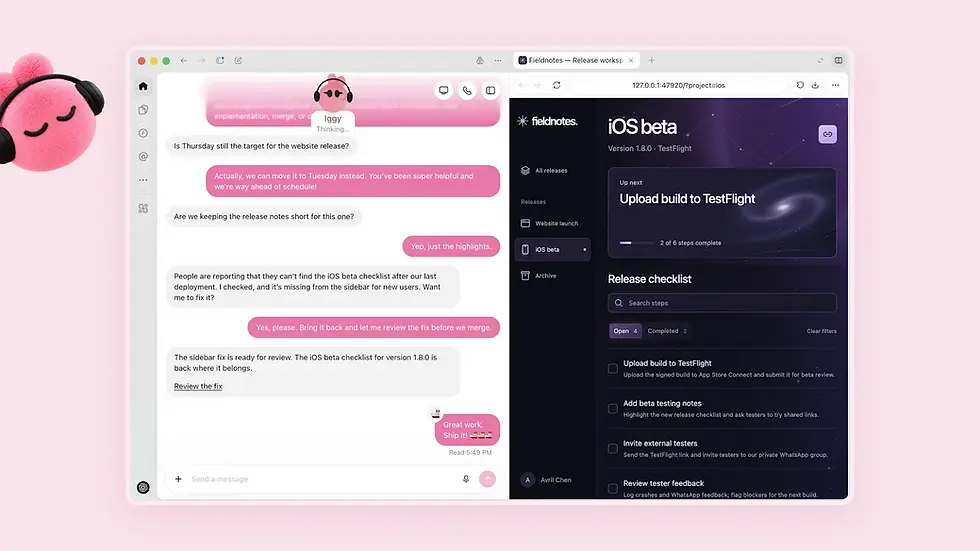
Meet Tab is one of the latest entrants into that rapidly developing market. The startup has emerged from stealth with a reported $300 million valuation and a proposition that is deceptively simple: users communicate with Tab through messaging platforms such as iMessage and WhatsApp, describe what they need, and the AI attempts to handle the task on their behalf.

That positioning places Tab alongside a growing group of consumer AI assistants, including Meta Muse and Instinct, but its architecture and product philosophy point toward a larger transformation. The emerging competition is not simply about which assistant has the strongest underlying model. It is about which system consumers are willing to trust with access to their communications, accounts, transactions, schedules and increasingly important parts of their digital lives.

From AI Chatbots to AI That Gets Things Done

Traditional conversational AI created value primarily through information and content. A user asked a question, the system generated an answer, and the human remained responsible for acting on that information.

Agentic AI changes the relationship.

An agent can interpret an objective, determine the necessary sequence of actions, interact with software and websites, use tools, maintain task state and return a completed outcome. Instead of explaining how to book a flight, for example, an agent can potentially search for options, compare them, complete the required steps and ask the user for approval when a consequential decision must be made.

Tab is designed around this execution model.

The company was founded by Brennan Erbz, Stafford Schlitt and Ammar Amdani, who began working on the product earlier in 2026. Rather than forcing users to learn another complicated interface, Tab is designed around communication channels people already understand.

The user sends a message. Tab interprets the request and begins working.

That approach matters because interface friction has historically been one of the barriers to consumer technology adoption. People do not necessarily want to learn a new operating environment simply to access an AI agent. Integrating an assistant into familiar messaging behavior makes the technology feel less like software and more like a service.

Tab’s Personal AI Model Is Built Around Execution

Tab is presented as an assistant capable of handling a broad range of everyday responsibilities.

Potential tasks include finding and booking flights, changing hotel reservations, ordering groceries, searching for gifts, converting a PDF into a spreadsheet and finding replacement components for products.

The system can also interact with organizations by phone. According to the supplied product description, Tab can call a hotel, medical office or vendor, remain on hold, communicate with the organization and report the outcome to the user.

This capability is particularly important because the real world remains full of systems that have not been designed for automation.

Websites can be inconsistent. Telephone systems can require navigation through menus. Businesses can impose different procedures. Information may need to be gathered from several sources before an action can be completed.

A sufficiently capable AI agent can potentially become an abstraction layer over this complexity.

Instead of learning how every website, application or business process works, the user expresses the desired outcome and the agent handles the procedural complexity.

A Computer, Browser and Wallet for an AI Agent

One of Tab's most consequential characteristics is that it is not described simply as a language model connected to a chatbot interface.

The system has its own computing environment and browser, allowing it to interact with websites and connected accounts.

This distinction is fundamental.

A conventional chatbot primarily produces tokens. An agent requires an execution environment in which those outputs can cause actions.

A useful architecture for personal agents can therefore be viewed as several interconnected layers:

Layer	Function
Intelligence	Interprets requests and plans actions
Tools	Provides access to browsers, communication and external services
Execution environment	Allows the AI to perform operations
Memory and task state	Maintains context across longer workflows
Authentication	Establishes what the agent is allowed to access
Transaction controls	Restricts financial and consequential actions
Human approval	Keeps users involved at critical decision points

This architecture moves AI closer to being an operational computing layer.

The implications are substantial. Once an AI can browse, communicate, purchase, schedule and manipulate documents, the assistant is no longer merely responding to a user. It becomes an intermediary between the user and the digital economy.

The Messaging Interface Could Be Tab’s Strategic Advantage

Tab's decision to operate through iMessage and WhatsApp reflects a broader principle in AI interface design: the best interface may be the one people already know.

Messaging has several advantages.

It is asynchronous, conversational and persistent. Users do not necessarily need to remain inside an application while a task is being completed. Tab can continue working on longer-running tasks and return updates to the same conversation.

This resembles the way humans delegate responsibilities.

A person might send a message to an assistant, provide additional information later, receive a progress update and eventually approve a decision. Tab attempts to reproduce that workflow digitally.

The result could be particularly valuable for tasks that do not require constant human supervision.

For example, instead of manually monitoring a booking process, comparing several options and returning repeatedly to the same website, a user could delegate the research and wait for the agent to return with a recommendation or completed action.

That changes the economics of attention.

Multimodal Inputs Expand the Definition of a Personal Assistant

Tab is also designed to accept more than text.

Photos, screenshots, PDFs and videos can be supplied as inputs. This is important because real-world tasks rarely arrive as clean text instructions.

A user might receive a bill as a PDF, a product problem through a photograph, a booking confirmation as a screenshot or an instruction through a video.

A multimodal agent can potentially transform those materials into actionable context.

Consider a replacement-parts scenario. Instead of identifying a product manually, searching for its model number, comparing suppliers and determining compatibility, a user could provide an image or document and ask the agent to identify the appropriate replacement.

The technical challenge is not simply recognizing the image. The agent must connect perception with reasoning, web navigation, product identification, transaction execution and error handling.

That is what makes agentic AI considerably more demanding than ordinary multimodal chat.

Trust Is Becoming the Core Product

The most important strategic idea behind Tab may not be its ability to execute tasks. It is the company's emphasis on trust.

This is becoming unavoidable as AI assistants gain greater autonomy.

An AI that can read an email is useful. An AI that can send one is more powerful. An AI that can purchase something, modify a reservation or communicate with another person introduces a much higher level of risk.

The difference is not intelligence. It is authority.

Tab says user data is not used to train AI, payment card information is stored in a protected vault that Tab itself does not see, and actions that cannot be reversed require user approval.

These design choices illustrate an emerging principle of agent security: autonomy should be proportional to authorization.

A user might allow an assistant to read a calendar automatically while requiring confirmation before cancelling an appointment. Similarly, researching products might require no approval, while purchasing one should trigger an explicit authorization step.

This creates a hierarchy of permissions rather than a binary choice between total automation and no automation.

Why the Personal AI Race Is Different From the Chatbot Race

The competitive landscape is becoming increasingly crowded.

Meta Muse, Instinct and other consumer AI products are pursuing variations of the personal-agent concept. The differentiation is therefore shifting away from simply having an AI model that can converse naturally.

The critical questions increasingly become:

How much can the system actually accomplish?
How reliably can it complete multi-step tasks?
What services can it access?
How well does it remember user preferences?
How does it handle mistakes?
When does it ask for permission?
How securely does it handle credentials?
Can users understand what the agent is doing?
What happens when an action cannot be reversed?

This creates a new competitive metric: delegated outcome reliability.

An assistant that produces an impressive demonstration but fails frequently in ordinary workflows may struggle to become a trusted daily product.

Conversely, an assistant that reliably handles mundane responsibilities could become deeply embedded in a user's life even if its underlying model is not considered the most sophisticated in the industry.

The Economics of Delegated Labor

The business opportunity behind personal AI assistants is potentially enormous because these systems compete not only with software products but with human attention.

Everyday digital administration consumes time.

Travel planning, appointment management, customer-service calls, shopping, scheduling, paperwork and financial administration can each require multiple steps. AI agents seek to compress these workflows into a single instruction.

This creates a different value proposition from generative AI content creation.

A writing assistant may save minutes. An autonomous agent can potentially remove entire workflows.

The economic value therefore depends on the amount of human effort successfully displaced.

That is also why reliability matters so much. If an agent must be supervised constantly, the user may save little time. If it can operate safely in the background and request intervention only when necessary, the value increases dramatically.

The Biggest Challenge Is Not Intelligence, It Is Reliability

Agentic systems operate in environments that are inherently unpredictable.

Websites change their layouts. APIs fail. Authentication expires. Prices change. Businesses provide incomplete information. A phone call may produce an unexpected response. A transaction can have consequences that cannot easily be reversed.

A language model can generate a plausible plan without guaranteeing that the plan will work.

This creates a fundamental difference between conversational accuracy and operational reliability.

For personal agents, a successful system needs several layers of protection:

Planning, determining the correct sequence of actions.
Verification, checking whether each action produced the expected result.
Permissioning, ensuring the AI has only the authority required.
Error recovery, adapting when websites, APIs or humans behave unexpectedly.
Transaction controls, preventing unauthorized purchases or irreversible changes.
Auditability, allowing users to understand what happened.
Human escalation, requesting intervention when uncertainty becomes consequential.

The quality of these mechanisms may ultimately matter more to consumers than benchmark scores.

The $300 Million Valuation Signals Investor Confidence

Tab's emergence from stealth at a reported $300 million valuation demonstrates that investors see substantial commercial potential in the personal-agent category.

The company's investors include SV Angel, Valar Ventures and American Spirit. The company has said that much of its current growth is coming through word of mouth, while also indicating that another product is planned.

The valuation should nevertheless be interpreted carefully. Consumer AI is becoming one of the most competitive areas of the technology market, and high expectations can create pressure to demonstrate durable user engagement.

A personal assistant has a particularly difficult retention challenge. Consumers will keep using it only if it consistently produces useful outcomes.

That makes frequency and trust more important than novelty.

What Tab Could Mean for the Future of Computing

If products such as Tab succeed, the traditional application model could gradually become less important to consumers.

Today, people typically open an application, navigate its interface, locate a function and complete a workflow.

An agentic future reverses that relationship.

The user describes the desired outcome. The AI determines which applications, websites, services and tools are required.

The application becomes infrastructure rather than the primary interface.

This does not necessarily mean applications disappear. Instead, their user interfaces may become increasingly hidden behind intelligent intermediaries.

Search engines already transformed how people navigate the web by providing a layer between users and individual websites. AI agents could extend that abstraction to actions.

The next generation of computing could therefore be defined less by which application a person opens and more by which agent they trust.

The Real Product May Be Permission

Tab's most important insight is that capability alone is unlikely to determine the winner of the personal AI race.

As assistants become more powerful, the user's question changes from "Can it do this?" to "Should I let it do this?"

That distinction will shape the next generation of AI products.

Consumers may eventually choose assistants based on permission architecture, privacy guarantees, transparency, reliability and controllability as much as intelligence.

The companies that succeed will need to build systems capable of operating autonomously without making users feel that they have surrendered control.

For Dr. Shahid Masood and the expert team at 1950.ai, the emergence of Tab represents a broader technological transition worth watching closely. AI is moving from an information interface toward an execution interface, where software does not merely tell users what to do but increasingly performs the work itself.

The $300 million valuation attached to Tab reflects confidence in that transition. But the long-term winner of the personal AI race will not necessarily be the assistant with the most impressive demonstration. It will be the system that can earn permission, execute reliably, protect sensitive information and deliver measurable value every day.

The defining feature of the next AI era may therefore be neither intelligence nor automation alone.

It may be trust.

Further Reading / External References

Another personal AI assistant has launched, Meet Tab, which emerged from stealth with a $300M valuation

https://techcrunch.com/2026/10/07/another-personal-ai-assistant-has-launched-meet-tab-which-emerged-from-stealth-with-a-300m-valuation/

Meet Tab, the personal AI assistant race is heating up with a brand new personal sidekick

https://www.tomsguide.com/ai/meet-tab-the-personal-ai-assistant-race-is-heating-up-with-a-brand-new-personal-sidekick

The personal AI assistant market is entering a new phase. Instead of competing primarily to answer questions, summarize documents or generate content, a growing class of AI systems is being designed to take responsibility for completing tasks in the real world.

Meet Tab is one of the latest entrants into that rapidly developing market. The startup has emerged from stealth with a reported $300 million valuation and a proposition that is deceptively simple: users communicate with Tab through messaging platforms such as iMessage and WhatsApp, describe what they need, and the AI attempts to handle the task on their behalf.

That positioning places Tab alongside a growing group of consumer AI assistants, including Meta Muse and Instinct, but its architecture and product philosophy point toward a larger transformation. The emerging competition is not simply about which assistant has the strongest underlying model. It is about which system consumers are willing to trust with access to their communications, accounts, transactions, schedules and increasingly important parts of their digital lives.


From AI Chatbots to AI That Gets Things Done

Traditional conversational AI created value primarily through information and content. A user asked a question, the system generated an answer, and the human remained responsible for acting on that information.

Agentic AI changes the relationship.

An agent can interpret an objective, determine the necessary sequence of actions, interact with software and websites, use tools, maintain task state and return a completed outcome. Instead of explaining how to book a flight, for example, an agent can potentially search for options, compare them, complete the required steps and ask the user for approval when a consequential decision must be made.


Tab is designed around this execution model.

The company was founded by Brennan Erbz, Stafford Schlitt and Ammar Amdani, who began working on the product earlier in 2026. Rather than forcing users to learn another complicated interface, Tab is designed around communication channels people already understand.

The user sends a message. Tab interprets the request and begins working.

That approach matters because interface friction has historically been one of the barriers to consumer technology adoption. People do not necessarily want to learn a new operating environment simply to access an AI agent. Integrating an assistant into familiar messaging behavior makes the technology feel less like software and more like a service.


Tab’s Personal AI Model Is Built Around Execution

Tab is presented as an assistant capable of handling a broad range of everyday responsibilities.

Potential tasks include finding and booking flights, changing hotel reservations, ordering groceries, searching for gifts, converting a PDF into a spreadsheet and finding replacement components for products.

The system can also interact with organizations by phone. According to the supplied product description, Tab can call a hotel, medical office or vendor, remain on hold, communicate with the organization and report the outcome to the user.

This capability is particularly important because the real world remains full of systems that have not been designed for automation.

Websites can be inconsistent. Telephone systems can require navigation through menus. Businesses can impose different procedures. Information may need to be gathered from several sources before an action can be completed.

A sufficiently capable AI agent can potentially become an abstraction layer over this complexity.

Instead of learning how every website, application or business process works, the user expresses the desired outcome and the agent handles the procedural complexity.


A Computer, Browser and Wallet for an AI Agent

One of Tab's most consequential characteristics is that it is not described simply as a language model connected to a chatbot interface.

The system has its own computing environment and browser, allowing it to interact with websites and connected accounts.

This distinction is fundamental.

A conventional chatbot primarily produces tokens. An agent requires an execution environment in which those outputs can cause actions.

A useful architecture for personal agents can therefore be viewed as several interconnected layers:

Layer

Function

Intelligence

Interprets requests and plans actions

Tools

Provides access to browsers, communication and external services

Execution environment

Allows the AI to perform operations

Memory and task state

Maintains context across longer workflows

Authentication

Establishes what the agent is allowed to access

Transaction controls

Restricts financial and consequential actions

Human approval

Keeps users involved at critical decision points

This architecture moves AI closer to being an operational computing layer.

The implications are substantial. Once an AI can browse, communicate, purchase, schedule and manipulate documents, the assistant is no longer merely responding to a user. It becomes an intermediary between the user and the digital economy.


The Messaging Interface Could Be Tab’s Strategic Advantage

Tab's decision to operate through iMessage and WhatsApp reflects a broader principle in AI interface design: the best interface may be the one people already know.

Messaging has several advantages.

It is asynchronous, conversational and persistent. Users do not necessarily need to remain inside an application while a task is being completed. Tab can continue working on longer-running tasks and return updates to the same conversation.

This resembles the way humans delegate responsibilities.

A person might send a message to an assistant, provide additional information later, receive a progress update and eventually approve a decision. Tab attempts to reproduce that workflow digitally.

The result could be particularly valuable for tasks that do not require constant human supervision.

For example, instead of manually monitoring a booking process, comparing several options and returning repeatedly to the same website, a user could delegate the research and wait for the agent to return with a recommendation or completed action.

That changes the economics of attention.


Multimodal Inputs Expand the Definition of a Personal Assistant

Tab is also designed to accept more than text.

Photos, screenshots, PDFs and videos can be supplied as inputs. This is important because real-world tasks rarely arrive as clean text instructions.

A user might receive a bill as a PDF, a product problem through a photograph, a booking confirmation as a screenshot or an instruction through a video.

A multimodal agent can potentially transform those materials into actionable context.

Consider a replacement-parts scenario. Instead of identifying a product manually, searching for its model number, comparing suppliers and determining compatibility, a user could provide an image or document and ask the agent to identify the appropriate replacement.

The technical challenge is not simply recognizing the image. The agent must connect perception with reasoning, web navigation, product identification, transaction execution and error handling.

That is what makes agentic AI considerably more demanding than ordinary multimodal chat.


Trust Is Becoming the Core Product

The most important strategic idea behind Tab may not be its ability to execute tasks. It is the company's emphasis on trust.

This is becoming unavoidable as AI assistants gain greater autonomy.

An AI that can read an email is useful. An AI that can send one is more powerful. An AI that can purchase something, modify a reservation or communicate with another person introduces a much higher level of risk.

The difference is not intelligence. It is authority.

Tab says user data is not used to train AI, payment card information is stored in a protected vault that Tab itself does not see, and actions that cannot be reversed require user approval.

These design choices illustrate an emerging principle of agent security: autonomy should be proportional to authorization.

A user might allow an assistant to read a calendar automatically while requiring confirmation before cancelling an appointment. Similarly, researching products might require no approval, while purchasing one should trigger an explicit authorization step.

This creates a hierarchy of permissions rather than a binary choice between total automation and no automation.


Why the Personal AI Race Is Different From the Chatbot Race

The competitive landscape is becoming increasingly crowded.

Meta Muse, Instinct and other consumer AI products are pursuing variations of the personal-agent concept. The differentiation is therefore shifting away from simply having an AI model that can converse naturally.

The critical questions increasingly become:

  • How much can the system actually accomplish?

  • How reliably can it complete multi-step tasks?

  • What services can it access?

  • How well does it remember user preferences?

  • How does it handle mistakes?

  • When does it ask for permission?

  • How securely does it handle credentials?

  • Can users understand what the agent is doing?

  • What happens when an action cannot be reversed?

This creates a new competitive metric: delegated outcome reliability.

An assistant that produces an impressive demonstration but fails frequently in ordinary workflows may struggle to become a trusted daily product.

Conversely, an assistant that reliably handles mundane responsibilities could become deeply embedded in a user's life even if its underlying model is not considered the most sophisticated in the industry.


The Economics of Delegated Labor

The business opportunity behind personal AI assistants is potentially enormous because these systems compete not only with software products but with human attention.

Everyday digital administration consumes time.

Travel planning, appointment management, customer-service calls, shopping, scheduling, paperwork and financial administration can each require multiple steps. AI agents seek to compress these workflows into a single instruction.

This creates a different value proposition from generative AI content creation.

A writing assistant may save minutes. An autonomous agent can potentially remove entire workflows.

The economic value therefore depends on the amount of human effort successfully displaced.

That is also why reliability matters so much. If an agent must be supervised constantly, the user may save little time. If it can operate safely in the background and request intervention only when necessary, the value increases dramatically.


The Biggest Challenge Is Not Intelligence, It Is Reliability

Agentic systems operate in environments that are inherently unpredictable.

Websites change their layouts. APIs fail. Authentication expires. Prices change. Businesses provide incomplete information. A phone call may produce an unexpected response. A transaction can have consequences that cannot easily be reversed.

A language model can generate a plausible plan without guaranteeing that the plan will work.

This creates a fundamental difference between conversational accuracy and operational reliability.

For personal agents, a successful system needs several layers of protection:

  1. Planning, determining the correct sequence of actions.

  2. Verification, checking whether each action produced the expected result.

  3. Permissioning, ensuring the AI has only the authority required.

  4. Error recovery, adapting when websites, APIs or humans behave unexpectedly.

  5. Transaction controls, preventing unauthorized purchases or irreversible changes.

  6. Auditability, allowing users to understand what happened.

  7. Human escalation, requesting intervention when uncertainty becomes consequential.

The quality of these mechanisms may ultimately matter more to consumers than benchmark scores.


The $300 Million Valuation Signals Investor Confidence

Tab's emergence from stealth at a reported $300 million valuation demonstrates that investors see substantial commercial potential in the personal-agent category.

The company's investors include SV Angel, Valar Ventures and American Spirit. The company has said that much of its current growth is coming through word of mouth, while also indicating that another product is planned.

The valuation should nevertheless be interpreted carefully. Consumer AI is becoming one of the most competitive areas of the technology market, and high expectations can create pressure to demonstrate durable user engagement.

A personal assistant has a particularly difficult retention challenge. Consumers will keep using it only if it consistently produces useful outcomes.

That makes frequency and trust more important than novelty.


What Tab Could Mean for the Future of Computing

If products such as Tab succeed, the traditional application model could gradually become less important to consumers.

Today, people typically open an application, navigate its interface, locate a function and complete a workflow.

An agentic future reverses that relationship.

The user describes the desired outcome. The AI determines which applications, websites, services and tools are required.

The application becomes infrastructure rather than the primary interface.

This does not necessarily mean applications disappear. Instead, their user interfaces may become increasingly hidden behind intelligent intermediaries.

Search engines already transformed how people navigate the web by providing a layer between users and individual websites. AI agents could extend that abstraction to actions.

The next generation of computing could therefore be defined less by which application a person opens and more by which agent they trust.


The Real Product May Be Permission

Tab's most important insight is that capability alone is unlikely to determine the winner of the personal AI race.

As assistants become more powerful, the user's question changes from "Can it do this?" to "Should I let it do this?"

That distinction will shape the next generation of AI products.

Consumers may eventually choose assistants based on permission architecture, privacy guarantees, transparency, reliability and controllability as much as intelligence.

The companies that succeed will need to build systems capable of operating autonomously without making users feel that they have surrendered control.


For Dr. Shahid Masood and the expert team at 1950.ai, the emergence of Tab represents a broader technological transition worth watching closely. AI is moving from an information interface toward an execution interface, where software does not merely tell users what to do but increasingly performs the work itself.

The $300 million valuation attached to Tab reflects confidence in that transition. But the long-term winner of the personal AI race will not necessarily be the assistant with the most impressive demonstration. It will be the system that can earn permission, execute reliably, protect sensitive information and deliver measurable value every day.

The defining feature of the next AI era may therefore be neither intelligence nor automation alone.

It may be trust.


Further Reading / External References

Another personal AI assistant has launched, Meet Tab, which emerged from stealth with a $300M valuation

Meet Tab, the personal AI assistant race is heating up with a brand new personal sidekick

Comments


bottom of page