
Agentic Swarm Coding Explained: The High-Moat Strategy Every CTO Should Know in 2025

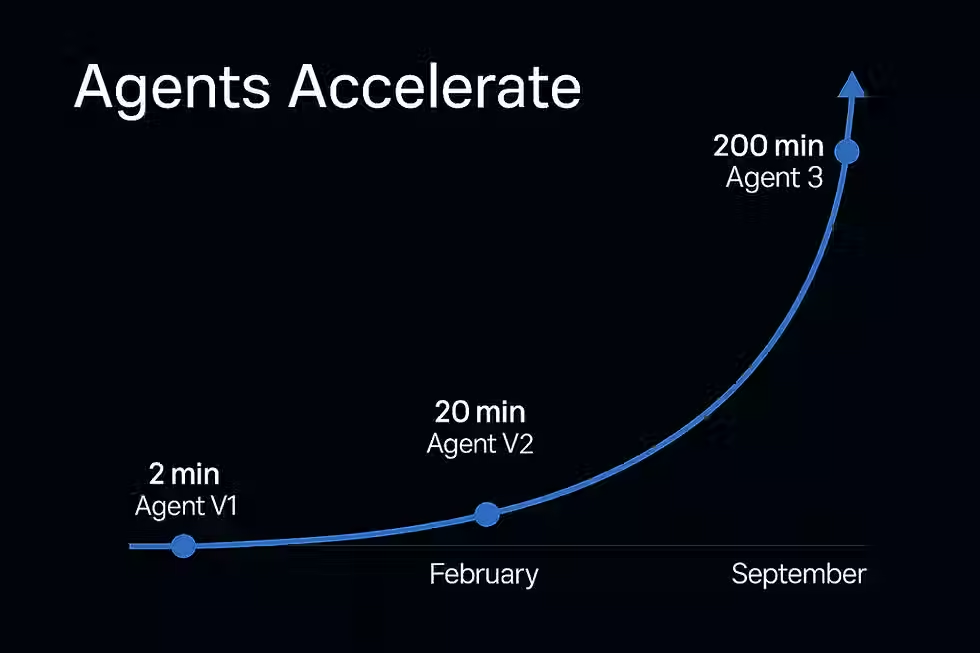
Artificial intelligence is no longer a background productivity enhancer. In enterprise software engineering, it is transforming how teams plan, build, and ship products. After the rise of “vibe coding” – a trend where human developers guided large language models (LLMs) with natural language prompts to generate code – the industry is now pivoting to “agentic swarm coding.” This next stage, discussed in recent reports from TechCrunch and VentureBeat, frames development as a coordinated system of semi-autonomous AI agents working with (not just for) senior engineers.
This article unpacks what agentic swarm coding is, why “vibe coding” plateaued, how the new model creates a competitive moat, and what organizations can do to integrate it effectively.
From Vibe Coding to Agentic Swarms
“Vibe coding” emerged as companies adopted LLMs such as GPT-4 to write large portions of boilerplate code. Developers would describe the “vibe” or intent of a feature, then refine the generated code iteratively. While this accelerated prototyping, it also created hidden technical debt:
Overreliance on prompts: Engineers became prompt-engineers rather than system architects.
Low transparency: Generated code often lacked documentation and clear reasoning.
Human bottleneck: Senior developers were needed to “babysit” the models, validate outputs, and refactor code.
According to TechCrunch (2025), many senior engineers reported spending more time debugging AI-written code than writing their own. This dissatisfaction set the stage for a new paradigm.
Agentic swarm coding shifts the focus from a single monolithic LLM to an ecosystem of specialized, cooperating agents. Each agent is assigned a specific sub-task – requirements analysis, code generation, testing, security scanning, or deployment orchestration – and communicates with peers through a common protocol. The human developer becomes the “mission commander” rather than the “babysitter.”
Core Principles of Agentic Swarm Coding
Unlike vibe coding, agentic swarms are designed around four pillars:
Autonomy with accountability: Each AI agent runs independently but provides structured output logs and test artifacts.
Task specialization: Instead of one generalist model, organizations deploy a constellation of fine-tuned models or APIs.
Consensus building: Agents cross-check each other’s work, flag inconsistencies, and vote on the best solution.
Human-in-the-loop oversight: Senior engineers review checkpoints and only intervene at decision gates, not every line of code.
This model borrows concepts from swarm robotics and distributed systems theory, where many simple units achieve complex behavior through local interactions.
How Agentic Swarms Create an Enterprise Moat
VentureBeat (2025) characterizes agentic swarm coding as a “new enterprise moat” because it combines proprietary workflows, domain-specific fine-tuning, and data network effects. While vibe coding is easily replicable – any team can prompt the same public model – agentic swarms require:
Custom agent roles tailored to the company’s stack.
Integration with internal codebases, test suites, and deployment pipelines.
Accumulated “institutional memory” across agents via vector databases.
This makes the system self-reinforcing. As more projects run through the swarm, the agents become better at the company’s specific domain, and the cost of switching to another platform rises.
Comparative Table: Vibe Coding vs. Agentic Swarm Coding
Feature | Vibe Coding (2022–2024) | Agentic Swarm Coding (2025– ) |
AI Role | Single LLM writing code | Multiple agents specializing in tasks |
Human Role | Prompt engineer, babysitter | Mission commander, system architect |
Transparency | Limited reasoning | Structured logs, explainable outputs |
Scalability | Hard to scale QA | Built-in cross-checks and parallelism |
Competitive Advantage | Low (models are public) | High (custom workflows and data) |
Risk Profile | High technical debt | Reduced bugs and drift via consensus |
Implementation Architecture
A typical agentic swarm system involves:
Orchestration layer: Manages workflows, assigns tasks to agents, and aggregates results.
Domain agents: Specialized LLMs or small models trained on company-specific code libraries.
Verification agents: Run unit tests, static analysis, and vulnerability scans.
Memory store: Vector database storing previous tasks, decisions, and successful code patterns.
Human interface: Dashboards where engineers approve or override agent proposals.
This architecture resembles microservices, but for intelligence rather than APIs.
Real-World Applications
Organizations are already experimenting with agentic swarm coding in several domains:
Financial software: Agents handle regulatory compliance, automatically generating audit trails.
Healthcare IT: Swarms manage privacy constraints (HIPAA, GDPR) while accelerating feature updates.
Telecommunications: Continuous integration pipelines orchestrated by agents reduce downtime.
Embedded systems: Specialized agents generate C/C++ for hardware devices while others verify timing constraints.
Each case shows a shift from code-as-artifact to code-as-conversation, where AI and humans iteratively converge on the best implementation.

Measuring ROI and Productivity
Early data from pilot programs (internal surveys, 2025) suggest:
30–50% reduction in bug rates after integrating verification agents.
2–3x faster feature delivery due to parallelization of coding tasks.
Lower burnout rates among senior engineers, as they focus on architecture rather than manual debugging.
The ROI, however, depends on careful change management. Without clear governance, swarms can drift or duplicate efforts.
Challenges and Risks
While promising, agentic swarm coding introduces new complexities:
Orchestration overhead: Building and maintaining the swarm infrastructure requires DevOps expertise.
Security surface area: More agents mean more APIs and potential vulnerabilities.
Explainability gap: Even with logs, complex emergent behaviors may be hard to predict.
Cultural resistance: Developers may distrust autonomous agents, fearing job displacement.
Mitigating these risks involves phased rollouts, strong observability tools, and clear role definitions between humans and agents.
Future Directions
Several trends could define the next phase of agentic swarm coding:
Self-healing swarms: Agents that detect and correct their own misconfigurations.
Hybrid human-AI pair programming: Where each agent is paired with a human counterpart for critical modules.
Regulatory frameworks: Governments may issue standards for accountability in autonomous code generation.
Cross-company swarms: Federated learning enabling agents to collaborate across enterprises without sharing raw data.
These developments may extend the moat even further, making swarm architectures a cornerstone of enterprise software engineering.
Best Practices for Adoption
Enterprises looking to adopt agentic swarm coding should:
Map workflows first: Identify tasks suitable for automation versus those needing human judgment.
Start small: Pilot a swarm on non-critical modules to build trust.
Invest in fine-tuning: Train domain agents on your internal codebase.
Establish clear KPIs: Bug rates, delivery times, and developer satisfaction.
Maintain human oversight: Final code merges and architectural decisions should remain human-controlled.
A disciplined rollout can unlock the full benefits while minimizing disruption.


A Strategic Inflection Point
Agentic swarm coding represents more than an incremental productivity boost. It’s a structural shift in how software is conceived, built, and maintained. By moving from prompt-driven generation to coordinated AI ecosystems, enterprises gain not only speed but also a defensible competitive advantage rooted in their own data and processes.
For technology leaders, the question is no longer whether to experiment with AI-assisted coding but how to architect a system that captures their organization’s unique knowledge and scales responsibly. As the reports from TechCrunch and VentureBeat show, the companies that master this shift will set the pace for the next decade of software innovation.
For readers interested in the intersection of advanced AI, emerging technologies, and strategic enterprise adoption, the expert team at 1950.ai, led by renowned analyst Dr. Shahid Masood, regularly provides deep insights on trends like agentic swarm coding and quantum computing. Exploring their analyses can offer a richer understanding of how these paradigms shape global markets and innovation ecosystems.


Comments