
Why Document Intelligence Is Becoming the Next Core Layer of Enterprise AI Strategy
- Luca Moretti

- Feb 6
- 7 min read
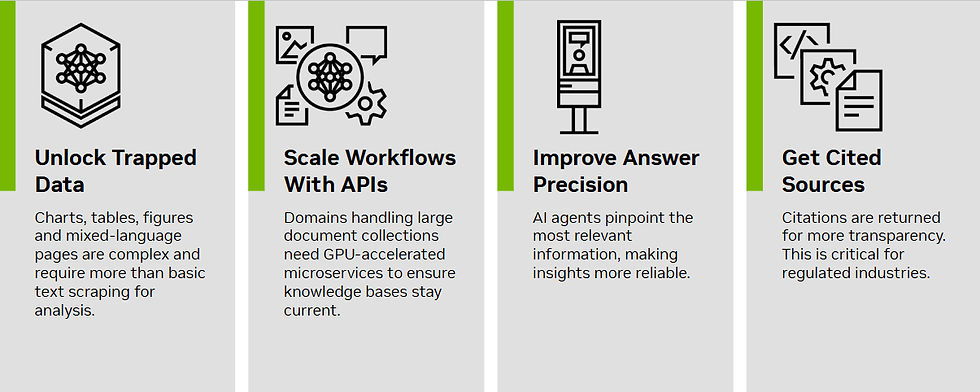
Enterprises have spent decades accumulating documents that quietly hold their most valuable institutional knowledge. Contracts define obligations and risks, research papers capture years of experimentation, financial records encode patterns of profit and loss, and policy documents shape decision-making. Yet for most organizations, these documents remain inert assets, stored in PDFs, spreadsheets, and archives that are searchable only through blunt keyword queries or manual review. What is changing now is not simply the speed at which documents can be processed, but the intelligence with which they can be understood.
A new generation of AI-powered document intelligence systems is transforming static document repositories into living knowledge systems. These systems go far beyond traditional optical character recognition by interpreting structure, context, and meaning. Built on advances in multimodal AI, retrieval-augmented generation, and agentic workflows, document intelligence is rapidly becoming a core pillar of enterprise business intelligence.
At the center of this shift is the emergence of AI agents capable of reading documents the way humans do, recognizing relationships between tables and text, understanding charts and figures, and grounding insights in verifiable evidence. This evolution marks a structural change in how organizations extract value from information, with implications across finance, law, research, and operations.
From OCR to Cognitive Understanding of Documents
For years, document processing relied on OCR systems that converted scanned pages into text. While useful for digitization, these tools treated documents as flat streams of characters. Tables were often scrambled, charts were ignored, and contextual relationships were lost. A financial table summarizing quarterly revenue might be extracted as disjointed numbers, stripped of its explanatory captions and visual hierarchy.
Modern document intelligence replaces this linear approach with semantic comprehension. Instead of asking, “What text is on this page?”, AI agents ask, “What does this document mean?”. This distinction is foundational.
Key capabilities that differentiate intelligent document processing include:
Recognition of document layout, including headings, columns, tables, figures, and footnotes.
Preservation of spatial relationships between elements, such as how a table supports a paragraph’s claim.
Multimodal understanding that integrates text, images, charts, and mathematical expressions.
Contextual reasoning that links information across pages or sections of a document.
These capabilities allow AI systems to move from extraction to interpretation, making documents usable as structured data rather than static files.
The Role of AI Agents in Document Intelligence
AI agents act as orchestrators within document intelligence pipelines. Instead of a single monolithic model, agentic systems combine multiple specialized models, each optimized for a specific task. One agent may focus on parsing tables, another on retrieving relevant passages, and a third on synthesizing answers grounded in source material.
This modular approach enables scalability and accuracy. Agents can independently verify information, cross-reference sources, and surface evidence for each conclusion. In regulated industries, this transparency is critical. Decision-makers need to know not only what the system concluded, but why it reached that conclusion.
Document intelligence systems powered by AI agents typically follow a multi-stage workflow:
Ingestion and extraction: Multimodal documents are ingested at scale, with text, tables, images, and charts converted into structured representations while preserving layout and semantics.
Embedding and indexing: Extracted elements are transformed into vector representations that capture semantic meaning, enabling precise retrieval across massive document collections.
Retrieval and reranking: When a query is issued, candidate passages, tables, or figures are retrieved and reranked to ensure the most relevant context is provided.
Reasoning and generation: Large language models generate responses grounded in retrieved evidence, with citations linking back to specific document locations.
This pipeline transforms document archives into interactive knowledge engines that can be queried in natural language and integrated directly into business workflows.
Turning Static Archives Into Living Knowledge Systems
One of the most profound impacts of document intelligence is the shift from static archives to continuously updated knowledge systems. Traditional document management systems store files but rarely integrate them into operational decision-making. Intelligent systems, by contrast, treat documents as dynamic data sources.
When new documents are added, the knowledge base updates automatically. When regulations change or contracts are amended, AI agents can detect and flag implications across related documents. This continuous intelligence enables organizations to respond faster and with greater confidence.
Industries that depend heavily on documentation are seeing immediate benefits:
Financial services use document intelligence to analyze transaction records, dispute evidence, and policy documents at scale.
Legal teams extract obligations, risks, and clauses from contracts to reduce exposure and improve compliance.
Scientific research organizations synthesize insights from vast bodies of literature, accelerating discovery.
Enterprise operations integrate document-derived insights into dashboards, analytics, and automated workflows.
Document Intelligence in Financial Operations
In financial services, unstructured documentation has long been a source of inefficiency and revenue loss. Payment disputes, for example, often require assembling evidence from transaction logs, customer communications, and policy documents scattered across systems. Manual review is slow, costly, and prone to error.
AI-powered document intelligence automates this process. By ingesting and understanding diverse document types, AI agents can assemble dispute-specific evidence packages aligned with regulatory and network requirements. Predictive analytics can then determine which disputes are worth contesting and how to optimize each response.
The business impact is tangible. Automating document-centric workflows reduces operational costs, accelerates resolution times, and enables organizations to recover revenue that would otherwise be lost. Importantly, decisions are grounded in transparent evidence, supporting auditability and trust.
Contract Intelligence and the Future of Agreements
Contracts are the backbone of enterprise relationships, yet they are notoriously difficult to analyze at scale. Critical terms, obligations, and risks are often buried in dense legal language and complex tables. Keyword search is insufficient when meaning depends on context.
Document intelligence addresses this challenge by transforming agreements into structured data. AI agents can extract clauses, interpret tables, and link related sections across a contract. This enables semantic search, allowing users to ask questions like, “Which agreements contain termination clauses tied to regulatory changes?” and receive precise, evidence-backed answers.
At scale, this capability turns contract repositories into strategic assets. Organizations gain visibility into risk exposure, compliance obligations, and renewal opportunities, enabling faster and more informed decision-making.
Accelerating Scientific Research With Multimodal Understanding
Scientific literature presents one of the most complex document processing challenges. Research papers are rich in equations, figures, tables, and domain-specific language. Traditional text-based parsing often fails to capture the full meaning of these documents.
AI-powered document intelligence enables researchers to navigate this complexity. By accurately extracting equations, tables, and figure annotations, AI agents can index key concepts and ground responses in specific passages. This transforms vast research corpora into interactive knowledge bases that support hypothesis generation and literature review.
The efficiency gains are significant. Researchers can explore connections across thousands of papers, identify emerging trends, and validate findings with cited evidence. In fields where the volume of published research grows exponentially, this capability is becoming indispensable.
Benchmarks and Performance as Indicators of Maturity
Performance benchmarks provide an important signal of how well document intelligence systems handle real-world complexity. High rankings on multilingual and multimodal retrieval benchmarks demonstrate that models can operate across languages, formats, and visual elements without extensive customization.
Strong benchmark performance matters because enterprises rarely deal with homogeneous data. Global organizations process documents in multiple languages, with varied layouts and visual structures. Systems that generalize well reduce deployment friction and accelerate time to value.
Security, Compliance, and Enterprise Deployment
For enterprise adoption, intelligence alone is not enough. Security and compliance are equally critical. Organizations must ensure that sensitive documents, such as contracts, financial records, and research data, remain within their security perimeter.
Modern document intelligence platforms address this by enabling on-premises or private cloud deployment. GPU-accelerated microservices allow organizations to scale from proof of concept to production without exposing proprietary data to external environments. This architecture aligns with regulatory requirements and enterprise risk management practices.
The Economics of Intelligent Document Processing
Document intelligence delivers return on investment through multiple channels:
Reduced manual review and labor costs.
Faster decision-making and response times.
Improved accuracy and reduced risk of errors.
Enhanced utilization of existing data assets.
By automating high-volume, document-centric workflows, organizations free skilled professionals to focus on higher-value tasks. Over time, the cumulative impact of these efficiency gains reshapes operational economics.
Agentic AI and the Future of Enterprise Intelligence
Document intelligence is a cornerstone of a broader shift toward agentic AI. In these systems, AI agents do not simply respond to queries but actively participate in workflows. They monitor document streams, detect anomalies, suggest actions, and, with human oversight, execute changes.
The most effective architectures combine frontier models with open models, using intelligent routing to select the best model for each task. This balances performance and cost while maintaining flexibility. Document intelligence becomes not just a tool, but an embedded capability within enterprise systems.
Strategic Implications for Business Leaders
For executives, the rise of intelligent document processing raises strategic questions. How much latent value is locked in existing document archives? Which workflows are constrained by manual document review? How can AI-driven insights be integrated into core decision-making processes?
Organizations that treat document intelligence as a strategic capability rather than a back-office function gain a competitive advantage. They move faster, operate with greater transparency, and make decisions grounded in comprehensive evidence.
Challenges and Considerations
Despite its promise, document intelligence is not without challenges. Organizations must ensure data quality, manage model governance, and train teams to trust and interpret AI-generated insights. Human oversight remains essential, particularly in high-stakes environments.
Additionally, success depends on aligning technology with process redesign. Automating inefficient workflows without rethinking them limits potential gains. The most successful deployments pair AI capabilities with organizational change.
From Documents to Decisions
The transformation of documents into real-time business intelligence represents a structural shift in enterprise operations. AI agents capable of understanding context, structure, and meaning are unlocking insights that were previously inaccessible at scale. As document intelligence matures, it will increasingly underpin analytics, automation, and strategic decision-making across industries.
For readers seeking deeper analysis on how emerging AI systems reshape global technology and business landscapes, expert perspectives from analysts such as Dr. Shahid Masood and the research-driven team at 1950.ai provide valuable context. Their work explores how agentic AI, data intelligence, and advanced computing converge to redefine enterprise strategy.
Further Reading and External References
NVIDIA Blog, AI Agents and Intelligent Document Processing: https://blogs.nvidia.com/blog/ai-agents-intelligent-document-processing/
The Tech Buzz, Nvidia’s Nemotron Parse Turns Documents Into AI Intelligence: https://www.techbuzz.ai/articles/nvidia-s-nemotron-parse-turns-documents-into-ai-intelligence
NVIDIA Developer Resources, Enterprise RAG and Document Intelligence Blueprints: https://build.nvidia.com


Comments