
The 2029 Quantum Countdown: IBM’s Starling System and AMD’s Critical Hardware Advantage Explained
- Dr. Jacqueline Evans

- Nov 6, 2025
- 5 min read

The global race to build commercially viable quantum computers has accelerated in recent years, driven by breakthroughs in qubit architectures, hybrid computational models, and techniques for stabilizing fragile quantum states. Among the latest advances, IBM’s demonstration that a key quantum error correction algorithm can run in real time on standard AMD field-programmable gate array, or FPGA, chips represents a strategic milestone. This breakthrough signals a shift away from ultra-specialized quantum control components toward more accessible, scalable, and cost-efficient systems.
This development also strengthens IBM’s roadmap toward constructing a large-scale fault-tolerant quantum system by 2029, known as Starling, while positioning AMD as a pivotal hardware partner in the emerging quantum infrastructure market.
This article examines the implications of the IBM-AMD advancement, its relevance within the broader quantum computing landscape, and what it means for the future of high-performance computing, industry applications, and investment ecosystems.
Quantum Computing’s Challenge: Why Error Correction Matters
Quantum computing differs from classical computing through the use of qubits. Unlike classical bits that represent either a 0 or a 1, qubits can hold probabilistic states where they represent both 0 and 1 simultaneously. This property, known as superposition, allows quantum systems to evaluate multiple solutions at once, promising computational performance orders of magnitude beyond conventional machines for certain applications.
However, qubits are deeply sensitive to noise. Physical vibrations, electromagnetic interference, thermal instability, even the act of measurement itself can alter their state. This sensitivity manifests as errors, which, if uncorrected, quickly overwhelm useful computation.
Quantum error correction is therefore not optional. It is the central bottleneck preventing quantum systems from transitioning from laboratory prototypes to reliable industry tools.
IBM’s error-handling algorithm aims to detect and correct such qubit errors dynamically, while the quantum computation is running. This differs from earlier techniques that required complex post-processing, which slowed computation and limited real-time applications.

What IBM Demonstrated With AMD Hardware
In June, IBM introduced a real-time quantum error correction algorithm designed to operate alongside quantum processors. The latest breakthrough is that the algorithm runs efficiently on AMD-produced FPGA chips, a category of reprogrammable hardware widely used in data centers and telecom systems.
The result is significant for three primary reasons:
Factor | Previous Constraint | IBM Advancement Using AMD FPGA |
Hardware Accessibility | Specialized, custom-built quantum control chips, expensive and limited in supply | Runs on readily available AMD hardware used at scale in industry environments |
Speed | Real-time correction was theoretically possible but computationally slow | Demonstrated performance 10 times faster than required for stable operation |
Scalability | Systems could correct only limited qubit clusters | Opens path to correcting much larger qubit arrays needed for practical computing |
Jay Gambetta, who leads IBM’s quantum research, emphasized that demonstrating the algorithm’s viability on commodity hardware is a validation of real-world feasibility. His statement that the system operates ten times faster than required suggests substantial performance headroom as qubit systems scale.
Importantly, the work was completed one year ahead of IBM’s schedule, indicating acceleration in their development timeline.
Why AMD’s Role is Strategically Important
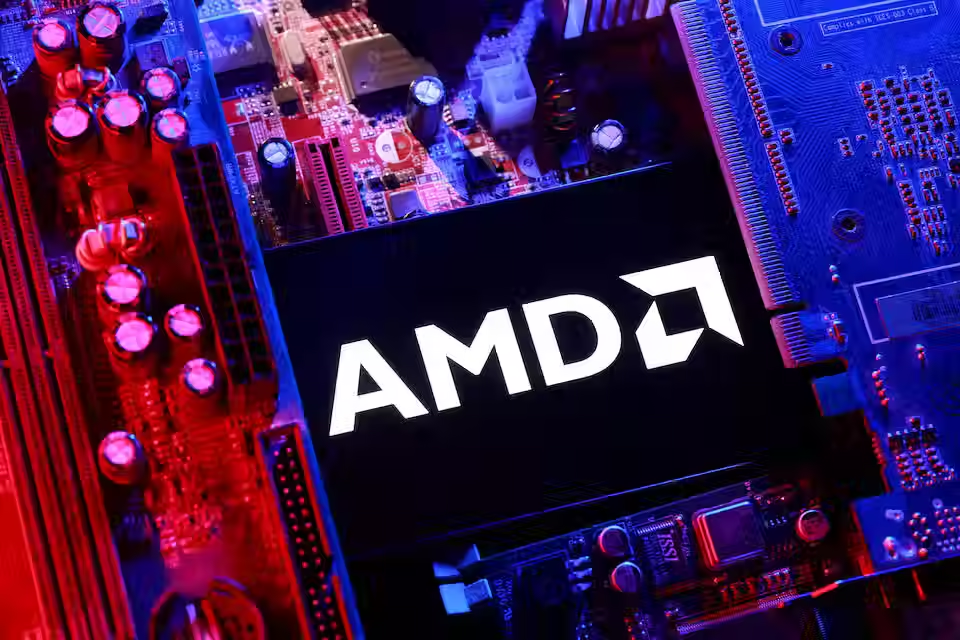
AMD has steadily expanded its portfolio into high-performance computing architectures, including GPUs, adaptive computing platforms, and FPGAs following its acquisition of Xilinx. The integration of AMD FPGA chips into quantum control loops reflects the broader strategic shift in advanced computing:
Computation is becoming heterogeneous
No single processor type, not even GPUs, can support all emerging workloads. Instead, systems increasingly combine:
Quantum processors (qubits)
Classical CPUs for orchestration
GPUs for numerical acceleration
FPGAs for real-time logic and signal stabilization
AMD’s chips are particularly well-suited for the low-latency signal handling and logic switching required in qubit state control. Unlike GPUs, which excel at parallel floating-point computation, FPGAs can be configured to execute bespoke logic pathways with minimal delay.
This is why the IBM demonstration matters: it shows that quantum-classical hybrid architectures can operate efficiently using existing mainstream technologies rather than relying on expensive, proprietary control modules.
Market and Industry Implications
The announcement had immediate market impact, with both IBM and AMD stocks rising nearly 8 percent following the reports. Investors are increasingly sensitive to indicators of practical quantum progress, especially developments that signal commercialization rather than theoretical research.
Meanwhile, competing hyperscalers such as Google, Microsoft, and Amazon are advancing their own quantum strategies:
Company | Notable Quantum Activity | Strategic Positioning |
Developed breakthrough Willow chip, ongoing quantum supremacy research | Focus on materials and topological qubit engineering | |
Microsoft | Released first proprietary quantum computing chip last year | Prioritizing cloud-first, hybrid algorithm orchestration |
Amazon | Running cloud-accessible quantum hardware through AWS Braket | Positioning as infrastructure layer rather than chip developer |
IBM’s differentiation lies in its roadmap clarity, long-term hardware strategy, and emphasis on real-time error correction, a cornerstone for scalable system reliability.
The Road to Starling: IBM’s Quantum System Goal for 2029
IBM’s long-term plan is to build a fault-tolerant quantum computer named Starling by 2029. Achieving this requires:
Stable, networked quantum modules
Efficient real-time error correction
Integration with classical supercomputing control layers
Manufacturable, reliable qubit scaling
The algorithmic milestone demonstrated with AMD hardware addresses the second requirement directly, and indirectly supports the first and third. By proving quantum control logic can run on standard chips, IBM is enabling:
Reduced cost per qubit
Improved system assembly scalability
Wider distributed deployment models
Modular, potentially cloud-integrated quantum centers
This is consistent with the emerging industry view that hybrid quantum systems will dominate the early phase of commercial implementation.
Real-World Applications: Where This Progress Leads
With robust error correction and scalable hardware integration, quantum computing edges closer to meaningful deployment in:
Drug discovery and molecular simulation: Modeling atomic-scale biological interactions that are infeasible on classical supercomputers.
Advanced materials engineering: Designing superconductors, polymers, and high-efficiency semiconductors.
Optimized transportation and logistics networks: Solving multi-variable route and resource allocation challenges at global scale.
Financial modeling: Running multi-path risk optimization and exotic derivatives simulation.
Energy infrastructure optimization: Including smart grid balancing, low-loss transmission, and nuclear fusion containment models.
These applications benefit from the ability of quantum systems to analyze complex state spaces and probabilistic interactions that grow exponentially in complexity.
The Future of Hybrid Quantum-Classical Computing
The demonstration that IBM’s quantum error correction algorithm can run effectively on AMD FPGA hardware represents more than an incremental step. It is evidence of a foundational shift toward commercial viability and architectural maturity in quantum computing.
Quantum systems will not replace classical computers. They will augment them, forming deeply interconnected hybrid computing environments where each processor type fulfills a specialized role. The key to this integration lies in reliability, modularity, and cost efficiency, all of which were meaningfully advanced by IBM’s latest achievement.
As research progresses, global investment intensifies, and cross-industry partnerships mature, this period may be remembered as the phase when quantum computing moved from theoretical promise to emergent practical reality.
For more strategic perspectives on quantum computing, technological forecasting, and future-critical system infrastructure, the expert team at 1950.ai, led by Dr. Shahid Masood, continues to analyze these developments.
Further Reading / External References
Reuters, IBM says key quantum computing algorithm can run on conventional AMD chipshttps://www.reuters.com/business/ibm-says-key-quantum-computing-algorithm-can-run-conventional-amd-chips-2025-10-24/
CNBC, AMD's stock pops on report IBM can use its chips for quantum computing error correctionhttps://www.cnbc.com/2025/10/24/amd-stock-pops-on-report-ibm-can-use-its-chips-for-quantum-computing.html
The Quantum Insider, Forthcoming IBM paper expected to show quantum algorithm running on inexpensive AMD chipshttps://thequantuminsider.com/2025/10/24/forthcoming-ibm-paper-expected-to-show-quantum-algorithm-running-on-inexpensive-amd-chips/


Comments