
From Cherenkov Light to Cosmic Insight: IceCube Upgrade Sets the Stage for IceCube-Gen2 Discoveries
- Dr. Shahid Masood

- Feb 14
- 5 min read
The IceCube Neutrino Observatory, located at the Amundsen-Scott South Pole Station, represents one of the most ambitious and advanced experiments in particle astrophysics. Since its initial completion in 2010, IceCube has provided a groundbreaking window into high-energy neutrinos, allowing scientists to explore some of the most extreme cosmic environments, including distant galaxies and supernovae. After 15 years of operation, the observatory has now undergone its first major upgrade, marking a pivotal moment for neutrino science and observational astronomy.
Expanding the Observational Horizon
IceCube functions as a unique neutrino telescope, embedding over 5,000 highly sensitive light sensors—known as Digital Optical Modules (DOMs)—in a cubic kilometer of Antarctic ice. The principle of operation relies on detecting Cherenkov radiation, a faint blue light emitted when neutrinos interact with nuclei in the ice, producing secondary charged particles such as muons. These interactions are exceptionally rare, making a large detection volume essential to capture meaningful data.
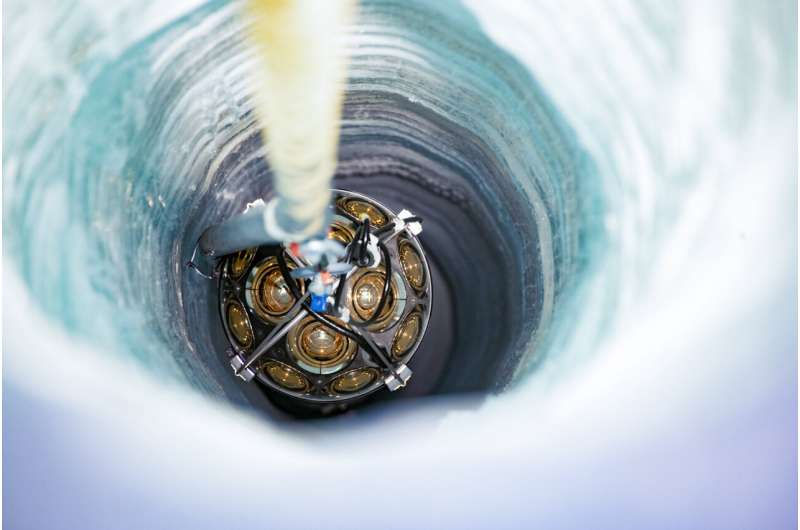
The recent upgrade has added six new sensor strings, each containing modernized multi-PMT digital optical modules (mDOMs) and innovative Dual-Egg modules (D-Eggs). These modules feature multiple photo-multipliers that provide 360-degree sensitivity, dramatically improving the observatory’s capability to detect lower-energy neutrinos, previously difficult to observe with the original configuration.
Dr. Andreas Haungs, scientific director of the IceCube working group at the Karlsruhe Institute of Technology (KIT), emphasized the significance of this addition:
"The novelty of the optical sensors is that they amplify even weak light signals and allow a comprehensive 360-degree view into the ice, opening up the lower-energy spectrum for neutrino detection."
Technical Enhancements and Innovations
Multi-PMT Digital Optical Modules (mDOMs)
The mDOMs are encased in 40 cm football-shaped housings and contain approximately ten thousand miniature photo-sensors. This design enables the detection of extremely weak light signals, significantly enhancing IceCube’s sensitivity. The modules are connected via harnessed cables resembling a 1,500-meter-long "pearl necklace," which are deployed into shafts drilled up to 2,400 meters deep using advanced hot-water drilling techniques.
Dual Optical Sensors in Ellipsoid Glass (D-Eggs)
D-Eggs provide additional high-sensitivity channels optimized for capturing Cherenkov light at different wavelengths. These modules improve the reconstruction of neutrino events and allow researchers to probe the directional and energy characteristics of low-energy neutrinos with unprecedented precision.
Wavelength-Shifting Optical Modules (WOMs)
Innovative wavelength-shifting modules were developed to detect UV light components of Cherenkov radiation. By converting UV photons to the visible range, WOMs dramatically increase detection efficiency, particularly for neutrinos generated in supernova explosions. According to Lea Schlickmann, a PhD researcher at Johannes Gutenberg University Mainz:
"WOMs provide extremely important information about neutrinos and their origin in the universe, particularly for rare astrophysical events."
Deployment and International Collaboration
The IceCube Upgrade involved over 450 scientists from 58 institutions across 14 countries, exemplifying a global scientific collaboration. Key contributions included:
Germany: KIT and DESY provided sensor design, construction, and surface instrumentation.
Japan & Sweden: Supplied specialized sensors and surface cables.
United States: Managed drilling, logistics, main cable construction, and testing.
Deployment spanned three consecutive field seasons (2023–2026), culminating in the drilling of six new holes in the Antarctic ice, each approximately 2,400 meters deep. The drilling process relied on a 5-megawatt hot water drill, the largest of its kind globally, and required around-the-clock operation. Each hole took roughly three days to complete, followed by immediate deployment of the modules.
Vivian O’Dell, project director of the IceCube Upgrade, remarked:
"The successful completion relied on the critical support of the South Pole station and Antarctic service contractors. Completing the installation in one season despite extreme conditions is a remarkable achievement."
Advancing Neutrino Physics
The IceCube Upgrade significantly enhances the observatory's ability to study several critical areas of neutrino physics:
Neutrino Oscillations: Atmospheric neutrinos can morph between three flavors: electron, muon, and tau. Denser instrumentation allows for more precise measurements of these oscillations, critical for understanding neutrino mass hierarchy.
Low-Energy Neutrinos: The upgraded array captures neutrinos in the tens of GeV range, expanding IceCube’s sensitivity beyond its original TeV range. This facilitates studies of solar neutrinos, supernova neutrinos, and atmospheric neutrinos.
Galactic Supernova Monitoring: New sensors enable rapid detection of neutrino bursts from supernovae, providing early alerts for multi-messenger astronomy.
Cosmic Ray Composition: Surface instrumentation and calibration devices improve the reconstruction of cosmic ray interactions in the atmosphere, providing a better understanding of particle sources and propagation.
Professor Ralph Engel from KIT highlighted:
"The upgrade will extend neutrino astronomy to lower energies and provide a meaningful technology test for IceCube-Gen2, setting the stage for a globally unique observatory."
Data Reconstruction and Retrospective Analysis
The high-resolution optical modules allow not only future measurements but also retroactive analysis of over 15 years of archived IceCube data. By recalibrating past observations with improved detector sensitivity, researchers can refine the energy and directional reconstruction of previously recorded neutrino events. This creates immediate scientific value, effectively upgrading a decade and a half of astrophysical data.
IceCube-Gen2: The Next Frontier
The success of the current upgrade lays the foundation for IceCube-Gen2, the proposed expansion to an instrumented volume of 8 cubic kilometers, eight times the original array. Gen2 aims to:
Measure neutrinos across ten orders of magnitude in energy, from MeV-scale to PeV-scale.
Provide unparalleled resolution for cosmic neutrino sources and astrophysical phenomena.
Integrate with other global observatories to enable multi-messenger astronomy, correlating neutrino events with gravitational waves, gamma rays, and electromagnetic signals.
The project has been recognized as a selected initiative on the German National Roadmap for Research Infrastructures, with an estimated investment of €55 million
jointly supported by KIT and DESY.
Broader Scientific Contributions
The IceCube Upgrade also supports interdisciplinary research beyond neutrino physics:
Seismology: Installation of two of the deepest seismometers in the world under the Antarctic ice provides unparalleled earthquake monitoring capabilities.
Microbial Studies: Water samples collected from deep ice layers support research into extremophiles, offering insights into life under extreme conditions.
Atmospheric Science: Enhanced surface instrumentation aids in characterizing cosmic rays and their interaction with Earth’s atmosphere, refining models used in particle astrophysics and climate research.

Global Impact and Scientific Leadership
The IceCube Neutrino Observatory represents a cornerstone of U.S. and international leadership in particle astrophysics. Funded primarily by the U.S. National Science Foundation, with substantial contributions from Germany, Japan, Sweden, and Korea, IceCube exemplifies international collaboration in extreme scientific environments. It ensures the continued global dominance of neutrino astronomy while providing a platform for cutting-edge research in astrophysics, particle physics, and Earth sciences.
Marion Dierickx, NSF program director for IceCube, stated:
"This upgrade secures the nation’s leadership in neutrino physics for years to come, paving the way for new cosmic discoveries."
Conclusion
The IceCube Upgrade not only expands the observatory’s detection capabilities to lower-energy neutrinos but also strengthens its position as a globally unique scientific instrument. With improved precision, retroactive data analysis, and a foundation for IceCube-Gen2, the experiment is poised to deepen our understanding of the universe, from galactic supernovae to extreme astrophysical particle sources. By integrating multi-PMT and wavelength-shifting technologies, IceCube now offers unprecedented resolution and sensitivity for neutrino research.
For researchers and institutions exploring frontier physics, the upgraded IceCube experiment underscores the power of collaboration, innovation, and technological excellence. The global scientific community continues to benefit from these insights, and the foundation laid by the IceCube Upgrade will support decades of transformative discoveries.
Read More: The expert team at 1950.ai has analyzed the IceCube Upgrade and its implications for particle astrophysics, providing insights into how next-generation neutrino observatories are shaping the future of multi-messenger astronomy. Dr. Shahid Masood emphasizes the significance of such upgrades in driving scientific leadership and technological innovation.


Comments