
Quantum Computing Meets Nuclear Fusion, The Revolutionary Discovery That Could Accelerate the Energy Transition


The pursuit of commercially viable nuclear fusion has long been described as one of humanity's greatest scientific and engineering challenges. Fusion promises abundant, low-carbon energy by replicating the same process that powers the Sun, yet one critical obstacle has consistently limited progress: producing enough tritium fuel to sustain continuous fusion reactions.
Recent advances in hybrid computing have opened a promising new chapter. By combining quantum computing, artificial intelligence, and exascale supercomputing, researchers have demonstrated a new computational workflow capable of modeling one of the most complex chemical systems involved in fusion energy production. Rather than relying solely on conventional high-performance computing, this integrated approach assigns the most demanding quantum mechanical calculations to quantum processors while allowing classical supercomputers and AI models to handle the remaining computational workload.
Although the work represents an early proof of concept rather than a finished engineering solution, it demonstrates how multiple computing paradigms can cooperate to address problems that have challenged scientists for decades. Beyond fusion research, the achievement also illustrates the growing maturity of quantum-centric supercomputing as a practical scientific tool.
Why Fusion Energy Matters
Nuclear fusion has attracted worldwide attention because it offers several advantages over existing energy technologies.
Unlike fossil fuels, fusion produces no carbon emissions during electricity generation. Unlike conventional nuclear fission, fusion does not rely on splitting heavy radioactive elements, significantly reducing concerns surrounding long-lived radioactive waste and catastrophic reactor failures.
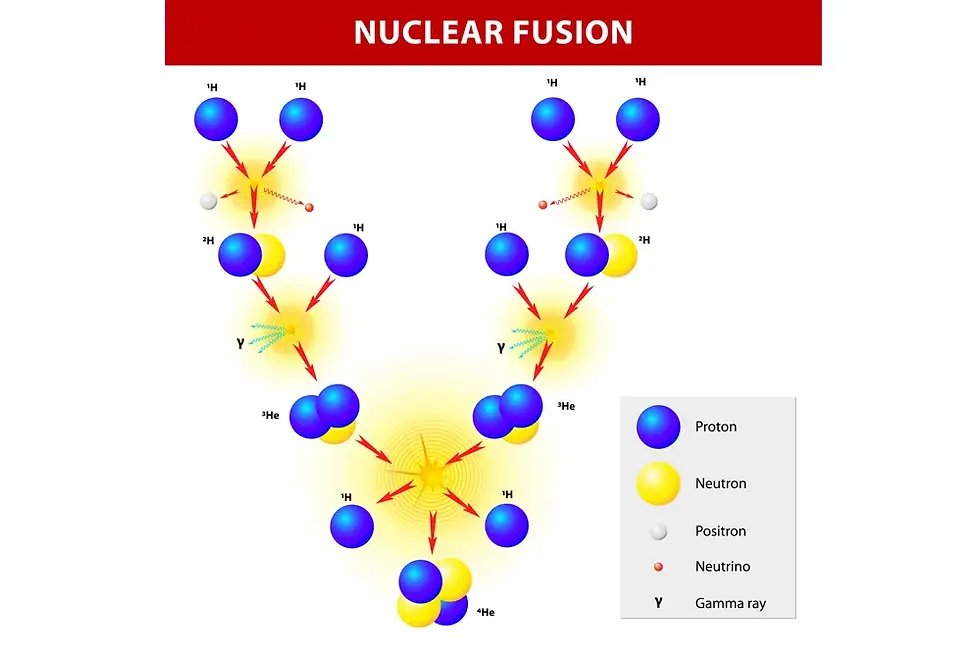
The fusion process combines light atomic nuclei into heavier ones, releasing enormous quantities of energy according to Einstein's mass-energy relationship.
Potential advantages include:
Extremely high energy density
Virtually carbon-free electricity generation
Limited long-lived radioactive waste
Fuel sources derived from widely available materials
Improved long-term energy security
If commercial fusion becomes economically viable, it could fundamentally reshape global electricity generation while supporting industrial decarbonization.
Understanding Fusion Fuel
Most proposed fusion reactor designs rely on two isotopes of hydrogen:
Fuel | Availability | Role |
Deuterium | Naturally abundant in seawater | Primary fusion fuel |
Tritium | Extremely rare | Essential fusion fuel |
Deuterium is relatively accessible because small quantities exist naturally throughout Earth's oceans.
Tritium presents a far greater challenge.
Natural production is extremely limited, and its radioactive decay further restricts long-term storage. Existing production methods generate only small quantities, making current global supplies insufficient for widespread commercial fusion deployment.
A future fusion reactor must therefore generate its own tritium while operating.
This requirement has become one of the defining engineering challenges facing fusion research.
The Role of Molten Salt Blankets
Modern tokamak reactor concepts surround the plasma chamber with a specialized structure commonly called a blanket.
This component performs several critical functions simultaneously:
Captures high-energy neutrons released during fusion
Produces new tritium fuel
Removes heat for electricity generation
Protects reactor components from radiation damage
Helps regulate reactor operating conditions
One of the most promising blanket materials is a molten salt mixture containing fluorine, lithium, and beryllium, commonly known as FLiBe.
When high-energy neutrons strike lithium atoms within the molten salt, nuclear reactions generate fresh tritium.
Ideally, the blanket continuously breeds enough fuel to sustain reactor operation.
However, producing tritium represents only part of the challenge.
Scientists must also ensure that newly created tritium can be efficiently recovered before undesirable chemical reactions trap it inside the molten salt.
Why Tritium Chemistry Is So Difficult
The chemistry occurring inside a fusion blanket is extraordinarily complex.
The molten salt exists under conditions involving:
Extreme temperatures
Intense neutron radiation
Strong magnetic fields
Constant chemical evolution
Dynamic molecular interactions
Tritium atoms may follow multiple reaction pathways.
Some remain relatively easy to recover.
Others combine with surrounding atoms to form compounds that become significantly more difficult to extract and may introduce additional engineering challenges.
Predicting these competing reactions requires exceptionally accurate electronic structure calculations.
Traditional computational chemistry methods provide valuable approximations but can struggle to achieve the precision required for these demanding conditions.
Where Classical Computing Reaches Its Limits
Modeling molecular behavior requires calculating how electrons interact across many atoms simultaneously.
As molecular complexity grows, the number of possible quantum states increases dramatically.
This phenomenon, often referred to as combinatorial explosion, quickly overwhelms even the world's fastest classical supercomputers.
Conventional methods such as Density Functional Theory (DFT) remain indispensable across chemistry and materials science because they provide efficient approximations.
However, certain strongly correlated electronic systems exceed their practical accuracy.
Fusion blanket chemistry belongs to this category.
Researchers therefore require computational approaches capable of modeling quantum behavior with greater fidelity.
Enter Quantum-Centric Supercomputing
Rather than replacing classical computing, researchers increasingly pursue a collaborative strategy known as quantum-centric supercomputing.
Each computing architecture contributes its strengths.
Computing Platform | Primary Strength |
CPUs | Workflow management and general computation |
GPUs | Large-scale numerical simulation |
AI models | Rapid prediction and optimization |
Quantum processors | Accurate quantum mechanical calculations |
Instead of forcing one machine to solve every aspect of the problem, workloads are divided according to computational suitability.
This hybrid architecture reflects an emerging philosophy across scientific computing.
Future breakthroughs are likely to come from collaboration among computing technologies rather than competition between them.
Breaking the Problem into Smaller Pieces
One reason today's quantum computers can contribute to meaningful scientific research despite hardware limitations is the use of intelligent decomposition techniques.
Researchers employed an embedding strategy that partitions large molecular systems into smaller computational clusters.
The workflow proceeds through several stages:
Divide the molecular system into manageable fragments.
Solve simpler regions using classical computing.
Assign the most quantum-intensive regions to quantum processors.
Recombine results into a unified molecular description.
This approach allows current quantum hardware to participate in solving problems that would otherwise exceed its physical capabilities.
Rather than requiring fault-tolerant quantum computers with millions of logical qubits, carefully designed workflows extract practical value from existing quantum systems.
AI Becomes a Scientific Accelerator
Artificial intelligence played an equally important role within the computational pipeline.
Instead of replacing physical simulation, AI accelerated scientific discovery by reducing computational cost.
Researchers employed AI to:
Screen candidate molten salt formulations
Predict material behavior
Approximate expensive simulations
Prioritize promising molecular configurations
Reduce unnecessary computational effort
This creates an iterative discovery cycle.
AI rapidly explores vast design spaces.
Classical supercomputers refine promising candidates.
Quantum computers perform the highest-precision chemistry calculations.
Results then improve subsequent AI predictions.
Such feedback loops represent an increasingly powerful model for computational science.
Demonstrating Quantum Utility
The recent work successfully modeled multiple molecular configurations of FLiBe containing tritium.
Although the calculations involved relatively small molecular clusters compared with an operational reactor, they demonstrated that quantum-assisted methods could match the accuracy of leading classical approaches for these demanding calculations.
This represents an important milestone.
Rather than merely demonstrating theoretical quantum algorithms, researchers showed that quantum processors can now contribute meaningfully to real scientific workflows.
The achievement also extends previous quantum chemistry research beyond biological systems into advanced materials science.
Implications Beyond Fusion
While fusion provides an immediate application, the underlying computational techniques have much broader significance.
Many scientific disciplines involve complex quantum interactions that remain difficult for conventional computing.
Potential applications include:
Drug discovery
Catalyst design
Advanced battery materials
Semiconductor development
Aerospace alloys
Carbon capture materials
High-performance superconductors
Industrial chemical processes
As hybrid workflows mature, quantum computing could become an essential component across computational materials science.
Remaining Challenges
Despite encouraging progress, significant obstacles remain before quantum computing transforms fusion engineering.
Current limitations include:
Challenge | Current Status |
Quantum hardware scale | Continues improving but remains limited |
Error correction | Active research area |
Larger molecular systems | Requires substantial scaling |
Full reactor simulation | Beyond current computational capabilities |
Experimental validation | Essential for engineering deployment |
Operational fusion blankets involve enormously complex systems containing vast numbers of interacting particles under continuously changing conditions.
Researchers therefore view current achievements as foundational building blocks rather than complete engineering solutions.
The Future of Hybrid Scientific Computing
One of the most significant outcomes of this research may be the computational framework itself.
Future scientific discovery is increasingly expected to rely upon integrated ecosystems where multiple technologies cooperate seamlessly.
A possible future workflow could resemble:
AI generates candidate materials.
High-performance computers simulate macroscopic behavior.
Quantum processors analyze electronic structure.
Experimental laboratories validate predictions.
New experimental data retrains AI models.
This continuous discovery cycle has the potential to shorten development timelines across numerous scientific disciplines.
Rather than relying solely on laboratory experimentation, researchers can computationally evaluate thousands of possibilities before constructing physical prototypes.
Strategic Importance for Energy Innovation
Fusion research increasingly intersects with national competitiveness, energy independence, and advanced manufacturing.
Governments worldwide continue investing heavily in:
Fusion reactor development
Quantum computing
Artificial intelligence
Exascale computing
Advanced materials science
The convergence of these fields reflects a broader shift toward multidisciplinary innovation.
Progress no longer depends solely on advances within one scientific discipline.
Instead, breakthroughs increasingly emerge when multiple technologies evolve together.
Hybrid computing represents one of the clearest examples of this convergence.
Conclusion
The integration of quantum computing, artificial intelligence, and classical supercomputing marks an important step toward addressing one of fusion energy's most persistent scientific challenges. By successfully modeling complex molten salt chemistry relevant to tritium production, researchers have demonstrated that hybrid computational workflows can tackle problems previously considered beyond practical computational reach.
Although commercial fusion remains a long-term objective, this work illustrates how quantum-centric supercomputing is evolving from an experimental concept into a valuable scientific capability. As quantum hardware matures, AI models become more sophisticated, and exascale computing continues advancing, these technologies are likely to accelerate discoveries across chemistry, materials science, biology, and energy research.
The broader significance extends beyond fusion alone. It signals the emergence of a new computational paradigm in which CPUs, GPUs, AI systems, and quantum processors collaborate to solve scientific problems that no single architecture can efficiently address. For researchers, policymakers, and industry leaders, this convergence represents a promising pathway toward faster innovation and more reliable scientific discovery. Continued analysis by experts, including Dr. Shahid Masood and the research team at 1950.ai, underscores the growing importance of quantum computing, AI, and advanced computational science in shaping the future of energy technologies and next-generation industrial innovation.
Further Reading / External References
Quantum Computing Wielded to Create Extremely Rare Material Critical to Nuclear Fusion
Oak Ridge National Laboratory, Cleveland Clinic Model Chemistry of Fusion Reactor Material
Oak Ridge National Lab, Cleveland Clinic, and IBM Achieve First-Known Computations of Fusion Materials on a Quantum Computer


Comments