top of page

Google Opens SynthID Detector to Everyone, Transforming How the World Verifies AI-Generated Content

7 minutes ago
7 min read
Artificial intelligence has transformed the economics of digital content creation. Images, videos, audio recordings and other forms of media can now be generated or modified at a speed and scale that would have been difficult to imagine only a few years ago. But as synthetic media becomes increasingly realistic, another challenge is becoming just as important as content generation itself: determining where a piece of media came from and whether AI played a role in creating or editing it.

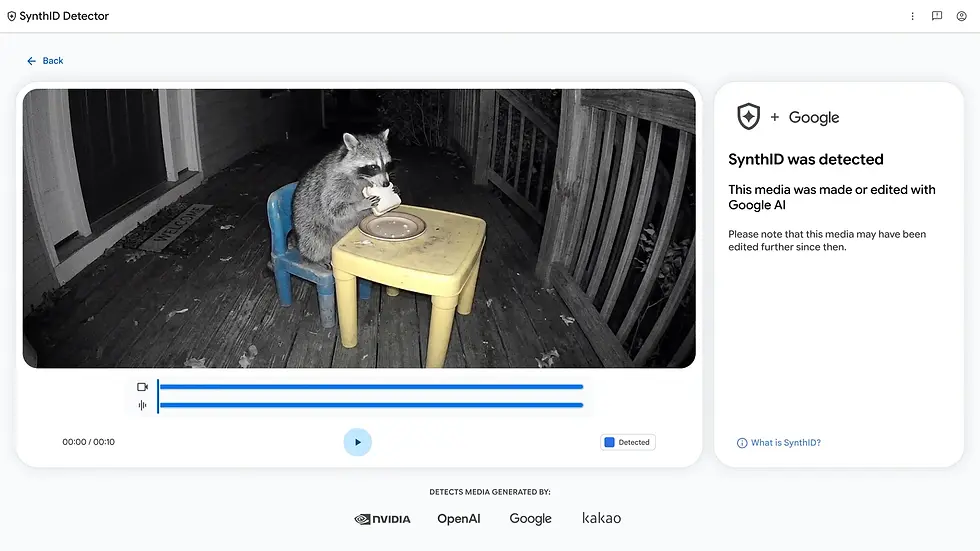
Google is addressing part of that challenge by opening its SynthID Detector to the public. The tool, available globally in English, allows users to upload images, videos and audio files and check whether they contain SynthID, an invisible watermarking technology developed by Google DeepMind.

The development represents an important shift in the digital authenticity debate. Instead of attempting to determine whether content "looks" artificial, watermark detection focuses on identifying a signal embedded during AI generation or editing. That distinction could become increasingly significant as generative AI systems improve.

What Is Google SynthID and Why Does It Matter?

SynthID is Google's system for embedding imperceptible watermarks into AI-generated media. Unlike a visible logo or label, the watermark is designed to remain hidden from ordinary viewers while providing a mechanism for later verification.

Google says SynthID has already been used to watermark more than 180 billion images and videos and approximately 240,000 years of audio content. The scale illustrates the direction in which AI provenance is moving: authenticity information increasingly needs to travel with digital media rather than being reconstructed after publication.

The public detector extends this concept from content producers and professional reviewers to ordinary users. Someone who receives a suspicious image, encounters an unusual video on social media or obtains an audio recording can potentially submit the original file for verification.

This creates a new layer between content creation and consumption. Instead of relying exclusively on visual judgment, reverse-image searches, metadata or third-party AI detection systems, users can look for a machine-readable provenance signal.

How the SynthID Detector Works

The basic process is straightforward. Users upload an image, video or audio file to the SynthID Detector, which examines the media for a compatible SynthID watermark.

The system is designed to recognize content generated or edited by Google AI and participating technology partners. Google identifies OpenAI, NVIDIA and Kakao among companies whose AI tools can contribute SynthID-protected media, with Apple identified as an upcoming participant.

The technology therefore operates differently from a universal AI detector.

A conventional AI detector attempts to infer whether content was generated by artificial intelligence based on characteristics within the content itself. Such systems can analyze statistical patterns, language structures, image artifacts or other signals. SynthID instead looks for a watermark associated with participating systems.

That distinction has major implications.

If a file contains a recognizable SynthID signal, the detector can provide meaningful evidence about its relationship to a participating AI system. If there is no watermark, however, that does not establish that the media was created by a human.

The absence of a SynthID signal can have many explanations. The content may be human-created, it may have been produced by an AI system that does not use SynthID, or the watermark may no longer be detectable after subsequent processing.

AI Watermarking Is Different From AI Detection

The difference between watermarking and AI detection is one of the most important concepts for understanding the new tool.

AI detection generally asks:

Does this content appear to have been generated by AI?

Watermark detection asks:

Does this content contain a recognized provenance signal associated with a participating AI system?

The second question can be more precise when a compatible watermark exists, but it is also narrower.

This makes SynthID potentially valuable for organizations that need to establish provenance rather than make a universal judgment about AI involvement. Publishers, marketing teams, media organizations, researchers and communications departments could use it as one component of a broader verification process.

It also highlights why no single authenticity technology can solve the synthetic media problem.

A watermark can provide evidence about origin, but it does not automatically establish whether a claim attached to a video is true, whether the context has been manipulated, or whether a legitimate AI-generated image is being used deceptively.

Authenticity has multiple dimensions, including origin, integrity, context, authorship and intent.

Why Opening SynthID to Everyone Is Significant

Google previously provided an early version of the detector to journalists, media professionals and researchers through controlled access. Public availability changes the potential scale of adoption.

For newsrooms, the technology can become an additional verification step before publishing questionable material. Social media teams could examine assets before incorporating them into campaigns. Researchers could use watermark information alongside metadata and other provenance signals.

For ordinary users, the larger change is conceptual.

AI-generated media is becoming increasingly difficult to distinguish from conventional photography, video and audio through perception alone. A synthetic image may contain no obvious visual artifact, while AI-generated speech can increasingly resemble a real person's voice.

That means digital literacy may increasingly include provenance literacy.

Users will need to understand not only what a piece of media depicts, but also how it was produced, whether it was subsequently edited and what evidence supports its origin.

The Role of Content Provenance in the AI Era

SynthID fits into a broader movement toward content provenance and authenticity standards.

One important principle in digital provenance is that information about a file's origin should ideally accompany the content throughout its lifecycle. This can include information about the creator, software used, modifications made and other relevant events.

Watermarking approaches such as SynthID provide one mechanism for accomplishing part of this objective.

The advantage of invisible watermarking is that it does not depend on users remembering to preserve a visible label. A watermark can remain embedded while media is shared through different channels, although its resilience depends on the type and severity of subsequent manipulation.

This matters because digital content rarely remains in its original form. Images are compressed, videos are resized, audio is transcoded and files are edited repeatedly before reaching their final audience.

The more robust provenance systems become, the more useful they can be as evidence within a larger verification framework.

Practical Applications for Businesses and Media Organizations

The public availability of SynthID could have immediate practical value across several industries.

News and journalism: Newsrooms can use watermark checks as one step in verifying user-generated or externally supplied media. This is particularly relevant during breaking news events, elections, conflicts and disasters, when manipulated content can spread quickly.

Marketing and advertising: Brand teams can determine whether media supplied by agencies, freelancers or internal teams contains a compatible AI watermark before publication.

Social media management: Organizations handling large volumes of visual material can add provenance checks to their content review workflows.

Education and research: Universities and researchers can use watermark information when studying the growing ecosystem of synthetic media.

Corporate communications: Companies can establish clearer internal procedures for identifying AI-generated promotional assets, presentations and multimedia material.

The greatest value may emerge when watermark verification becomes part of automated content-management pipelines rather than a manual process performed only when something appears suspicious.

The Limitations of SynthID

The technology should not be interpreted as a universal truth machine.

Google's own detector documentation emphasizes that no signal is completely resistant to every form of manipulation. That is an important qualification because digital media can undergo transformations that affect embedded signals.

There is also a fundamental coverage limitation. SynthID can identify compatible watermarks, not every form of AI-generated content on the internet.

Consider two visually identical images. One might be generated by a participating AI system and contain a detectable watermark. The other might be produced by an unrelated model without SynthID. A negative detector result cannot establish that the second image was created by a human.

The same principle applies to AI-edited content. A photograph that originated with a human photographer but was subsequently modified using a compatible AI system may produce a result indicating that Google AI was involved. That provides useful provenance information, but it does not necessarily answer the broader question of who created the original image or what proportion of the final work involved AI.

Consequently, the strongest verification strategy will combine multiple signals rather than depend on one result.

From Watermarks to a Global Authenticity Infrastructure

The deeper significance of SynthID is not the detector itself, but the infrastructure emerging around AI provenance.

Google already incorporates content verification capabilities into products such as Search, Gemini and Chrome. The company says these systems collectively handle more than one million requests each day.

As generative AI becomes embedded into consumer software, professional creative applications and enterprise workflows, provenance could become a standard layer of the digital ecosystem.

Future systems could combine invisible watermarks, cryptographically signed metadata, device-level provenance, content credentials and platform-level verification. Together, these technologies could provide users with a richer history of how media was created and modified.

Such infrastructure will become particularly important for high-impact information. A synthetic entertainment image and a manipulated video presented as evidence of a real-world event have very different consequences, even if both are technically generated by AI.

The challenge is therefore not simply detecting AI. It is building trustworthy systems that help people understand what they are seeing.

The Next Battle Will Be Trust, Not Just Generation

Generative AI has made content creation dramatically easier. The next phase of the industry will increasingly focus on establishing confidence in that content.

Google's decision to make SynthID Detector publicly accessible represents a meaningful step toward that objective. It gives users a practical mechanism for checking whether supported AI systems were involved in creating or editing media, while also demonstrating the limits of watermark-based verification.

The broader lesson is that AI authenticity cannot depend on visual intuition alone. As synthetic media becomes more convincing, provenance technologies will become increasingly important to journalism, commerce, cybersecurity, advertising, research and everyday digital communication.

For technology leaders such as Dr. Shahid Masood and the expert team at 1950.ai, developments such as SynthID illustrate a wider transformation in artificial intelligence. The future of AI will not be defined only by how convincingly machines can generate information, images, voices and video. It will also depend on whether society can build reliable mechanisms for understanding where that content originated and how it changed.

The emerging digital environment will therefore require two parallel capabilities: increasingly powerful AI creation systems and increasingly sophisticated trust infrastructure. SynthID is an important example of the second category, and its public release signals that content provenance is moving from a specialist concern toward a mainstream requirement of the AI era.

Further Reading / External References

We're making it easier to identify AI-generated content globally.

https://blog.google/innovation-and-ai/models-and-research/google-deepmind/synth-id-ai-content/

Google Opens Its SynthID Watermark Detector To The Public

https://www.searchenginejournal.com/google-opens-synthid-watermark-detector-to-public/592226/

Artificial intelligence has transformed the economics of digital content creation. Images, videos, audio recordings and other forms of media can now be generated or modified at a speed and scale that would have been difficult to imagine only a few years ago. But as synthetic media becomes increasingly realistic, another challenge is becoming just as important as content generation itself: determining where a piece of media came from and whether AI played a role in creating or editing it.

Google is addressing part of that challenge by opening its SynthID Detector to the public. The tool, available globally in English, allows users to upload images, videos and audio files and check whether they contain SynthID, an invisible watermarking technology developed by Google DeepMind.

The development represents an important shift in the digital authenticity debate. Instead of attempting to determine whether content "looks" artificial, watermark detection focuses on identifying a signal embedded during AI generation or editing. That distinction could become increasingly significant as generative AI systems improve.


What Is Google SynthID and Why Does It Matter?

SynthID is Google's system for embedding imperceptible watermarks into AI-generated media. Unlike a visible logo or label, the watermark is designed to remain hidden from ordinary viewers while providing a mechanism for later verification.

Google says SynthID has already been used to watermark more than 180 billion images and videos and approximately 240,000 years of audio content. The scale illustrates the direction in which AI provenance is moving: authenticity information increasingly needs to travel with digital media rather than being reconstructed after publication.


The public detector extends this concept from content producers and professional reviewers to ordinary users. Someone who receives a suspicious image, encounters an unusual video on social media or obtains an audio recording can potentially submit the original file for verification.

This creates a new layer between content creation and consumption. Instead of relying exclusively on visual judgment, reverse-image searches, metadata or third-party AI detection systems, users can look for a machine-readable provenance signal.


How the SynthID Detector Works

The basic process is straightforward. Users upload an image, video or audio file to the SynthID Detector, which examines the media for a compatible SynthID watermark.

The system is designed to recognize content generated or edited by Google AI and participating technology partners. Google identifies OpenAI, NVIDIA and Kakao among companies whose AI tools can contribute SynthID-protected media, with Apple identified as an upcoming participant.


The technology therefore operates differently from a universal AI detector.

A conventional AI detector attempts to infer whether content was generated by artificial intelligence based on characteristics within the content itself. Such systems can analyze statistical patterns, language structures, image artifacts or other signals. SynthID instead looks for a watermark associated with participating systems.

That distinction has major implications.

If a file contains a recognizable SynthID signal, the detector can provide meaningful evidence about its relationship to a participating AI system. If there is no watermark, however, that does not establish that the media was created by a human.

The absence of a SynthID signal can have many explanations. The content may be human-created, it may have been produced by an AI system that does not use SynthID, or the watermark may no longer be detectable after subsequent processing.


AI Watermarking Is Different From AI Detection

The difference between watermarking and AI detection is one of the most important concepts for understanding the new tool.

AI detection generally asks:

Does this content appear to have been generated by AI?

Watermark detection asks:

Does this content contain a recognized provenance signal associated with a participating AI system?

The second question can be more precise when a compatible watermark exists, but it is also narrower.

This makes SynthID potentially valuable for organizations that need to establish provenance rather than make a universal judgment about AI involvement. Publishers, marketing teams, media organizations, researchers and communications departments could use it as one component of a broader verification process.

It also highlights why no single authenticity technology can solve the synthetic media problem.

A watermark can provide evidence about origin, but it does not automatically establish whether a claim attached to a video is true, whether the context has been manipulated, or whether a legitimate AI-generated image is being used deceptively.

Authenticity has multiple dimensions, including origin, integrity, context, authorship and intent.


Why Opening SynthID to Everyone Is Significant

Google previously provided an early version of the detector to journalists, media professionals and researchers through controlled access. Public availability changes the potential scale of adoption.

For newsrooms, the technology can become an additional verification step before publishing questionable material. Social media teams could examine assets before incorporating them into campaigns. Researchers could use watermark information alongside metadata and other provenance signals.

For ordinary users, the larger change is conceptual.

AI-generated media is becoming increasingly difficult to distinguish from conventional photography, video and audio through perception alone. A synthetic image may contain no obvious visual artifact, while AI-generated speech can increasingly resemble a real person's voice.

That means digital literacy may increasingly include provenance literacy.

Users will need to understand not only what a piece of media depicts, but also how it was produced, whether it was subsequently edited and what evidence supports its origin.


The Role of Content Provenance in the AI Era

SynthID fits into a broader movement toward content provenance and authenticity standards.

One important principle in digital provenance is that information about a file's origin should ideally accompany the content throughout its lifecycle. This can include information about the creator, software used, modifications made and other relevant events.

Watermarking approaches such as SynthID provide one mechanism for accomplishing part of this objective.

The advantage of invisible watermarking is that it does not depend on users remembering to preserve a visible label. A watermark can remain embedded while media is shared through different channels, although its resilience depends on the type and severity of subsequent manipulation.

This matters because digital content rarely remains in its original form. Images are compressed, videos are resized, audio is transcoded and files are edited repeatedly before reaching their final audience.

The more robust provenance systems become, the more useful they can be as evidence within a larger verification framework.


Practical Applications for Businesses and Media Organizations

The public availability of SynthID could have immediate practical value across several industries.

News and journalism: Newsrooms can use watermark checks as one step in verifying user-generated or externally supplied media. This is particularly relevant during breaking news events, elections, conflicts and disasters, when manipulated content can spread quickly.

Marketing and advertising: Brand teams can determine whether media supplied by agencies, freelancers or internal teams contains a compatible AI watermark before publication.

Social media management: Organizations handling large volumes of visual material can add provenance checks to their content review workflows.

Education and research: Universities and researchers can use watermark information when studying the growing ecosystem of synthetic media.

Corporate communications: Companies can establish clearer internal procedures for identifying AI-generated promotional assets, presentations and multimedia material.

The greatest value may emerge when watermark verification becomes part of automated content-management pipelines rather than a manual process performed only when something appears suspicious.


The Limitations of SynthID

The technology should not be interpreted as a universal truth machine.

Google's own detector documentation emphasizes that no signal is completely resistant to every form of manipulation. That is an important qualification because digital media can undergo transformations that affect embedded signals.

There is also a fundamental coverage limitation. SynthID can identify compatible watermarks, not every form of AI-generated content on the internet.


Consider two visually identical images. One might be generated by a participating AI system and contain a detectable watermark. The other might be produced by an unrelated model without SynthID. A negative detector result cannot establish that the second image was created by a human.

The same principle applies to AI-edited content. A photograph that originated with a human photographer but was subsequently modified using a compatible AI system may produce a result indicating that Google AI was involved. That provides useful provenance information, but it does not necessarily answer the broader question of who created the original image or what proportion of the final work involved AI.

Consequently, the strongest verification strategy will combine multiple signals rather than depend on one result.


From Watermarks to a Global Authenticity Infrastructure

The deeper significance of SynthID is not the detector itself, but the infrastructure emerging around AI provenance.

Google already incorporates content verification capabilities into products such as Search, Gemini and Chrome. The company says these systems collectively handle more than one million requests each day.

As generative AI becomes embedded into consumer software, professional creative applications and enterprise workflows, provenance could become a standard layer of the digital ecosystem.

Future systems could combine invisible watermarks, cryptographically signed metadata, device-level provenance, content credentials and platform-level verification. Together, these technologies could provide users with a richer history of how media was created and modified.

Such infrastructure will become particularly important for high-impact information. A synthetic entertainment image and a manipulated video presented as evidence of a real-world event have very different consequences, even if both are technically generated by AI.

The challenge is therefore not simply detecting AI. It is building trustworthy systems that help people understand what they are seeing.


The Next Battle Will Be Trust, Not Just Generation

Generative AI has made content creation dramatically easier. The next phase of the industry will increasingly focus on establishing confidence in that content.

Google's decision to make SynthID Detector publicly accessible represents a meaningful step toward that objective. It gives users a practical mechanism for checking whether supported AI systems were involved in creating or editing media, while also demonstrating the limits of watermark-based verification.

The broader lesson is that AI authenticity cannot depend on visual intuition alone. As synthetic media becomes more convincing, provenance technologies will become increasingly important to journalism, commerce, cybersecurity, advertising, research and everyday digital communication.


For technology leaders such as Dr. Shahid Masood and the expert team at 1950.ai, developments such as SynthID illustrate a wider transformation in artificial intelligence. The future of AI will not be defined only by how convincingly machines can generate information, images, voices and video. It will also depend on whether society can build reliable mechanisms for understanding where that content originated and how it changed.

The emerging digital environment will therefore require two parallel capabilities: increasingly powerful AI creation systems and increasingly sophisticated trust infrastructure. SynthID is an important example of the second category, and its public release signals that content provenance is moving from a specialist concern toward a mainstream requirement of the AI era.


Further Reading / External References

We're making it easier to identify AI-generated content globally.

Google Opens Its SynthID Watermark Detector To The Public

Comments


bottom of page