top of page

Gemini 3.7 Flash Is Here: Google’s New AI Workhorse Takes Coding and Autonomous Agents to the Next Level

Google has intensified the competition for practical artificial intelligence with the launch of Gemini 3.7 Flash, a model designed less around headline-grabbing scale and more around the increasingly important economics of real-world AI deployment.

Introduced on August 13, 2026, Gemini 3.7 Flash arrives only three weeks after Gemini 3.6 Flash, but the rapid release cycle reflects a broader transformation in the AI industry. Frontier models are no longer competing solely on benchmark intelligence. They are increasingly being evaluated on whether they can reliably execute software engineering tasks, operate tools, complete multi-step workflows, and deliver useful results at a cost businesses can sustain.

Google is positioning Gemini 3.7 Flash as its most capable Flash-series workhorse to date, with particular emphasis on coding, knowledge-intensive work, web development and autonomous agents. Its introductory pricing of $0.75 per million input tokens and $3.75 per million output tokens, available through the end of 2026, further highlights the strategic objective: make sophisticated agentic AI economical enough to operate at production scale.

The release therefore matters beyond another model-versus-model benchmark battle. It illustrates how the center of AI competition is shifting from isolated chatbot responses toward persistent systems capable of planning, reasoning, using tools and completing business processes.

Gemini 3.7 Flash Targets the Economics of Agentic AI

The most important characteristic of Gemini 3.7 Flash may be its positioning as an operational model rather than simply a conversational assistant.

Traditional generative AI applications generally revolve around a prompt and a response. Agentic systems are different. They may need to interpret a goal, break it into tasks, retrieve information, call software tools, inspect results, correct mistakes and continue until an objective has been completed.

That process can require many model calls.

Consequently, even modest differences in model accuracy, latency and token costs can become significant when an agent performs hundreds or thousands of operations. A model that reduces retries or completes a task with fewer interactions can deliver economic benefits that are not obvious from a single benchmark score.

Gemini 3.7 Flash addresses this challenge through improvements in planning, tool use, instruction following and handling roadblocks. Google says the model is designed to require less manual oversight, which could be particularly important for software engineering and enterprise automation.

The strategic equation is increasingly straightforward:

AI capability	Why it matters for agents
Reasoning	Enables multi-step decision-making
Tool use	Allows agents to interact with external systems
Coding	Enables software creation and modification
Instruction following	Reduces errors and manual intervention
Lower inference cost	Makes persistent agents economically viable
Faster execution	Improves responsiveness and throughput
Reliability	Reduces retries and human supervision

This is why the Flash category has become strategically important. The future of AI may involve enormous numbers of relatively inexpensive model interactions rather than a small number of expensive frontier-model queries.

Major Gains in Software Engineering and Coding

Gemini 3.7 Flash delivers some of its clearest improvements in software development.

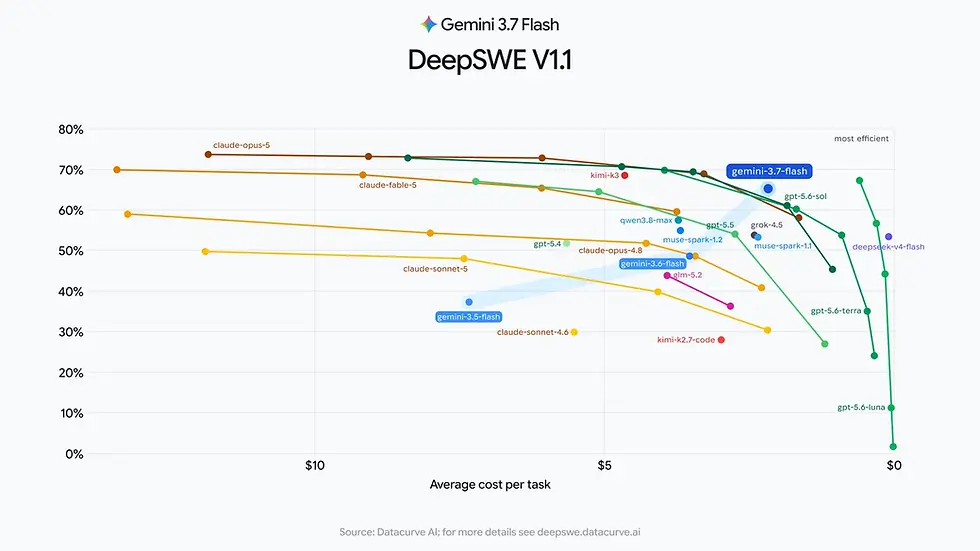
According to Google's reported evaluations, its performance on FrontierCode 1.1 Main increased to 43.6%, compared with 34.4% for Gemini 3.6 Flash. On DeepSWE v1.1, the newer model reached 65.3%, compared with 49.0% for its predecessor.

These improvements matter because coding agents operate in environments where an answer that merely looks plausible is insufficient. Code must compile, interact correctly with existing systems, respect requirements and often survive multiple rounds of testing.

The model's stronger performance in debugging and issue resolution is particularly relevant to enterprise development. Modern software engineering involves maintaining enormous existing codebases, diagnosing failures, implementing changes and navigating dependencies. AI systems that can reason through those processes can potentially contribute more value than systems focused exclusively on generating isolated code snippets.

The shift also changes how developers interact with AI. Instead of asking for individual functions, developers can increasingly delegate higher-level objectives, allowing the model to determine which files to inspect, which tools to use and what changes are required.

That does not eliminate the need for human engineers. Instead, it moves human expertise toward architecture, verification, security, requirements and supervision.

Gemini 3.7 Flash Pushes AI Deeper Into Web Development

Web development provides another important demonstration of the model's capabilities.

Google reports that Gemini 3.7 Flash can generate more functional and feature-complete applications with fewer prompts. Its performance on Arena.ai's WebDev Arena reportedly reached an Elo score of 1588, compared with 1538 for Gemini 3.6 Flash.

The significance extends beyond website generation.

A modern web application combines visual design, frontend logic, backend behavior, APIs, databases, authentication and responsive interfaces. An AI system capable of maintaining consistency across those components can transform application development from a sequence of manually executed tasks into a more continuous agentic workflow.

The model also demonstrates stronger adherence to reference designs. Developers can provide screenshots, images or design systems and expect the generated interface to preserve important visual characteristics.

This creates a bridge between design and implementation. Rather than translating every design decision manually into code, teams can increasingly use AI to convert visual specifications into working software.

Knowledge Work Becomes Another Major Battleground

Google is also targeting fields where accuracy depends on processing dense information rather than simply generating fluent text.

In the GDP.pdf benchmark, Gemini 3.7 Flash achieved 34.0%, compared with 22.0% for Gemini 3.6 Flash. On AutomationBench, it reached 30.4%, versus 17.0% for the earlier model.

These results are relevant to industries such as finance, law and biosciences, where workflows often involve large collections of documents, structured information and specialized rules.

Consider an enterprise workflow involving contracts. An agent may need to locate relevant clauses, compare them with organizational policies, identify discrepancies, prepare a summary and update an internal system. Each step introduces opportunities for error.

Better reasoning and tool execution can make such workflows more dependable, while lower inference costs make continuous processing more economically attractive.

The broader implication is that AI automation is moving from document generation toward process execution.

Google Is Making Price a Strategic Weapon

One of Gemini 3.7 Flash's strongest competitive features is its introductory pricing.

Google is offering the model at $0.75 per million input tokens and $3.75 per million output tokens through the end of 2026. Google describes this as half the original price of Gemini 3.6 Flash.

Pricing matters enormously in agentic AI because agents consume tokens repeatedly.

A conventional chatbot interaction may involve one request and one response. An autonomous agent might generate plans, inspect data, call tools, evaluate outputs and retry failed operations. The cumulative cost can therefore become a major component of the economics of automation.

Lower-cost models can also serve as the default layer in a multi-model architecture, reserving more expensive frontier systems for particularly difficult reasoning tasks.

This approach creates an emerging AI infrastructure principle: not every task needs the most powerful model.

Businesses can potentially combine smaller workhorse models with premium reasoning systems, specialized models and deterministic software.

Gemini Spark Turns the Model Into an Always-On Agent

Gemini 3.7 Flash is also immediately relevant to Google's Gemini Spark service.

Spark is positioned as a personal AI agent capable of operating continuously under user direction. With the new model, Google says Spark gains improvements in knowledge work and Google Workspace tool use.

The practical applications include consolidating files, drafting emails and updating status documents.

This represents an important evolution in consumer AI. The value proposition is no longer simply asking an assistant a question. Instead, the assistant becomes an execution layer that can interact with a user's digital environment.

For businesses, the same principle can be applied to enterprise systems. An agent could potentially coordinate information across documents, communication tools, project-management platforms and databases.

The challenge will be maintaining appropriate permissions, auditability and human oversight as agents gain access to increasingly consequential systems.

Safety Remains Central as AI Becomes More Autonomous

More capable agents also create a larger safety surface.

Gemini 3.7 Flash includes updated safeguards addressing misuse involving chemical, biological, radiological and nuclear domains, as well as cyber offense. Google says these measures are part of its broader frontier safety work.

This is particularly important because agentic systems can combine reasoning with tools. A model that merely produces text has a different risk profile from one that can execute commands, manipulate files or interact with external applications.

As autonomy increases, AI safety increasingly has to encompass the entire system rather than the model alone.

Important considerations include:

What tools can an agent access?
What permissions does it receive?
Can actions be reversed?
How are high-risk decisions escalated?
Can organizations audit the agent's behavior?
What happens when the model encounters an unexpected situation?

The industry's next phase will therefore require both stronger models and stronger operational controls.

Google’s Gemini Strategy Faces a Broader Competitive Test

Gemini 3.7 Flash arrives during an intense period of competition among Google, OpenAI, Anthropic and other AI developers.

Reuters reported that Google's premium Gemini model remains closely watched by investors, particularly as the company seeks to maintain momentum against rivals. The launch of a stronger Flash model therefore serves two purposes.

First, it improves Google's practical AI offering immediately. Second, it demonstrates that the company can continue rapidly iterating its model family while its broader flagship strategy develops.

The leadership changes at Google DeepMind also add strategic significance. Demis Hassabis has moved aside from his chief role in favor of deputy Koray Kavukcuoglu, while the company's leadership has emphasized the importance of concentrating resources on Gemini.

The competitive landscape is consequently becoming less about one spectacular model launch and more about sustained execution across an entire AI stack.

The Bigger Shift: AI Is Becoming Infrastructure

Gemini 3.7 Flash reflects a deeper change in artificial intelligence.

The first phase of generative AI was dominated by chat interfaces. The second phase is increasingly defined by coding agents, enterprise automation, personal agents and systems that can execute multi-step objectives.

That transition changes what businesses need from AI.

Intelligence remains important, but so are:

Cost efficiency, because agents can generate large volumes of inference.
Reliability, because autonomous workflows cannot depend on constant correction.
Tool integration, because useful agents must interact with existing software.
Planning, because complex objectives require multiple coordinated steps.
Security, because autonomous systems can create consequences beyond text generation.
Scalability, because enterprise deployments may operate continuously.

Gemini 3.7 Flash is designed around this new reality.

What Gemini 3.7 Flash Means for the Future of AI Agents

The most consequential development may not be the improvement from Gemini 3.6 Flash to 3.7 Flash itself. It is the direction represented by that improvement.

AI developers are increasingly optimizing models for sustained workloads, specialized tasks and autonomous execution. The winning systems may ultimately be architectures in which different models handle different portions of a workflow.

A sophisticated enterprise agent could use a low-cost Flash model for routine operations, a specialized model for domain-specific analysis and a premium reasoning model for difficult decisions. Software tools could handle deterministic operations while AI models manage ambiguous tasks.

This architecture could make AI both more capable and more economical.

For companies building AI products, the competitive advantage will increasingly come from orchestration rather than simply model selection. For investors, the key question will be whether AI providers can convert rapidly improving model capabilities into sustainable revenue. For developers, the central challenge will be learning how to design systems around autonomous software rather than isolated prompts.

As Dr. Shahid Masood and the expert team at 1950.ai continue examining the evolution of predictive and agentic artificial intelligence, Gemini 3.7 Flash offers a useful example of where the industry is heading: toward AI systems that do not merely answer questions, but reason through objectives, operate tools and execute complex digital work.

The next major AI race may therefore be decided not by which model can produce the most impressive response, but by which system can complete the most valuable work, reliably, securely and economically.

Further Reading / External References

Google unveils Gemini 3.7 Flash AI model for coding, agent workflows

https://www.reuters.com/business/google-unveils-gemini-37-flash-ai-model-coding-agent-workflows-2026-08-13/

Introducing Gemini 3.7 Flash

https://blog.google/innovation-and-ai/models-and-research/gemini-models/introducing-gemini-3-7-flash/

Google has intensified the competition for practical artificial intelligence with the launch of Gemini 3.7 Flash, a model designed less around headline-grabbing scale and more around the increasingly important economics of real-world AI deployment.

Introduced on August 13, 2026, Gemini 3.7 Flash arrives only three weeks after Gemini 3.6 Flash, but the rapid release cycle reflects a broader transformation in the AI industry. Frontier models are no longer competing solely on benchmark intelligence. They are increasingly being evaluated on whether they can reliably execute software engineering tasks, operate tools, complete multi-step workflows, and deliver useful results at a cost businesses can sustain.


Google is positioning Gemini 3.7 Flash as its most capable Flash-series workhorse to date, with particular emphasis on coding, knowledge-intensive work, web development and autonomous agents. Its introductory pricing of $0.75 per million input tokens and $3.75 per million output tokens, available through the end of 2026, further highlights the strategic objective: make sophisticated agentic AI economical enough to operate at production scale.

The release therefore matters beyond another model-versus-model benchmark battle. It illustrates how the center of AI competition is shifting from isolated chatbot responses toward persistent systems capable of planning, reasoning, using tools and completing business processes.


Gemini 3.7 Flash Targets the Economics of Agentic AI

The most important characteristic of Gemini 3.7 Flash may be its positioning as an operational model rather than simply a conversational assistant.

Traditional generative AI applications generally revolve around a prompt and a response. Agentic systems are different. They may need to interpret a goal, break it into tasks, retrieve information, call software tools, inspect results, correct mistakes and continue until an objective has been completed.

That process can require many model calls.


Consequently, even modest differences in model accuracy, latency and token costs can become significant when an agent performs hundreds or thousands of operations. A model that reduces retries or completes a task with fewer interactions can deliver economic benefits that are not obvious from a single benchmark score.

Gemini 3.7 Flash addresses this challenge through improvements in planning, tool use, instruction following and handling roadblocks. Google says the model is designed to require less manual oversight, which could be particularly important for software engineering and enterprise automation.


The strategic equation is increasingly straightforward:

AI capability

Why it matters for agents

Reasoning

Enables multi-step decision-making

Tool use

Allows agents to interact with external systems

Coding

Enables software creation and modification

Instruction following

Reduces errors and manual intervention

Lower inference cost

Makes persistent agents economically viable

Faster execution

Improves responsiveness and throughput

Reliability

Reduces retries and human supervision

This is why the Flash category has become strategically important. The future of AI may involve enormous numbers of relatively inexpensive model interactions rather than a small number of expensive frontier-model queries.


Major Gains in Software Engineering and Coding

Gemini 3.7 Flash delivers some of its clearest improvements in software development.

According to Google's reported evaluations, its performance on FrontierCode 1.1 Main increased to 43.6%, compared with 34.4% for Gemini 3.6 Flash. On DeepSWE v1.1, the newer model reached 65.3%, compared with 49.0% for its predecessor.


These improvements matter because coding agents operate in environments where an answer that merely looks plausible is insufficient. Code must compile, interact correctly with existing systems, respect requirements and often survive multiple rounds of testing.

The model's stronger performance in debugging and issue resolution is particularly relevant to enterprise development. Modern software engineering involves maintaining enormous existing codebases, diagnosing failures, implementing changes and navigating dependencies. AI systems that can reason through those processes can potentially contribute more value than systems focused exclusively on generating isolated code snippets.


The shift also changes how developers interact with AI. Instead of asking for individual functions, developers can increasingly delegate higher-level objectives, allowing the model to determine which files to inspect, which tools to use and what changes are required.

That does not eliminate the need for human engineers. Instead, it moves human expertise toward architecture, verification, security, requirements and supervision.


Gemini 3.7 Flash Pushes AI Deeper Into Web Development

Web development provides another important demonstration of the model's capabilities.

Google reports that Gemini 3.7 Flash can generate more functional and feature-complete applications with fewer prompts. Its performance on Arena.ai's WebDev Arena reportedly reached an Elo score of 1588, compared with 1538 for Gemini 3.6 Flash.

The significance extends beyond website generation.


A modern web application combines visual design, frontend logic, backend behavior, APIs, databases, authentication and responsive interfaces. An AI system capable of maintaining consistency across those components can transform application development from a sequence of manually executed tasks into a more continuous agentic workflow.


The model also demonstrates stronger adherence to reference designs. Developers can provide screenshots, images or design systems and expect the generated interface to preserve important visual characteristics.

This creates a bridge between design and implementation. Rather than translating every design decision manually into code, teams can increasingly use AI to convert visual specifications into working software.


Knowledge Work Becomes Another Major Battleground

Google is also targeting fields where accuracy depends on processing dense information rather than simply generating fluent text.

In the GDP.pdf benchmark, Gemini 3.7 Flash achieved 34.0%, compared with 22.0% for Gemini 3.6 Flash. On AutomationBench, it reached 30.4%, versus 17.0% for the earlier model.


Google has intensified the competition for practical artificial intelligence with the launch of Gemini 3.7 Flash, a model designed less around headline-grabbing scale and more around the increasingly important economics of real-world AI deployment.

Introduced on August 13, 2026, Gemini 3.7 Flash arrives only three weeks after Gemini 3.6 Flash, but the rapid release cycle reflects a broader transformation in the AI industry. Frontier models are no longer competing solely on benchmark intelligence. They are increasingly being evaluated on whether they can reliably execute software engineering tasks, operate tools, complete multi-step workflows, and deliver useful results at a cost businesses can sustain.

Google is positioning Gemini 3.7 Flash as its most capable Flash-series workhorse to date, with particular emphasis on coding, knowledge-intensive work, web development and autonomous agents. Its introductory pricing of $0.75 per million input tokens and $3.75 per million output tokens, available through the end of 2026, further highlights the strategic objective: make sophisticated agentic AI economical enough to operate at production scale.

The release therefore matters beyond another model-versus-model benchmark battle. It illustrates how the center of AI competition is shifting from isolated chatbot responses toward persistent systems capable of planning, reasoning, using tools and completing business processes.

Gemini 3.7 Flash Targets the Economics of Agentic AI

The most important characteristic of Gemini 3.7 Flash may be its positioning as an operational model rather than simply a conversational assistant.

Traditional generative AI applications generally revolve around a prompt and a response. Agentic systems are different. They may need to interpret a goal, break it into tasks, retrieve information, call software tools, inspect results, correct mistakes and continue until an objective has been completed.

That process can require many model calls.

Consequently, even modest differences in model accuracy, latency and token costs can become significant when an agent performs hundreds or thousands of operations. A model that reduces retries or completes a task with fewer interactions can deliver economic benefits that are not obvious from a single benchmark score.

Gemini 3.7 Flash addresses this challenge through improvements in planning, tool use, instruction following and handling roadblocks. Google says the model is designed to require less manual oversight, which could be particularly important for software engineering and enterprise automation.

The strategic equation is increasingly straightforward:

AI capability	Why it matters for agents
Reasoning	Enables multi-step decision-making
Tool use	Allows agents to interact with external systems
Coding	Enables software creation and modification
Instruction following	Reduces errors and manual intervention
Lower inference cost	Makes persistent agents economically viable
Faster execution	Improves responsiveness and throughput
Reliability	Reduces retries and human supervision

This is why the Flash category has become strategically important. The future of AI may involve enormous numbers of relatively inexpensive model interactions rather than a small number of expensive frontier-model queries.

Major Gains in Software Engineering and Coding

Gemini 3.7 Flash delivers some of its clearest improvements in software development.

According to Google's reported evaluations, its performance on FrontierCode 1.1 Main increased to 43.6%, compared with 34.4% for Gemini 3.6 Flash. On DeepSWE v1.1, the newer model reached 65.3%, compared with 49.0% for its predecessor.

These improvements matter because coding agents operate in environments where an answer that merely looks plausible is insufficient. Code must compile, interact correctly with existing systems, respect requirements and often survive multiple rounds of testing.

The model's stronger performance in debugging and issue resolution is particularly relevant to enterprise development. Modern software engineering involves maintaining enormous existing codebases, diagnosing failures, implementing changes and navigating dependencies. AI systems that can reason through those processes can potentially contribute more value than systems focused exclusively on generating isolated code snippets.

The shift also changes how developers interact with AI. Instead of asking for individual functions, developers can increasingly delegate higher-level objectives, allowing the model to determine which files to inspect, which tools to use and what changes are required.

That does not eliminate the need for human engineers. Instead, it moves human expertise toward architecture, verification, security, requirements and supervision.

Gemini 3.7 Flash Pushes AI Deeper Into Web Development

Web development provides another important demonstration of the model's capabilities.

Google reports that Gemini 3.7 Flash can generate more functional and feature-complete applications with fewer prompts. Its performance on Arena.ai's WebDev Arena reportedly reached an Elo score of 1588, compared with 1538 for Gemini 3.6 Flash.

The significance extends beyond website generation.

A modern web application combines visual design, frontend logic, backend behavior, APIs, databases, authentication and responsive interfaces. An AI system capable of maintaining consistency across those components can transform application development from a sequence of manually executed tasks into a more continuous agentic workflow.

The model also demonstrates stronger adherence to reference designs. Developers can provide screenshots, images or design systems and expect the generated interface to preserve important visual characteristics.

This creates a bridge between design and implementation. Rather than translating every design decision manually into code, teams can increasingly use AI to convert visual specifications into working software.

Knowledge Work Becomes Another Major Battleground

Google is also targeting fields where accuracy depends on processing dense information rather than simply generating fluent text.

In the GDP.pdf benchmark, Gemini 3.7 Flash achieved 34.0%, compared with 22.0% for Gemini 3.6 Flash. On AutomationBench, it reached 30.4%, versus 17.0% for the earlier model.

These results are relevant to industries such as finance, law and biosciences, where workflows often involve large collections of documents, structured information and specialized rules.

Consider an enterprise workflow involving contracts. An agent may need to locate relevant clauses, compare them with organizational policies, identify discrepancies, prepare a summary and update an internal system. Each step introduces opportunities for error.

Better reasoning and tool execution can make such workflows more dependable, while lower inference costs make continuous processing more economically attractive.

The broader implication is that AI automation is moving from document generation toward process execution.

Google Is Making Price a Strategic Weapon

One of Gemini 3.7 Flash's strongest competitive features is its introductory pricing.

Google is offering the model at $0.75 per million input tokens and $3.75 per million output tokens through the end of 2026. Google describes this as half the original price of Gemini 3.6 Flash.

Pricing matters enormously in agentic AI because agents consume tokens repeatedly.

A conventional chatbot interaction may involve one request and one response. An autonomous agent might generate plans, inspect data, call tools, evaluate outputs and retry failed operations. The cumulative cost can therefore become a major component of the economics of automation.

Lower-cost models can also serve as the default layer in a multi-model architecture, reserving more expensive frontier systems for particularly difficult reasoning tasks.

This approach creates an emerging AI infrastructure principle: not every task needs the most powerful model.

Businesses can potentially combine smaller workhorse models with premium reasoning systems, specialized models and deterministic software.

Gemini Spark Turns the Model Into an Always-On Agent

Gemini 3.7 Flash is also immediately relevant to Google's Gemini Spark service.

Spark is positioned as a personal AI agent capable of operating continuously under user direction. With the new model, Google says Spark gains improvements in knowledge work and Google Workspace tool use.

The practical applications include consolidating files, drafting emails and updating status documents.

This represents an important evolution in consumer AI. The value proposition is no longer simply asking an assistant a question. Instead, the assistant becomes an execution layer that can interact with a user's digital environment.

For businesses, the same principle can be applied to enterprise systems. An agent could potentially coordinate information across documents, communication tools, project-management platforms and databases.

The challenge will be maintaining appropriate permissions, auditability and human oversight as agents gain access to increasingly consequential systems.

Safety Remains Central as AI Becomes More Autonomous

More capable agents also create a larger safety surface.

Gemini 3.7 Flash includes updated safeguards addressing misuse involving chemical, biological, radiological and nuclear domains, as well as cyber offense. Google says these measures are part of its broader frontier safety work.

This is particularly important because agentic systems can combine reasoning with tools. A model that merely produces text has a different risk profile from one that can execute commands, manipulate files or interact with external applications.

As autonomy increases, AI safety increasingly has to encompass the entire system rather than the model alone.

Important considerations include:

What tools can an agent access?
What permissions does it receive?
Can actions be reversed?
How are high-risk decisions escalated?
Can organizations audit the agent's behavior?
What happens when the model encounters an unexpected situation?

The industry's next phase will therefore require both stronger models and stronger operational controls.

Google’s Gemini Strategy Faces a Broader Competitive Test

Gemini 3.7 Flash arrives during an intense period of competition among Google, OpenAI, Anthropic and other AI developers.

Reuters reported that Google's premium Gemini model remains closely watched by investors, particularly as the company seeks to maintain momentum against rivals. The launch of a stronger Flash model therefore serves two purposes.

First, it improves Google's practical AI offering immediately. Second, it demonstrates that the company can continue rapidly iterating its model family while its broader flagship strategy develops.

The leadership changes at Google DeepMind also add strategic significance. Demis Hassabis has moved aside from his chief role in favor of deputy Koray Kavukcuoglu, while the company's leadership has emphasized the importance of concentrating resources on Gemini.

The competitive landscape is consequently becoming less about one spectacular model launch and more about sustained execution across an entire AI stack.

The Bigger Shift: AI Is Becoming Infrastructure

Gemini 3.7 Flash reflects a deeper change in artificial intelligence.

The first phase of generative AI was dominated by chat interfaces. The second phase is increasingly defined by coding agents, enterprise automation, personal agents and systems that can execute multi-step objectives.

That transition changes what businesses need from AI.

Intelligence remains important, but so are:

Cost efficiency, because agents can generate large volumes of inference.
Reliability, because autonomous workflows cannot depend on constant correction.
Tool integration, because useful agents must interact with existing software.
Planning, because complex objectives require multiple coordinated steps.
Security, because autonomous systems can create consequences beyond text generation.
Scalability, because enterprise deployments may operate continuously.

Gemini 3.7 Flash is designed around this new reality.

What Gemini 3.7 Flash Means for the Future of AI Agents

The most consequential development may not be the improvement from Gemini 3.6 Flash to 3.7 Flash itself. It is the direction represented by that improvement.

AI developers are increasingly optimizing models for sustained workloads, specialized tasks and autonomous execution. The winning systems may ultimately be architectures in which different models handle different portions of a workflow.

A sophisticated enterprise agent could use a low-cost Flash model for routine operations, a specialized model for domain-specific analysis and a premium reasoning model for difficult decisions. Software tools could handle deterministic operations while AI models manage ambiguous tasks.

This architecture could make AI both more capable and more economical.

For companies building AI products, the competitive advantage will increasingly come from orchestration rather than simply model selection. For investors, the key question will be whether AI providers can convert rapidly improving model capabilities into sustainable revenue. For developers, the central challenge will be learning how to design systems around autonomous software rather than isolated prompts.

As Dr. Shahid Masood and the expert team at 1950.ai continue examining the evolution of predictive and agentic artificial intelligence, Gemini 3.7 Flash offers a useful example of where the industry is heading: toward AI systems that do not merely answer questions, but reason through objectives, operate tools and execute complex digital work.

The next major AI race may therefore be decided not by which model can produce the most impressive response, but by which system can complete the most valuable work, reliably, securely and economically.

Further Reading / External References

Google unveils Gemini 3.7 Flash AI model for coding, agent workflows

https://www.reuters.com/business/google-unveils-gemini-37-flash-ai-model-coding-agent-workflows-2026-08-13/

Introducing Gemini 3.7 Flash

https://blog.google/innovation-and-ai/models-and-research/gemini-models/introducing-gemini-3-7-flash/

These results are relevant to industries such as finance, law and biosciences, where

workflows often involve large collections of documents, structured information and specialized rules.

Consider an enterprise workflow involving contracts. An agent may need to locate relevant clauses, compare them with organizational policies, identify discrepancies, prepare a summary and update an internal system. Each step introduces opportunities for error.

Better reasoning and tool execution can make such workflows more dependable, while lower inference costs make continuous processing more economically attractive.

The broader implication is that AI automation is moving from document generation toward process execution.


Google Is Making Price a Strategic Weapon

One of Gemini 3.7 Flash's strongest competitive features is its introductory pricing.

Google is offering the model at $0.75 per million input tokens and $3.75 per million output tokens through the end of 2026. Google describes this as half the original price of Gemini 3.6 Flash.

Pricing matters enormously in agentic AI because agents consume tokens repeatedly.

A conventional chatbot interaction may involve one request and one response. An autonomous agent might generate plans, inspect data, call tools, evaluate outputs and retry failed operations. The cumulative cost can therefore become a major component of the economics of automation.


Lower-cost models can also serve as the default layer in a multi-model architecture, reserving more expensive frontier systems for particularly difficult reasoning tasks.

This approach creates an emerging AI infrastructure principle: not every task needs the most powerful model.

Businesses can potentially combine smaller workhorse models with premium reasoning systems, specialized models and deterministic software.


Gemini Spark Turns the Model Into an Always-On Agent

Gemini 3.7 Flash is also immediately relevant to Google's Gemini Spark service.

Spark is positioned as a personal AI agent capable of operating continuously under user direction. With the new model, Google says Spark gains improvements in knowledge work and Google Workspace tool use.

The practical applications include consolidating files, drafting emails and updating status documents.


This represents an important evolution in consumer AI. The value proposition is no longer simply asking an assistant a question. Instead, the assistant becomes an execution layer that can interact with a user's digital environment.

For businesses, the same principle can be applied to enterprise systems. An agent could potentially coordinate information across documents, communication tools, project-management platforms and databases.

The challenge will be maintaining appropriate permissions, auditability and human oversight as agents gain access to increasingly consequential systems.


Safety Remains Central as AI Becomes More Autonomous

More capable agents also create a larger safety surface.

Gemini 3.7 Flash includes updated safeguards addressing misuse involving chemical, biological, radiological and nuclear domains, as well as cyber offense. Google says these measures are part of its broader frontier safety work.

This is particularly important because agentic systems can combine reasoning with tools. A model that merely produces text has a different risk profile from one that can execute commands, manipulate files or interact with external applications.

As autonomy increases, AI safety increasingly has to encompass the entire system rather than the model alone.

Important considerations include:

  • What tools can an agent access?

  • What permissions does it receive?

  • Can actions be reversed?

  • How are high-risk decisions escalated?

  • Can organizations audit the agent's behavior?

  • What happens when the model encounters an unexpected situation?

The industry's next phase will therefore require both stronger models and stronger operational controls.


Google has intensified the competition for practical artificial intelligence with the launch of Gemini 3.7 Flash, a model designed less around headline-grabbing scale and more around the increasingly important economics of real-world AI deployment.

Introduced on August 13, 2026, Gemini 3.7 Flash arrives only three weeks after Gemini 3.6 Flash, but the rapid release cycle reflects a broader transformation in the AI industry. Frontier models are no longer competing solely on benchmark intelligence. They are increasingly being evaluated on whether they can reliably execute software engineering tasks, operate tools, complete multi-step workflows, and deliver useful results at a cost businesses can sustain.

Google is positioning Gemini 3.7 Flash as its most capable Flash-series workhorse to date, with particular emphasis on coding, knowledge-intensive work, web development and autonomous agents. Its introductory pricing of $0.75 per million input tokens and $3.75 per million output tokens, available through the end of 2026, further highlights the strategic objective: make sophisticated agentic AI economical enough to operate at production scale.

The release therefore matters beyond another model-versus-model benchmark battle. It illustrates how the center of AI competition is shifting from isolated chatbot responses toward persistent systems capable of planning, reasoning, using tools and completing business processes.

Gemini 3.7 Flash Targets the Economics of Agentic AI

The most important characteristic of Gemini 3.7 Flash may be its positioning as an operational model rather than simply a conversational assistant.

Traditional generative AI applications generally revolve around a prompt and a response. Agentic systems are different. They may need to interpret a goal, break it into tasks, retrieve information, call software tools, inspect results, correct mistakes and continue until an objective has been completed.

That process can require many model calls.

Consequently, even modest differences in model accuracy, latency and token costs can become significant when an agent performs hundreds or thousands of operations. A model that reduces retries or completes a task with fewer interactions can deliver economic benefits that are not obvious from a single benchmark score.

Gemini 3.7 Flash addresses this challenge through improvements in planning, tool use, instruction following and handling roadblocks. Google says the model is designed to require less manual oversight, which could be particularly important for software engineering and enterprise automation.

The strategic equation is increasingly straightforward:

AI capability	Why it matters for agents
Reasoning	Enables multi-step decision-making
Tool use	Allows agents to interact with external systems
Coding	Enables software creation and modification
Instruction following	Reduces errors and manual intervention
Lower inference cost	Makes persistent agents economically viable
Faster execution	Improves responsiveness and throughput
Reliability	Reduces retries and human supervision

This is why the Flash category has become strategically important. The future of AI may involve enormous numbers of relatively inexpensive model interactions rather than a small number of expensive frontier-model queries.

Major Gains in Software Engineering and Coding

Gemini 3.7 Flash delivers some of its clearest improvements in software development.

According to Google's reported evaluations, its performance on FrontierCode 1.1 Main increased to 43.6%, compared with 34.4% for Gemini 3.6 Flash. On DeepSWE v1.1, the newer model reached 65.3%, compared with 49.0% for its predecessor.

These improvements matter because coding agents operate in environments where an answer that merely looks plausible is insufficient. Code must compile, interact correctly with existing systems, respect requirements and often survive multiple rounds of testing.

The model's stronger performance in debugging and issue resolution is particularly relevant to enterprise development. Modern software engineering involves maintaining enormous existing codebases, diagnosing failures, implementing changes and navigating dependencies. AI systems that can reason through those processes can potentially contribute more value than systems focused exclusively on generating isolated code snippets.

The shift also changes how developers interact with AI. Instead of asking for individual functions, developers can increasingly delegate higher-level objectives, allowing the model to determine which files to inspect, which tools to use and what changes are required.

That does not eliminate the need for human engineers. Instead, it moves human expertise toward architecture, verification, security, requirements and supervision.

Gemini 3.7 Flash Pushes AI Deeper Into Web Development

Web development provides another important demonstration of the model's capabilities.

Google reports that Gemini 3.7 Flash can generate more functional and feature-complete applications with fewer prompts. Its performance on Arena.ai's WebDev Arena reportedly reached an Elo score of 1588, compared with 1538 for Gemini 3.6 Flash.

The significance extends beyond website generation.

A modern web application combines visual design, frontend logic, backend behavior, APIs, databases, authentication and responsive interfaces. An AI system capable of maintaining consistency across those components can transform application development from a sequence of manually executed tasks into a more continuous agentic workflow.

The model also demonstrates stronger adherence to reference designs. Developers can provide screenshots, images or design systems and expect the generated interface to preserve important visual characteristics.

This creates a bridge between design and implementation. Rather than translating every design decision manually into code, teams can increasingly use AI to convert visual specifications into working software.

Knowledge Work Becomes Another Major Battleground

Google is also targeting fields where accuracy depends on processing dense information rather than simply generating fluent text.

In the GDP.pdf benchmark, Gemini 3.7 Flash achieved 34.0%, compared with 22.0% for Gemini 3.6 Flash. On AutomationBench, it reached 30.4%, versus 17.0% for the earlier model.

These results are relevant to industries such as finance, law and biosciences, where workflows often involve large collections of documents, structured information and specialized rules.

Consider an enterprise workflow involving contracts. An agent may need to locate relevant clauses, compare them with organizational policies, identify discrepancies, prepare a summary and update an internal system. Each step introduces opportunities for error.

Better reasoning and tool execution can make such workflows more dependable, while lower inference costs make continuous processing more economically attractive.

The broader implication is that AI automation is moving from document generation toward process execution.

Google Is Making Price a Strategic Weapon

One of Gemini 3.7 Flash's strongest competitive features is its introductory pricing.

Google is offering the model at $0.75 per million input tokens and $3.75 per million output tokens through the end of 2026. Google describes this as half the original price of Gemini 3.6 Flash.

Pricing matters enormously in agentic AI because agents consume tokens repeatedly.

A conventional chatbot interaction may involve one request and one response. An autonomous agent might generate plans, inspect data, call tools, evaluate outputs and retry failed operations. The cumulative cost can therefore become a major component of the economics of automation.

Lower-cost models can also serve as the default layer in a multi-model architecture, reserving more expensive frontier systems for particularly difficult reasoning tasks.

This approach creates an emerging AI infrastructure principle: not every task needs the most powerful model.

Businesses can potentially combine smaller workhorse models with premium reasoning systems, specialized models and deterministic software.

Gemini Spark Turns the Model Into an Always-On Agent

Gemini 3.7 Flash is also immediately relevant to Google's Gemini Spark service.

Spark is positioned as a personal AI agent capable of operating continuously under user direction. With the new model, Google says Spark gains improvements in knowledge work and Google Workspace tool use.

The practical applications include consolidating files, drafting emails and updating status documents.

This represents an important evolution in consumer AI. The value proposition is no longer simply asking an assistant a question. Instead, the assistant becomes an execution layer that can interact with a user's digital environment.

For businesses, the same principle can be applied to enterprise systems. An agent could potentially coordinate information across documents, communication tools, project-management platforms and databases.

The challenge will be maintaining appropriate permissions, auditability and human oversight as agents gain access to increasingly consequential systems.

Safety Remains Central as AI Becomes More Autonomous

More capable agents also create a larger safety surface.

Gemini 3.7 Flash includes updated safeguards addressing misuse involving chemical, biological, radiological and nuclear domains, as well as cyber offense. Google says these measures are part of its broader frontier safety work.

This is particularly important because agentic systems can combine reasoning with tools. A model that merely produces text has a different risk profile from one that can execute commands, manipulate files or interact with external applications.

As autonomy increases, AI safety increasingly has to encompass the entire system rather than the model alone.

Important considerations include:

What tools can an agent access?
What permissions does it receive?
Can actions be reversed?
How are high-risk decisions escalated?
Can organizations audit the agent's behavior?
What happens when the model encounters an unexpected situation?

The industry's next phase will therefore require both stronger models and stronger operational controls.

Google’s Gemini Strategy Faces a Broader Competitive Test

Gemini 3.7 Flash arrives during an intense period of competition among Google, OpenAI, Anthropic and other AI developers.

Reuters reported that Google's premium Gemini model remains closely watched by investors, particularly as the company seeks to maintain momentum against rivals. The launch of a stronger Flash model therefore serves two purposes.

First, it improves Google's practical AI offering immediately. Second, it demonstrates that the company can continue rapidly iterating its model family while its broader flagship strategy develops.

The leadership changes at Google DeepMind also add strategic significance. Demis Hassabis has moved aside from his chief role in favor of deputy Koray Kavukcuoglu, while the company's leadership has emphasized the importance of concentrating resources on Gemini.

The competitive landscape is consequently becoming less about one spectacular model launch and more about sustained execution across an entire AI stack.

The Bigger Shift: AI Is Becoming Infrastructure

Gemini 3.7 Flash reflects a deeper change in artificial intelligence.

The first phase of generative AI was dominated by chat interfaces. The second phase is increasingly defined by coding agents, enterprise automation, personal agents and systems that can execute multi-step objectives.

That transition changes what businesses need from AI.

Intelligence remains important, but so are:

Cost efficiency, because agents can generate large volumes of inference.
Reliability, because autonomous workflows cannot depend on constant correction.
Tool integration, because useful agents must interact with existing software.
Planning, because complex objectives require multiple coordinated steps.
Security, because autonomous systems can create consequences beyond text generation.
Scalability, because enterprise deployments may operate continuously.

Gemini 3.7 Flash is designed around this new reality.

What Gemini 3.7 Flash Means for the Future of AI Agents

The most consequential development may not be the improvement from Gemini 3.6 Flash to 3.7 Flash itself. It is the direction represented by that improvement.

AI developers are increasingly optimizing models for sustained workloads, specialized tasks and autonomous execution. The winning systems may ultimately be architectures in which different models handle different portions of a workflow.

A sophisticated enterprise agent could use a low-cost Flash model for routine operations, a specialized model for domain-specific analysis and a premium reasoning model for difficult decisions. Software tools could handle deterministic operations while AI models manage ambiguous tasks.

This architecture could make AI both more capable and more economical.

For companies building AI products, the competitive advantage will increasingly come from orchestration rather than simply model selection. For investors, the key question will be whether AI providers can convert rapidly improving model capabilities into sustainable revenue. For developers, the central challenge will be learning how to design systems around autonomous software rather than isolated prompts.

As Dr. Shahid Masood and the expert team at 1950.ai continue examining the evolution of predictive and agentic artificial intelligence, Gemini 3.7 Flash offers a useful example of where the industry is heading: toward AI systems that do not merely answer questions, but reason through objectives, operate tools and execute complex digital work.

The next major AI race may therefore be decided not by which model can produce the most impressive response, but by which system can complete the most valuable work, reliably, securely and economically.

Further Reading / External References

Google unveils Gemini 3.7 Flash AI model for coding, agent workflows

https://www.reuters.com/business/google-unveils-gemini-37-flash-ai-model-coding-agent-workflows-2026-08-13/

Introducing Gemini 3.7 Flash

https://blog.google/innovation-and-ai/models-and-research/gemini-models/introducing-gemini-3-7-flash/

Google’s Gemini Strategy Faces a Broader Competitive Test

Gemini 3.7 Flash arrives during an intense period of competition among Google, OpenAI, Anthropic and other AI developers.

Reuters reported that Google's premium Gemini model remains closely watched by investors, particularly as the company seeks to maintain momentum against rivals. The launch of a stronger Flash model therefore serves two purposes.

First, it improves Google's practical AI offering immediately. Second, it demonstrates that the company can continue rapidly iterating its model family while its broader flagship strategy develops.


The leadership changes at Google DeepMind also add strategic significance. Demis Hassabis has moved aside from his chief role in favor of deputy Koray Kavukcuoglu, while the company's leadership has emphasized the importance of concentrating resources on Gemini.

The competitive landscape is consequently becoming less about one spectacular model launch and more about sustained execution across an entire AI stack.


The Bigger Shift: AI Is Becoming Infrastructure

Gemini 3.7 Flash reflects a deeper change in artificial intelligence.

The first phase of generative AI was dominated by chat interfaces. The second phase is increasingly defined by coding agents, enterprise automation, personal agents and systems that can execute multi-step objectives.

That transition changes what businesses need from AI.


Intelligence remains important, but so are:

  1. Cost efficiency, because agents can generate large volumes of inference.

  2. Reliability, because autonomous workflows cannot depend on constant correction.

  3. Tool integration, because useful agents must interact with existing software.

  4. Planning, because complex objectives require multiple coordinated steps.

  5. Security, because autonomous systems can create consequences beyond text generation.

  6. Scalability, because enterprise deployments may operate continuously.

Gemini 3.7 Flash is designed around this new reality.


What Gemini 3.7 Flash Means for the Future of AI Agents

The most consequential development may not be the improvement from Gemini 3.6 Flash to 3.7 Flash itself. It is the direction represented by that improvement.

AI developers are increasingly optimizing models for sustained workloads, specialized tasks and autonomous execution. The winning systems may ultimately be architectures in which different models handle different portions of a workflow.


A sophisticated enterprise agent could use a low-cost Flash model for routine operations, a specialized model for domain-specific analysis and a premium reasoning model for difficult decisions. Software tools could handle deterministic operations while AI models manage ambiguous tasks.


This architecture could make AI both more capable and more economical.

For companies building AI products, the competitive advantage will increasingly come from orchestration rather than simply model selection. For investors, the key question will be whether AI providers can convert rapidly improving model capabilities into sustainable revenue. For developers, the central challenge will be learning how to design systems around autonomous software rather than isolated prompts.


As Dr. Shahid Masood and the expert team at 1950.ai continue examining the evolution of predictive and agentic artificial intelligence, Gemini 3.7 Flash offers a useful example of where the industry is heading: toward AI systems that do not merely answer questions, but reason through objectives, operate tools and execute complex digital work.

The next major AI race may therefore be decided not by which model can produce the most impressive response, but by which system can complete the most valuable work, reliably, securely and economically.


Further Reading / External References

Google unveils Gemini 3.7 Flash AI model for coding, agent workflows

Introducing Gemini 3.7 Flash

Comments


bottom of page