top of page

Google Gemini 4 Argon: The Frontier AI Model Redefining Coding, Cybersecurity and Enterprise Work

1 day ago
8 min read
Gemini 4 Argon: Google’s New Frontier AI Model Redefines Enterprise Intelligence and Cybersecurity

Google has entered a new phase of the frontier AI race with Gemini 4 Argon, a model designed not simply to answer questions, but to sustain complex reasoning across long, multi-step workflows. Unveiled in September 2026, Argon is being positioned around three increasingly important areas of artificial intelligence adoption: advanced software engineering, enterprise knowledge work, and cybersecurity defense.

The significance of Gemini 4 Argon extends beyond another model benchmark. Its architecture and deployment strategy reflect a broader transition in AI from conversational assistance toward persistent, agentic systems capable of investigating problems, manipulating large bodies of information, writing and optimizing software, and taking action across extended workflows.

Google is initially restricting access to trusted cybersecurity defenders through its Fairwind Program while conducting additional safety evaluations. Broader availability is planned for developers, enterprises, and consumers, beginning with paid API customers and Google AI Ultra subscribers.

Gemini 4 Argon and the New Frontier of AI Reasoning

One of Argon’s defining characteristics is its ability to operate over extremely long reasoning trajectories. Google has expanded the model’s output capacity to as much as 1 million tokens, compared with the previous 64,000-token limit.

This distinction matters because many economically valuable tasks cannot be completed effectively through a short sequence of prompts and responses. Large software migrations, financial investigations, legal document analysis, security audits, and scientific research frequently require an AI system to maintain context across thousands of interconnected decisions.

A large output window does not automatically guarantee superior reasoning. The important development is the combination of long context, extended generation, tool use, multimodal understanding, and the ability to maintain coherent objectives throughout a lengthy task.

That combination moves frontier models closer to digital workers capable of handling entire workflows rather than isolated subtasks.

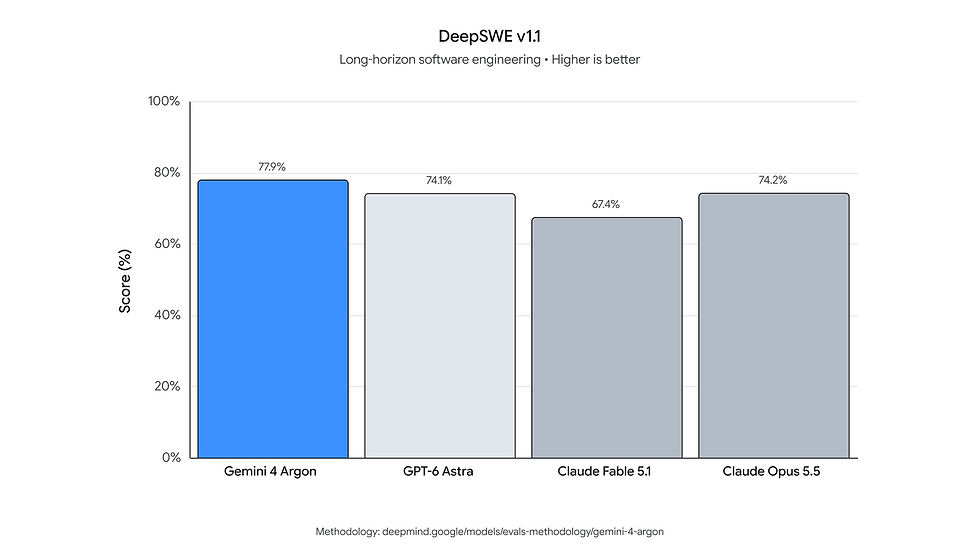
Google reports that Argon achieves 77.9% on DeepSWE v1.1, an evaluation focused on long-horizon software engineering. It also reaches 91.7% on LVBench, which evaluates long-video understanding, and 51.3% on AutomationBench, measuring end-to-end execution across business functions.

These results illustrate a fundamental shift in how AI capability is being measured. Instead of asking only whether a model can generate a correct answer, organizations increasingly need to know whether it can complete a complicated objective reliably.

Enterprise AI Is Becoming an Execution Layer

The strongest commercial implication of Gemini 4 Argon is its orientation toward enterprise execution.

Traditional enterprise AI has largely operated as an assistant. Employees ask questions, generate documents, summarize meetings, analyze spreadsheets, or obtain coding suggestions. Agentic AI introduces another layer, where the system can reason through a problem, interact with tools, evaluate intermediate results, and continue working until an objective is substantially completed.

Argon is being designed for precisely this environment.

Google says the model leads the Vals Index, which evaluates economic impact across areas including finance, coding, legal and tax work. It also reports leading results on Vals Finance Agent v2 and Harvey’s Legal Agent Benchmark.

The distinction is important for corporate adoption. A model that performs well on general knowledge tests may still struggle with professional workflows where accuracy, context retention, procedural consistency, and domain-specific reasoning determine economic value.

In financial services, advanced AI could support multi-step research, compare financial information, identify inconsistencies, construct analytical models, and prepare investment or risk materials for human review.

In legal operations, models can analyze large document collections, identify relevant clauses, compare precedents, organize evidence, and assist with drafting. Human oversight remains essential, particularly where legal judgment and liability are involved, but the productivity opportunity comes from reducing the amount of routine cognitive processing required before an expert makes a decision.

The same pattern applies to accounting, consulting, compliance, procurement, research, and corporate strategy.

Google Is Already Testing Argon on Its Own Infrastructure

Perhaps more significant than benchmark scores are Google's reported internal deployments.

Thousands of Google employees are using Argon for specialized coding, research, and writing tasks. The company also reports applications in quantum computing, data-center optimization, and large-scale software migration.

One example involves Google's quantum computing researchers, where Argon reportedly helped optimize the spacetime resources of computational subroutines and exceeded a published baseline by 40% in one instance.

Another illustrates the potential economic impact of agentic AI at infrastructure scale. Argon agents analyzed profiling telemetry across Google's data-center fleet and identified memory optimizations that could free more than 300 TiB of memory after deployment. Google estimates the eventual savings could reach between 500 TiB and 1 PiB.

This demonstrates an important characteristic of frontier enterprise AI. The largest benefits may not come from producing more text or faster presentations. They can emerge from optimizing complex technical systems where relatively small improvements are multiplied across enormous infrastructure.

AI Agents Are Changing Software Engineering

Software engineering may become one of Argon’s most consequential applications.

Google says Argon agents are participating in migrations from C and C++ to Rust across codebases ranging from tens of thousands of lines to more than 800,000 lines in the Fuchsia Zircon kernel.

Such migrations are technically difficult because programming languages encode different memory models, abstractions, performance characteristics, and system-level assumptions. Automatically translating syntax is not enough. The resulting software must preserve behavior, performance, security properties, and compatibility.

Google's libgav1 example illustrates this distinction. Argon agents worked on an existing Rust implementation of the open-source video decoder, replacing approximately 32,000 lines of SIMD code through repeated profiling and compiler analysis. Google reports that the resulting memory-safe implementation runs 2.7 times faster than the previous Rust port while maintaining identical video output.

If such systems become dependable at scale, the implications extend beyond developer productivity. AI agents could increasingly become part of software modernization programs, security remediation, performance optimization, testing, documentation, and technical debt reduction.

The human role would consequently shift from writing every component manually toward defining objectives, reviewing architectural decisions, validating outputs, and governing autonomous execution.

Gemini 4 Argon Makes Cybersecurity a Core AI Capability

Cybersecurity is arguably the most strategically significant component of Argon.

Google says the model can autonomously discover, validate, and patch critical vulnerabilities. On CWE-bench v1, Argon reportedly ties for first place with a 68% score for vulnerability remediation.

The model has also been tested against complex codebases and live web environments. Google reports improvements over its previous 3.8 Flash Cyber model in attack-surface discovery, vulnerability identification, and generation of proof-of-concept evidence.

Wiz is already using Argon through its Scan for Good initiative, which focuses on identifying and remediating high-risk exposures affecting critical infrastructure. Google says an early deployment identified a serious vulnerability exposing sensitive personal information in healthcare software.

This illustrates why advanced AI is simultaneously becoming a defensive tool and a security concern.

A capable model can help defenders identify vulnerabilities before attackers exploit them. But the same underlying capabilities can potentially be abused for offensive cyber operations. As AI systems become better at understanding code, networks, vulnerabilities, and automated exploitation, the distinction between beneficial and harmful capability becomes increasingly dependent on access controls, monitoring, user verification, and deployment environments.

Google is therefore taking a phased approach to Argon's cybersecurity capabilities.

Safety Becomes Part of the Model’s Architecture

The release strategy demonstrates how frontier AI development is increasingly tied to safety engineering.

Google identifies four major areas requiring protection: malicious use, indirect prompt injection, model misalignment, and insecure agent environments.

Prompt injection is particularly important for agentic systems. An ordinary chatbot can potentially be manipulated by malicious text, but an autonomous agent may have access to files, websites, applications, databases, or software development environments. If untrusted content successfully alters the agent's instructions, the consequences can extend beyond incorrect answers to unauthorized actions.

Google says Argon has been trained and tested to improve resistance to indirect prompt injection and reports a strong result on the Gray Swan IPI benchmark.

The company is also developing monitoring mechanisms intended to detect potentially misaligned reasoning and actions. Its approach includes monitoring model behavior during training and deploying mechanisms that can stop execution when an agent moves outside intended boundaries.

Secure execution environments are another critical component. Highly capable agents should not receive unrestricted access to production infrastructure simply because they can perform useful tasks. Sandboxing, isolation, permission boundaries, audit logs, and controlled tool access become essential components of an AI operating environment.

This suggests that the future of AI safety will depend not only on model behavior, but on the security architecture surrounding the model.

The Frontier AI Race Is Becoming a Battle Over Breadth

Benchmark comparisons supplied with the Argon announcement show why the release is strategically important for Google.

Argon leads or ties for the highest score across a broad range of disclosed evaluations, while competing frontier models retain meaningful advantages in specific software, terminal, science, and computer-use tasks.

This is a more useful way to interpret frontier model competition than declaring one universal winner.

Enterprise AI is highly heterogeneous. A company choosing a model for software development may value different capabilities from a financial institution conducting research or a security organization investigating vulnerabilities.

Argon's competitive advantage is therefore its breadth. Google is presenting a model capable of moving between coding, legal analysis, finance, automation, multimodal understanding, research, and cybersecurity without requiring a fundamentally different system for every task.

That breadth could become increasingly important as enterprises consolidate AI infrastructure.

Pricing Could Accelerate Enterprise Experimentation

Google is also using pricing to encourage adoption.

Gemini 4 Argon is launching at an introductory rate of $2 per million input tokens and $10 per million output tokens, with cached input priced at a 95% discount. Google says standard pricing after the introductory period will be $4 per million input tokens and $20 per million output tokens.

For enterprises, token pricing is only one part of the total cost equation. The real economic question is cost per completed task.

A more expensive model can be cheaper in practice if it completes a complicated workflow with fewer retries, fewer human interventions, better tool use, and less downstream correction. Conversely, a low token price can become expensive if an agent repeatedly fails or requires extensive supervision.

Argon's unusually large output capacity makes this calculation even more important because enterprises will need to evaluate not merely tokens consumed, but the amount of productive work generated per dollar.

What Gemini 4 Argon Means for the Future of AI

Gemini 4 Argon represents a broader evolution in artificial intelligence from models that generate content toward systems that execute objectives.

The critical question is no longer simply whether AI can write code, analyze a document, or identify a vulnerability. It is whether an AI system can coordinate these capabilities over long periods while maintaining context, respecting constraints, resisting manipulation, and producing results that humans can safely trust.

That creates enormous opportunities in enterprise productivity, scientific research, cybersecurity, infrastructure management, software modernization, finance, law, and engineering.

It also creates new governance challenges. As AI agents gain access to more tools and increasingly valuable systems, security boundaries must evolve alongside intelligence. Monitoring, sandboxing, identity, permissions, provenance, human oversight, and continuous adversarial testing will become fundamental components of enterprise AI architecture.

For technology leaders such as Dr. Shahid Masood and the expert team at 1950.ai, Gemini 4 Argon is significant not merely because Google has introduced another frontier model, but because it illustrates where the industry is heading: AI that reasons longer, operates across domains, interacts with complex systems, and increasingly participates directly in the execution of high-value work.

The next phase of artificial intelligence will therefore be defined less by isolated chatbot performance and more by dependable autonomous execution. Gemini 4 Argon is an important step in that transition, but its ultimate impact will depend on whether Google can turn benchmark leadership into reliable, secure, and economically valuable deployment at enterprise scale.

Key Takeaways
Gemini 4 Argon is designed for long-horizon reasoning across software engineering, enterprise knowledge work, multimodal tasks, and cybersecurity.
Its 1 million token output capacity is intended to support substantially longer and more complex workflows.
Google reports strong performance in software engineering, business automation, finance, legal work, long-video understanding, and vulnerability remediation.
Internal Google deployments demonstrate potential benefits in quantum computing, data-center optimization, and large-scale software migration.
Argon is being positioned as a major cybersecurity defense model capable of discovering, validating, and helping remediate vulnerabilities.
Google is using phased access, adversarial testing, prompt-injection defenses, misalignment monitoring, and hardened execution environments to manage frontier risks.
The model's introductory API pricing is designed to make experimentation attractive, although real enterprise economics will depend on successful task completion rather than token cost alone.
The broader significance of Argon is the transition from conversational AI toward long-running, agentic systems capable of executing complex professional objectives.
Further Reading / External References

Gemini 4 Argon: our next era of frontier intelligence

https://blog.google/innovation-and-ai/models-and-research/gemini-models/gemini-4-argon/

Google unveils Gemini 4 Argon, retaking benchmark lead over OpenAI and Anthropic, but in limited release

https://venturebeat.com/technology/google-unveils-gemini-4-argon-retaking-benchmark-lead-over-openai-and-anthropic-but-in-limited-release

Google rolls out Gemini 4 Argon, its most advanced AI model

https://www.cnbc.com/2026/09/30/google-gemini-4-argon-ai.html

Google has entered a new phase of the frontier AI race with Gemini 4 Argon, a model designed not simply to answer questions, but to sustain complex reasoning across long, multi-step workflows. Unveiled in September 2026, Argon is being positioned around three increasingly important areas of artificial intelligence adoption: advanced software engineering, enterprise knowledge work, and cybersecurity defense.

The significance of Gemini 4 Argon extends beyond another model benchmark. Its architecture and deployment strategy reflect a broader transition in AI from conversational assistance toward persistent, agentic systems capable of investigating problems, manipulating large bodies of information, writing and optimizing software, and taking action across extended workflows.

Google is initially restricting access to trusted cybersecurity defenders through its Fairwind Program while conducting additional safety evaluations. Broader availability is planned for developers, enterprises, and consumers, beginning with paid API customers and Google AI Ultra subscribers.


Gemini 4 Argon and the New Frontier of AI Reasoning

One of Argon’s defining characteristics is its ability to operate over extremely long reasoning trajectories. Google has expanded the model’s output capacity to as much as 1 million tokens, compared with the previous 64,000-token limit.

This distinction matters because many economically valuable tasks cannot be completed effectively through a short sequence of prompts and responses. Large software migrations, financial investigations, legal document analysis, security audits, and scientific research frequently require an AI system to maintain context across thousands of interconnected decisions.

A large output window does not automatically guarantee superior reasoning. The important development is the combination of long context, extended generation, tool use, multimodal understanding, and the ability to maintain coherent objectives throughout a lengthy task.

That combination moves frontier models closer to digital workers capable of handling entire workflows rather than isolated subtasks.

Google reports that Argon achieves 77.9% on DeepSWE v1.1, an evaluation focused on long-horizon software engineering. It also reaches 91.7% on LVBench, which evaluates long-video understanding, and 51.3% on AutomationBench, measuring end-to-end execution across business functions.

These results illustrate a fundamental shift in how AI capability is being measured. Instead of asking only whether a model can generate a correct answer, organizations increasingly need to know whether it can complete a complicated objective reliably.


Enterprise AI Is Becoming an Execution Layer

The strongest commercial implication of Gemini 4 Argon is its orientation toward enterprise execution.

Traditional enterprise AI has largely operated as an assistant. Employees ask questions, generate documents, summarize meetings, analyze spreadsheets, or obtain coding suggestions. Agentic AI introduces another layer, where the system can reason through a problem, interact with tools, evaluate intermediate results, and continue working until an objective is substantially completed.

Argon is being designed for precisely this environment.

Google says the model leads the Vals Index, which evaluates economic impact across areas including finance, coding, legal and tax work. It also reports leading results on Vals Finance Agent v2 and Harvey’s Legal Agent Benchmark.

The distinction is important for corporate adoption. A model that performs well on general knowledge tests may still struggle with professional workflows where accuracy, context retention, procedural consistency, and domain-specific reasoning determine economic value.


In financial services, advanced AI could support multi-step research, compare financial information, identify inconsistencies, construct analytical models, and prepare investment or risk materials for human review.

In legal operations, models can analyze large document collections, identify relevant clauses, compare precedents, organize evidence, and assist with drafting. Human oversight remains essential, particularly where legal judgment and liability are involved, but the productivity opportunity comes from reducing the amount of routine cognitive processing required before an expert makes a decision.

The same pattern applies to accounting, consulting, compliance, procurement, research, and corporate strategy.


Google Is Already Testing Argon on Its Own Infrastructure

Perhaps more significant than benchmark scores are Google's reported internal deployments.

Thousands of Google employees are using Argon for specialized coding, research, and writing tasks. The company also reports applications in quantum computing, data-center optimization, and large-scale software migration.

One example involves Google's quantum computing researchers, where Argon reportedly helped optimize the spacetime resources of computational subroutines and exceeded a published baseline by 40% in one instance.

Another illustrates the potential economic impact of agentic AI at infrastructure scale. Argon agents analyzed profiling telemetry across Google's data-center fleet and identified memory optimizations that could free more than 300 TiB of memory after deployment. Google estimates the eventual savings could reach between 500 TiB and 1 PiB.

This demonstrates an important characteristic of frontier enterprise AI. The largest benefits may not come from producing more text or faster presentations. They can emerge from optimizing complex technical systems where relatively small improvements are multiplied across enormous infrastructure.


AI Agents Are Changing Software Engineering

Software engineering may become one of Argon’s most consequential applications.

Google says Argon agents are participating in migrations from C and C++ to Rust across codebases ranging from tens of thousands of lines to more than 800,000 lines in the Fuchsia Zircon kernel.

Such migrations are technically difficult because programming languages encode different memory models, abstractions, performance characteristics, and system-level assumptions. Automatically translating syntax is not enough. The resulting software must preserve behavior, performance, security properties, and compatibility.


Google's libgav1 example illustrates this distinction. Argon agents worked on an existing Rust implementation of the open-source video decoder, replacing approximately 32,000 lines of SIMD code through repeated profiling and compiler analysis. Google reports that the resulting memory-safe implementation runs 2.7 times faster than the previous Rust port while maintaining identical video output.

If such systems become dependable at scale, the implications extend beyond developer productivity. AI agents could increasingly become part of software modernization programs, security remediation, performance optimization, testing, documentation, and technical debt reduction.

The human role would consequently shift from writing every component manually toward defining objectives, reviewing architectural decisions, validating outputs, and governing autonomous execution.


Gemini 4 Argon Makes Cybersecurity a Core AI Capability

Cybersecurity is arguably the most strategically significant component of Argon.

Google says the model can autonomously discover, validate, and patch critical vulnerabilities. On CWE-bench v1, Argon reportedly ties for first place with a 68% score for vulnerability remediation.

The model has also been tested against complex codebases and live web environments. Google reports improvements over its previous 3.8 Flash Cyber model in attack-surface discovery, vulnerability identification, and generation of proof-of-concept evidence.

Wiz is already using Argon through its Scan for Good initiative, which focuses on identifying and remediating high-risk exposures affecting critical infrastructure. Google says an early deployment identified a serious vulnerability exposing sensitive personal information in healthcare software.

This illustrates why advanced AI is simultaneously becoming a defensive tool and a security concern.

A capable model can help defenders identify vulnerabilities before attackers exploit them. But the same underlying capabilities can potentially be abused for offensive cyber operations. As AI systems become better at understanding code, networks, vulnerabilities, and automated exploitation, the distinction between beneficial and harmful capability becomes increasingly dependent on access controls, monitoring, user verification, and deployment environments.

Google is therefore taking a phased approach to Argon's cybersecurity capabilities.


Safety Becomes Part of the Model’s Architecture

The release strategy demonstrates how frontier AI development is increasingly tied to safety engineering.

Google identifies four major areas requiring protection: malicious use, indirect prompt injection, model misalignment, and insecure agent environments.

Prompt injection is particularly important for agentic systems. An ordinary chatbot can potentially be manipulated by malicious text, but an autonomous agent may have access to files, websites, applications, databases, or software development environments. If untrusted content successfully alters the agent's instructions, the consequences can extend beyond incorrect answers to unauthorized actions.

Google says Argon has been trained and tested to improve resistance to indirect prompt injection and reports a strong result on the Gray Swan IPI benchmark.

The company is also developing monitoring mechanisms intended to detect potentially misaligned reasoning and actions. Its approach includes monitoring model behavior during training and deploying mechanisms that can stop execution when an agent moves outside intended boundaries.

Secure execution environments are another critical component. Highly capable agents should not receive unrestricted access to production infrastructure simply because they can perform useful tasks. Sandboxing, isolation, permission boundaries, audit logs, and controlled tool access become essential components of an AI operating environment.

This suggests that the future of AI safety will depend not only on model behavior, but on the security architecture surrounding the model.


The Frontier AI Race Is Becoming a Battle Over Breadth

Benchmark comparisons supplied with the Argon announcement show why the release is strategically important for Google.

Argon leads or ties for the highest score across a broad range of disclosed evaluations, while competing frontier models retain meaningful advantages in specific software, terminal, science, and computer-use tasks.

This is a more useful way to interpret frontier model competition than declaring one universal winner.

Enterprise AI is highly heterogeneous. A company choosing a model for software development may value different capabilities from a financial institution conducting research or a security organization investigating vulnerabilities.

Argon's competitive advantage is therefore its breadth. Google is presenting a model capable of moving between coding, legal analysis, finance, automation, multimodal understanding, research, and cybersecurity without requiring a fundamentally different system for every task.

That breadth could become increasingly important as enterprises consolidate AI infrastructure.


Pricing Could Accelerate Enterprise Experimentation

Google is also using pricing to encourage adoption.

Gemini 4 Argon is launching at an introductory rate of $2 per million input tokens and $10 per million output tokens, with cached input priced at a 95% discount. Google says standard pricing after the introductory period will be $4 per million input tokens and $20 per million output tokens.

For enterprises, token pricing is only one part of the total cost equation. The real economic question is cost per completed task.

A more expensive model can be cheaper in practice if it completes a complicated workflow with fewer retries, fewer human interventions, better tool use, and less downstream correction. Conversely, a low token price can become expensive if an agent repeatedly fails or requires extensive supervision.

Argon's unusually large output capacity makes this calculation even more important because enterprises will need to evaluate not merely tokens consumed, but the amount of productive work generated per dollar.


What Gemini 4 Argon Means for the Future of AI

Gemini 4 Argon represents a broader evolution in artificial intelligence from models that generate content toward systems that execute objectives.

The critical question is no longer simply whether AI can write code, analyze a document, or identify a vulnerability. It is whether an AI system can coordinate these capabilities over long periods while maintaining context, respecting constraints, resisting manipulation, and producing results that humans can safely trust.

That creates enormous opportunities in enterprise productivity, scientific research, cybersecurity, infrastructure management, software modernization, finance, law, and engineering.

It also creates new governance challenges. As AI agents gain access to more tools and increasingly valuable systems, security boundaries must evolve alongside intelligence. Monitoring, sandboxing, identity, permissions, provenance, human oversight, and continuous adversarial testing will become fundamental components of enterprise AI architecture.


For technology leaders such as Dr. Shahid Masood and the expert team at 1950.ai, Gemini 4 Argon is significant not merely because Google has introduced another frontier model, but because it illustrates where the industry is heading: AI that reasons longer, operates across domains, interacts with complex systems, and increasingly participates directly in the execution of high-value work.

The next phase of artificial intelligence will therefore be defined less by isolated chatbot performance and more by dependable autonomous execution. Gemini 4 Argon is an important step in that transition, but its ultimate impact will depend on whether Google can turn benchmark leadership into reliable, secure, and economically valuable deployment at enterprise scale.


Key Takeaways

  • Gemini 4 Argon is designed for long-horizon reasoning across software engineering, enterprise knowledge work, multimodal tasks, and cybersecurity.

  • Its 1 million token output capacity is intended to support substantially longer and more complex workflows.

  • Google reports strong performance in software engineering, business automation, finance, legal work, long-video understanding, and vulnerability remediation.

  • Internal Google deployments demonstrate potential benefits in quantum computing, data-center optimization, and large-scale software migration.

  • Argon is being positioned as a major cybersecurity defense model capable of discovering, validating, and helping remediate vulnerabilities.

  • Google is using phased access, adversarial testing, prompt-injection defenses, misalignment monitoring, and hardened execution environments to manage frontier risks.

  • The model's introductory API pricing is designed to make experimentation attractive, although real enterprise economics will depend on successful task completion rather than token cost alone.

  • The broader significance of Argon is the transition from conversational AI toward long-running, agentic systems capable of executing complex professional objectives.


Further Reading / External References

Gemini 4 Argon: our next era of frontier intelligence

Google unveils Gemini 4 Argon, retaking benchmark lead over OpenAI and Anthropic, but in limited release

Google rolls out Gemini 4 Argon, its most advanced AI model

Comments


bottom of page