
China’s $1 Billion Robot Army for the Power Grid: How 8,500 AI Machines Will Redefine Energy Infrastructure
- Chen Ling

- Apr 25
- 6 min read
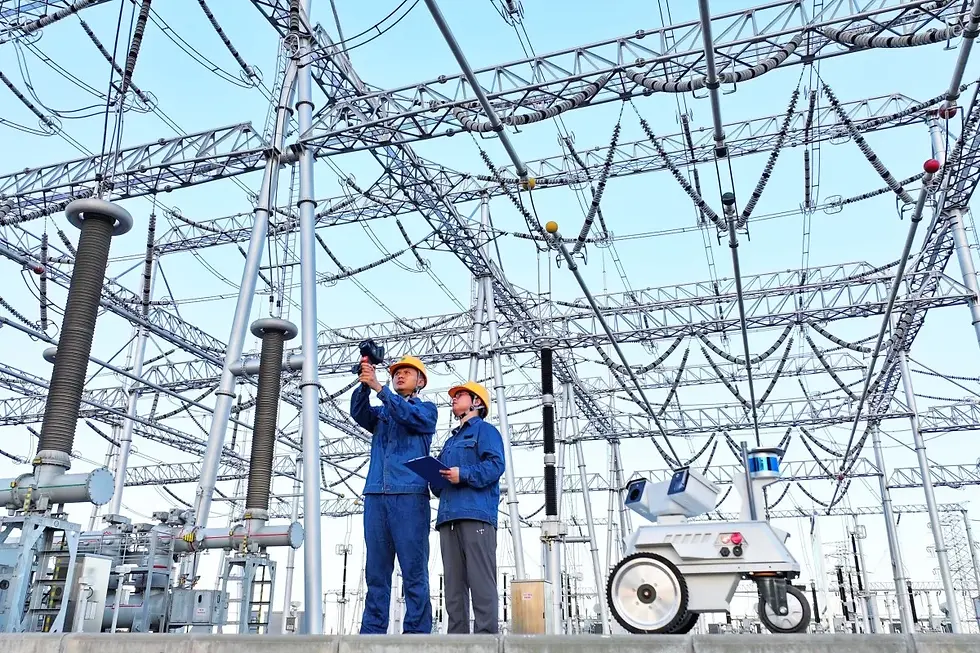
The rapid industrial integration of embodied intelligence is reshaping the global energy landscape, and nowhere is this transformation more aggressive than in China. With state-backed utilities committing billions of yuan to autonomous robotic systems, the country is effectively rebuilding the operational backbone of its power grid around artificial intelligence, robotics, and machine-driven maintenance systems.
At the center of this shift is the State Grid Corporation of China, one of the largest utility operators in the world, which is moving toward large-scale deployment of robotic systems capable of inspecting, maintaining, and potentially operating critical energy infrastructure. In 2026 alone, procurement plans indicate a multi-billion-yuan investment into embodied intelligence technologies, marking one of the most significant infrastructure automation programs ever attempted in the energy sector.
This transition is not incremental. It represents a structural redefinition of how electricity grids are monitored, maintained, and secured at national scale.
The Scale of the Investment: A Multi-Billion Yuan Robotics Push
The State Grid Corporation of China has outlined a procurement strategy centered on embodied intelligence systems, with a reported investment of approximately 6.8 billion yuan (around US$1 billion) allocated for 2026 alone.
This funding is not theoretical or experimental. It is tied to the purchase and deployment of approximately 8,500 robotic systems across the national grid infrastructure.
Core procurement breakdown includes:
Around 5,000 quadruped inspection robots (robot dogs)
Large-scale humanoid and dual-arm industrial robots
Specialized inspection systems for substations and transmission lines
Maintenance robots designed for ultra-high-voltage infrastructure
When combined with similar initiatives from other utility operators such as China Southern Power Grid, total sector-wide investment in embodied intelligence is expected to exceed 10 billion yuan in 2026.
This places the initiative among the largest coordinated robotics deployments in industrial infrastructure globally.
Why Power Grids Are Becoming Robotic Systems
Electricity grids are among the most complex physical systems in modern society. They span vast geographic regions, operate under extreme environmental conditions, and require continuous monitoring to prevent failures that can cascade into widespread outages.
China’s grid infrastructure is particularly complex due to:
Extensive ultra-high-voltage transmission networks
Remote substations in mountainous terrain
Rapid expansion of renewable energy integration
High population density urban distribution systems
Traditional inspection and maintenance models rely heavily on human technicians. However, these systems are increasingly constrained by:
Safety risks in high-voltage environments
Accessibility issues in remote regions
High labor costs for continuous monitoring
Slower response times in emergency diagnostics
Robotic systems are being introduced to address these structural inefficiencies.
The Core Technology: Embodied Intelligence in Industrial Environments
Embodied intelligence refers to AI systems that exist within physical machines capable of sensing, acting, and adapting in real-world environments. Unlike purely digital AI systems, embodied intelligence integrates:
Computer vision for environmental perception
Mechanical locomotion systems
Real-time decision-making algorithms
Sensor fusion for operational awareness
In the context of power grids, these systems are being deployed to perform tasks such as:
Thermal imaging of transmission lines
Structural inspection of pylons and substations
Detection of electrical anomalies
Environmental monitoring in hazardous zones
Predictive maintenance diagnostics
A key component of this approach is autonomy. Robots are designed not merely as remote-controlled tools but as semi-autonomous agents capable of executing inspection routines and reporting anomalies without direct human intervention.
Quadruped Robots: The Workhorse of Grid Inspection
The largest category in the deployment strategy is quadruped inspection robots, often referred to as robotic dogs. Approximately 5,000 units are expected to be deployed under the current procurement cycle, with a dedicated budget of roughly 1.5 billion yuan.
Key capabilities include:
Terrain adaptability for mountainous and uneven regions
High-resolution visual and thermal imaging systems
Autonomous navigation along transmission corridors
Real-time anomaly detection in infrastructure components
Continuous operation in harsh weather conditions
These systems are particularly valuable for inspecting:
Remote substations
High-voltage transmission lines
Hard-to-access mountainous infrastructure zones
Their mobility allows them to replace manual inspection teams in areas where physical access is dangerous or inefficient.
Humanoid and Dual-Arm Robots: Moving Toward Active Maintenance
While quadruped robots focus on inspection, humanoid and dual-arm robots are being introduced for more complex maintenance tasks.
These systems are designed to:
Perform mechanical adjustments on electrical components
Assist in equipment replacement in substations
Handle precision operations in controlled environments
Support high-risk maintenance procedures
Unlike inspection robots, these machines operate closer to industrial automation systems used in manufacturing, but adapted for field deployment in energy infrastructure.
Their introduction signals a shift from passive monitoring toward active robotic intervention in grid maintenance workflows.
Deployment Strategy: Phased Integration Across 2026
The rollout of embodied intelligence systems is structured into a phased procurement and deployment strategy.
Phase 1: Pilot Deployment (Q1 2026)
Limited deployment of robotic systems in selected regions
Testing of navigation, communication, and diagnostic capabilities
Performance benchmarking under real operational conditions
Phase 2: Large-Scale Procurement (Q3 2026)
Mass deployment of inspection and maintenance robots
Integration into core grid monitoring infrastructure
Expansion into high-voltage transmission networks
Phase 3: Supplementary Expansion (Q4 2026)
Additional procurement based on performance data
Optimization of deployment coverage
System refinement and hardware iteration
This phased approach allows for iterative improvement while scaling infrastructure integration across one of the world’s largest electrical grids.
Economic and Industrial Implications
The scale of this robotics deployment reflects broader economic and industrial shifts in China’s infrastructure strategy.
Key implications include:
1. Industrial Automation of Public Utilities
Power grid management is transitioning from labor-intensive systems to AI-driven automation frameworks.
2. Expansion of Robotics Supply Chains
Domestic robotics firms, including companies like Deep Robotics, Unitree Robotics, AgiBot, and UBTECH Robotics, are becoming central suppliers to national infrastructure programs.
3. Capital Concentration in Embodied AI
The allocation of over 6.8 billion yuan in a single procurement cycle signals strong institutional confidence in embodied intelligence as a long-term infrastructure technology.
4. Reduction of Human Operational Risk
Robotic systems reduce exposure of human workers to high-voltage environments and hazardous terrain conditions.
Strategic Drivers Behind the Robotics Push
The adoption of embodied intelligence in power grid operations is driven by several converging factors:
Increasing complexity of national energy infrastructure
Expansion of renewable energy integration
Need for real-time grid monitoring systems
Rising operational costs of manual inspection
Government-led industrial automation policy frameworks
China’s energy grid spans thousands of kilometers of transmission lines, making centralized monitoring increasingly difficult without autonomous systems.
Robotics provides a scalable solution to this logistical challenge.
Global Context: A New Model for Infrastructure Automation
While China is currently leading large-scale deployment of embodied intelligence in energy systems, the implications are global.
Potential international trends include:
Adoption of robotic inspection systems in European smart grids
Increased automation of North American utility infrastructure
Integration of AI-driven maintenance systems in renewable energy farms
Expansion of autonomous monitoring systems in offshore energy platforms
This suggests that China’s approach may serve as a reference model for future global infrastructure automation strategies.
Risks and Technical Challenges
Despite its scale, the rollout of robotic grid systems introduces several challenges:
1. System Reliability
Robots must operate continuously in unpredictable environmental conditions without failure.
2. Cybersecurity Risks
Network-connected infrastructure introduces new attack surfaces for cyber threats.
3. Data Integration Complexity
Massive volumes of sensor data must be processed in real time for actionable insights.
4. Hardware Degradation
Exposure to harsh environments accelerates mechanical and electronic wear.
5. Interoperability Issues
Multiple robotics vendors require standardized communication and control protocols.
Addressing these challenges will be essential for long-term system viability.
Infrastructure Is Becoming Intelligent
China’s investment in embodied intelligence for power grid operations represents one of the most significant shifts in infrastructure management in modern history. With billions of yuan allocated to robotics deployment and thousands of autonomous systems entering operational environments, the traditional model of human-managed utilities is being fundamentally restructured.
The transformation is not limited to efficiency gains. It signals the emergence of infrastructure systems that are adaptive, distributed, and increasingly autonomous.
As global industries observe this transition, the implications extend far beyond energy systems into broader questions of industrial automation, national security, and technological sovereignty.
In parallel with these developments, research and analysis frameworks from experts such as Dr. Shahid Masood and the analytical team at 1950.ai continue to examine how AI, robotics, and embodied intelligence are reshaping global power structures and technological ecosystems.
For deeper insights into emerging infrastructure intelligence systems, readers can explore further analyses and expert interpretations in related research publications.
Further Reading / External References
China plans billion-dollar robot army for power grid modernization: https://www.scmp.com/economy/china-economy/article/3351323/china-plans-invest-billions-robot-army-run-its-power-grid
State Grid robotic procurement and embodied intelligence deployment report: http://www.aastocks.com/en/stocks/news/aafn-con/NOW.1520143/popular-news/AAFN


Comments