
Breakthrough Organic Photovoltaic Study Shows How Quantum Chemistry Can Unlock Superior Solar Performance

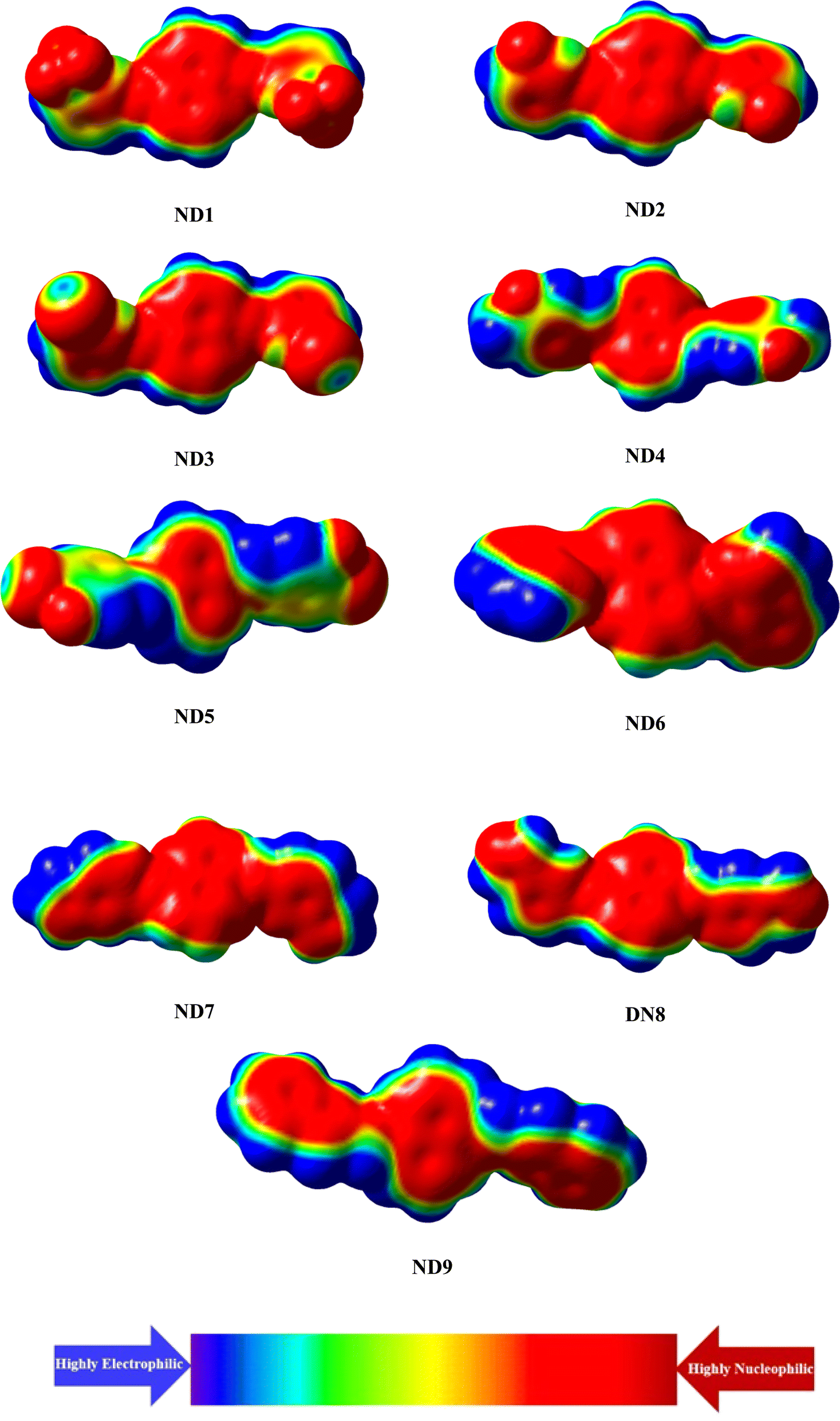
The global transition toward renewable energy technologies is accelerating rapidly as governments, industries, and researchers seek alternatives to fossil-fuel-dependent power systems. Within this evolving landscape, organic photovoltaics have emerged as one of the most promising next-generation solar technologies due to their lightweight structure, mechanical flexibility, lower manufacturing costs, and compatibility with large-area fabrication methods. Among the most transformative developments in this sector is the emergence of non-fullerene-based organic solar cells, which are increasingly demonstrating superior tunability and efficiency compared to conventional fullerene-based systems.
A recent quantum chemical study focused on naphthalene diamine derivatives represents a major advancement in this field. The research investigates how molecular engineering techniques can precisely tune the electronic and photovoltaic properties of naphthalene diamine compounds through the incorporation of highly efficient electron acceptors. By strategically modifying terminal acceptor units and optimizing molecular architectures, the study demonstrates substantial improvements in optical absorption, charge transfer behavior, and overall photovoltaic performance.
The findings offer valuable insights into the future of high-performance organic solar cell materials and reinforce the growing importance of computational chemistry in designing advanced energy systems before laboratory synthesis even begins.
The Rise of Non-Fullerene Organic Solar Cells
Organic photovoltaics have evolved significantly during the last two decades. Early generations of organic solar cells depended heavily on fullerene acceptors due to their excellent electron-transport capabilities. However, fullerene materials presented several limitations:
Weak visible-light absorption
Limited tunability of energy levels
Morphological instability
High production costs
Restricted molecular engineering flexibility
These challenges encouraged researchers to explore non-fullerene acceptors capable of delivering stronger optical absorption and more adaptable electronic properties.
Non-fullerene organic solar cells now represent one of the fastest-growing areas within photovoltaic research because they enable scientists to customize molecular structures with exceptional precision. This tunability allows for optimization of:
Property | Importance in Solar Cells |
Energy band gap | Controls light harvesting efficiency |
Charge mobility | Determines transport efficiency |
Absorption spectrum | Influences solar spectrum utilization |
Molecular planarity | Enhances electron delocalization |
Thermal stability | Improves operational lifespan |
Exciton dissociation | Supports charge separation efficiency |
The latest naphthalene diamine research contributes directly to this broader movement toward customizable organic photovoltaic systems.
Why Naphthalene Diamine Is Attracting Scientific Attention
Naphthalene diamine possesses a highly attractive molecular framework for optoelectronic applications. Its fused aromatic ring system provides strong π-conjugation, while its amine groups support donor-acceptor interactions critical for charge transport processes.
Despite these advantages, pure naphthalene diamine systems have historically faced limitations related to inefficient charge transfer and restricted spectral absorption. Researchers therefore focused on molecular engineering strategies capable of overcoming these bottlenecks.
The study introduced three rationally designed series of naphthalene-1,5-diamine-based compounds:
NBT1–NBT4
NBT5–NBT8
NBT9–NBT12
These compounds employed an A1–π1–A2–π2–A2–π1–A1 molecular configuration combined with terminal modifications involving:
Thiophene linkers
Malononitrile-based acceptors
Benzothiophene-based acceptors
This architecture was specifically designed to optimize intramolecular charge transfer and improve photovoltaic functionality.
Quantum Chemical Modeling as a Design Tool
One of the most important aspects of the research lies in its computational methodology. Instead of relying solely on expensive and time-consuming laboratory experimentation, the researchers utilized advanced quantum chemical calculations to predict photovoltaic behavior.
The study employed the MPW1PW91/6-311G(d,p) level of theory, alongside density functional theory and time-dependent density functional theory techniques.
These computational methods enabled detailed evaluation of:
Frontier molecular orbitals
Global reactivity parameters
Density of states
UV-Visible absorption spectra
Transition density matrices
Electron-hole distributions
Open-circuit voltage characteristics
This approach reflects a major transformation occurring across materials science. Computational chemistry increasingly enables researchers to predict material behavior before physical synthesis, dramatically accelerating innovation cycles.
According to Nobel Prize-winning chemist Walter Kohn, one of the pioneers of density functional theory:
“The ability to predict material properties computationally changes the entire paradigm of scientific discovery.”
That paradigm shift is clearly visible in the development of modern organic photovoltaic systems.
Engineering Electronic Properties Through Molecular Modification
The core breakthrough of the study stems from how electron-withdrawing acceptors modified the electronic structure of the naphthalene diamine framework.
The incorporation of highly efficient acceptors significantly reduced energy gaps across the designed compounds.
Key Electronic Findings
Compound Range | Energy Gap (eV) | Absorption Range (nm) |
NBT Series | 2.641–2.323 eV | 534.484–638.238 nm |
Lower energy gaps are critically important because they allow materials to absorb a broader portion of the solar spectrum. This directly improves light-harvesting capability and increases the probability of generating usable electrical current.
Among all designed compounds, NBT12 demonstrated the strongest performance profile.
NBT12 Performance Highlights
Parameter | Result |
Lowest energy gap | 2.323 eV |
Highest absorption maximum | 638.238 nm |
Charge transfer efficiency | Highest among all compounds |
Optical performance | Superior visible-light harvesting |
The enhanced performance was largely attributed to stronger donor-acceptor interactions and improved electron delocalization across the molecular backbone.
The Critical Role of Intramolecular Charge Transfer
Efficient solar energy conversion depends heavily on intramolecular charge transfer dynamics. Once photons are absorbed, electrons must rapidly separate from holes and move efficiently through the photovoltaic material.
The study revealed that molecular engineering substantially improved charge transfer pathways.
Several structural features contributed to this improvement:
Enhanced π-conjugation
Increased molecular planarity
Stronger electron-withdrawing acceptors
Optimized donor-acceptor interactions
Reduced charge recombination losses
The transition density matrix and electron-hole distribution analyses confirmed more efficient charge separation in optimized derivatives.
This is particularly important because recombination losses remain one of the largest efficiency limitations in organic photovoltaics.
Molecular Planarity and Conjugation Length Matter Deeply
One of the most scientifically important findings involved the relationship between molecular planarity and photovoltaic efficiency.
Computational modeling demonstrated that planar molecular geometries facilitated superior π-electron delocalization across the molecular backbone.
This produced several beneficial effects:
Faster charge transport
Reduced recombination
Lower energetic losses
Enhanced optical absorption
Improved exciton migration
The study further showed that extended conjugation lengths contributed to red-shifted absorption spectra, allowing the materials to capture more visible and near-infrared solar radiation.
This is crucial because sunlight contains a large amount of energy within these spectral regions.
Expanding Absorption Across the Solar Spectrum
Traditional organic photovoltaic materials often suffer from narrow absorption windows. The newly engineered naphthalene diamine derivatives demonstrated significantly broader spectral coverage.
The reported absorption maxima ranged from approximately 534 nm to 638 nm, indicating strong visible-light harvesting capabilities.
Several acceptor modifications successfully shifted absorption toward longer wavelengths.
Advantages of Broadened Absorption
Greater solar energy utilization
Higher photocurrent generation potential
Improved external quantum efficiency
Enhanced device performance under low-light conditions
This spectral tunability is one of the defining advantages of non-fullerene organic photovoltaic systems.
Charge Mobility and Reorganization Energy Improvements
Beyond absorption properties, the study also evaluated charge transport efficiency using reorganization energy calculations and charge transfer integrals.
These metrics are critical because photovoltaic devices rely on rapid electron and hole transport to minimize energy losses.
The engineered compounds displayed reduced reorganization energies, suggesting highly favorable charge mobility characteristics.
Why Lower Reorganization Energy Matters
Lower Reorganization Energy Leads To | Photovoltaic Benefit |
Faster electron transport | Higher current generation |
Reduced energetic barriers | Improved efficiency |
Lower charge trapping | Enhanced operational stability |
Better carrier mobility | Stronger device performance |
Efficient charge mobility is essential for scaling laboratory materials into commercially viable photovoltaic systems.
Stability Challenges in Organic Photovoltaics
One of the persistent concerns surrounding organic solar cells is long-term stability. Many organic materials degrade under heat, oxygen exposure, or prolonged ultraviolet radiation.
The quantum chemical analyses addressed this issue by examining:
Thermal stability
Photostability
Structural robustness
Molecular resilience under operational conditions
The findings indicated that certain engineered derivatives exhibited improved stability profiles due to stronger molecular interactions and optimized electronic structures.
This is highly significant because operational durability remains a major commercial barrier for organic photovoltaic deployment.
Open-Circuit Voltage and Device Efficiency Potential
The researchers also investigated open-circuit voltage behavior using HOMO-PTB7 and LUMO-acceptor estimations.
The results demonstrated favorable energy-level alignments for efficient charge transfer.
Efficient open-circuit voltage is essential because it directly influences:
Power conversion efficiency
Device output voltage
Energy extraction capability
Overall photovoltaic performance
Balanced HOMO-LUMO alignment minimizes energy losses during electron transfer processes.
Implications for Flexible Solar Technologies
The implications of this research extend well beyond laboratory theory. Naphthalene diamine derivatives possess characteristics that make them attractive candidates for future flexible photovoltaic systems.
Potential applications include:
Wearable electronics
Flexible solar panels
Building-integrated photovoltaics
Portable charging systems
Smart textiles
Transparent photovoltaic coatings
Unlike traditional silicon solar panels, organic photovoltaic systems can potentially be manufactured using low-cost printing techniques on lightweight substrates.
This opens opportunities for entirely new energy deployment models.
Artificial Intelligence and Computational Chemistry Are Accelerating Discovery
The broader significance of the study also reflects the growing convergence between computational science, artificial intelligence, and materials engineering.
Modern computational chemistry platforms now allow researchers to rapidly:
Simulate molecular behavior
Predict photovoltaic performance
Screen candidate materials
Optimize molecular architectures
Reduce experimental costs
This transformation dramatically shortens development timelines for next-generation energy materials.
As theoretical physicist Richard Feynman once stated:
“There’s plenty of room at the bottom.”
Today, molecular engineering is fully exploiting that room by manipulating material behavior at the quantum level.
The Future of Organic Photovoltaics
The rapid evolution of donor-acceptor engineering signals a major transition in renewable energy materials science.
Several trends are likely to shape the future of this sector:
Emerging Industry Directions
AI-assisted molecular design
Fully printable solar devices
Multi-junction organic photovoltaics
Near-infrared harvesting materials
Self-healing photovoltaic coatings
Ultra-lightweight flexible energy systems
High-efficiency tandem organic cells
The latest naphthalene diamine study contributes directly to these emerging pathways.
Conclusion
The quantum chemical investigation into naphthalene diamine derivatives represents a major advancement in the pursuit of high-efficiency organic photovoltaic materials. Through sophisticated molecular engineering strategies involving highly efficient acceptor units, researchers successfully demonstrated substantial improvements in electronic structure, optical absorption, charge transfer efficiency, and photovoltaic performance.
The study highlights how carefully tuned donor-acceptor architectures can dramatically reduce energy gaps, broaden visible-light absorption, and improve charge mobility characteristics. Among the engineered compounds, NBT12 emerged as the strongest candidate due to its exceptionally low energy gap, high absorption maximum, and efficient intramolecular charge transfer behavior.
Equally important, the research reinforces the growing role of computational chemistry and quantum mechanical modeling in accelerating renewable energy innovation. By predicting material behavior before experimental synthesis, researchers can dramatically streamline the development of next-generation photovoltaic systems.
As the global demand for lightweight, flexible, and scalable renewable energy technologies continues rising, molecularly engineered organic photovoltaics may become increasingly important components of future energy infrastructure.
Researchers, policymakers, and technology leaders worldwide are closely monitoring advances in this field because the long-term implications extend far beyond laboratory science. The future of efficient solar energy harvesting may ultimately depend on precisely engineered molecular systems like these.
For readers seeking deeper insights into emerging technologies, renewable energy systems, artificial intelligence, and advanced scientific research, follow expert analysis from Dr. Shahid Masood and the expert team at 1950.ai, where cutting-edge technological transformations are explored with in-depth global perspective.
Further Reading / External References
Nature Scientific Reports — Tuning the electronic and photovoltaic properties of naphthalene diamine through molecular engineering with efficient acceptors: a quantum chemical study: https://www.nature.com/articles/s41598-026-48264-1
GeneOnline — Naphthalene Diamine Derivatives’ Photovoltaic Properties Adjusted Through Molecular Engineering: https://www.geneonline.com/naphthalene-diamine-derivatives-photovoltaic-properties-adjusted-through-molecular-engineering/
Bioengineer — Enhancing Naphthalene Diamine for Solar Cells via Molecular Engineering: https://bioengineer.org/enhancing-naphthalene-diamine-for-solar-cells-via-molecular-engineering/


Comments