
Beyond Chatbots: BAND’s $17M Seed Round Reveals the Hidden Bottleneck Holding Back Multi-Agent AI Systems
- Michal Kosinski

- Apr 25
- 6 min read
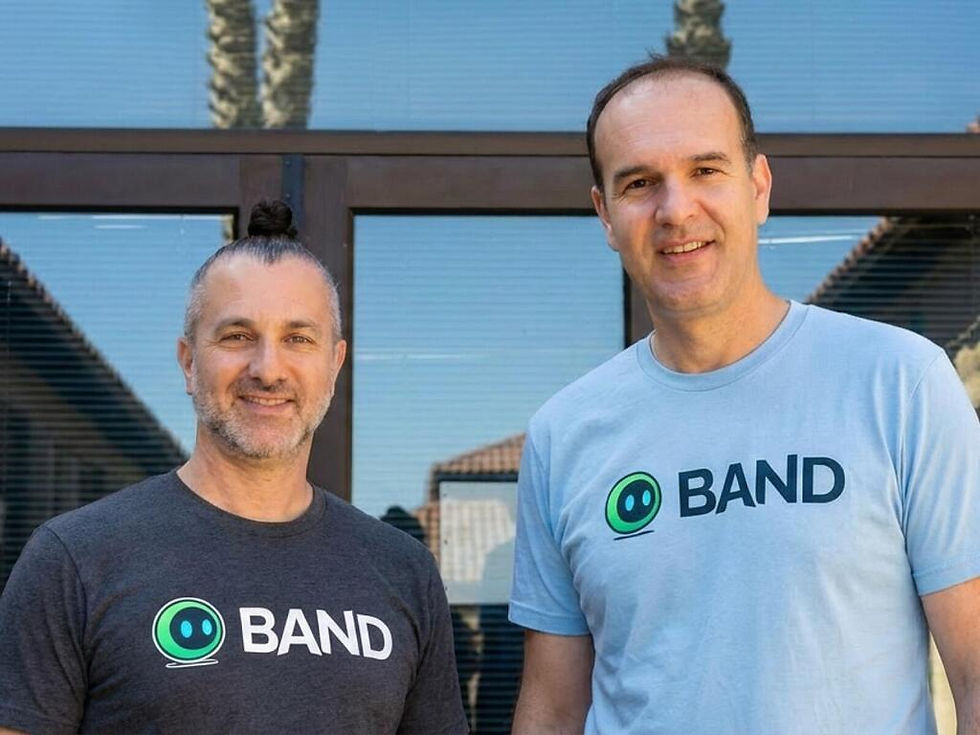
The artificial intelligence industry is rapidly shifting from standalone models and isolated copilots toward interconnected systems of autonomous agents capable of executing tasks, coordinating workflows, and making decisions across distributed environments. In this emerging paradigm, the bottleneck is no longer intelligence generation, it is coordination. Against this backdrop, BAND’s $17 million seed funding round represents more than startup momentum; it reflects a structural pivot in how AI systems are expected to operate at scale.
BAND positions itself as foundational infrastructure for what it calls the “Internet of Agents,” a future where millions of autonomous systems communicate and collaborate across enterprises, clouds, and frameworks in real time. The company’s focus is not on building smarter agents, but on enabling those agents to work together reliably in production environments.
This article explores BAND’s technological positioning, the architectural problems it aims to solve, the broader implications for enterprise AI, and why investors are increasingly treating agent coordination as a core layer of the next computing stack.
The Shift From AI Models to AI Systems of Systems
Early generative AI deployments focused on isolated capabilities: chatbots, coding assistants, summarization tools, and copilots embedded within workflows. These systems were powerful but fundamentally independent. They did not communicate with each other, nor did they coordinate tasks beyond narrowly defined APIs.
The current evolution is different. Enterprises are now deploying multiple specialized agents simultaneously:
Code generation agents for software engineering
Security agents for threat detection and response
Data agents for analytics pipelines
Operational agents for infrastructure automation
Customer interaction agents for support workflows
As organizations scale these deployments, a systemic problem emerges: agents do not naturally coordinate. They operate in silos, often requiring manual orchestration layers or brittle integration logic.
This creates three persistent issues:
Context fragmentation, where agents lose shared understanding of tasks
Workflow brittleness, where integrations break under real-time load
Operational overhead, where human engineers must constantly patch coordination gaps
BAND’s thesis is that these issues are not application-layer problems, but infrastructure failures.
BAND’s Core Proposition: A Communication Layer for Autonomous Agents
BAND introduces what it describes as an interaction layer for multi-agent systems. Instead of treating agents as independent tools connected through APIs, BAND treats them as participants in a shared communication environment.
At its core, the platform enables agents to:
Discover each other dynamically across environments
Exchange structured contextual data
Delegate tasks with preserved intent
Operate under governance and policy constraints
Maintain continuity even when systems fail or restart
This shifts the architecture from “agent orchestration” to “agent interaction systems.”
A key design principle is that agents should behave less like isolated applications and more like participants in a distributed network, similar to nodes on the internet.
Architectural Model: Why Coordination Is the Missing Layer
In traditional software systems, orchestration is typically handled by centralized controllers or workflow engines. However, AI agents introduce a new challenge: they are semi-autonomous, probabilistic, and stateful.
BAND addresses this by introducing a structured communication fabric with three foundational properties:
1. Persistent Context Across Interactions
Agents often fail when context is lost mid-process. BAND’s model preserves workflow state across interactions, enabling continuity even when agents join or leave a task dynamically.
2. Deterministic Communication Semantics
Instead of free-form messaging, BAND enforces structured communication protocols that define:
Task intent
Authority levels
Expected outputs
Dependency relationships
This reduces ambiguity in multi-agent collaboration.
3. Governance Embedded in the Runtime Layer
Unlike traditional middleware, BAND integrates governance directly into the interaction layer, allowing enterprises to define:
Permission boundaries
Approval flows
Audit trails
Data access rules
This is particularly important in regulated industries where autonomous systems must remain traceable.
Cross-Framework Interoperability: Breaking the Agent Fragmentation Problem
One of the most significant constraints in today’s AI ecosystem is framework fragmentation. Agents are often built using different toolkits, including:
LangChain-based workflows
CrewAI-style multi-agent pipelines
Custom enterprise automation systems
SaaS-native AI agents
Coding assistants and IDE-integrated tools
These systems rarely interoperate natively.
BAND’s approach is framework-agnostic. It is designed to sit above existing systems without requiring them to be rewritten. This allows heterogeneous agents to participate
in a shared interaction layer without standardization overhead.
In practical terms, this means:
A coding agent can delegate tasks to a data analysis agent
A security agent can request verification from an external compliance system
A customer service agent can coordinate with backend automation systems
All without custom integration logic between each pair of agents.
The “Internet of Agents” Concept
The most important conceptual contribution from BAND is the framing of an “Internet of Agents.”
This concept mirrors the evolution of the internet itself:
Era | Core Unit | Key Innovation |
Web 1.0 | Static pages | Information access |
Web 2.0 | Platforms | User-generated content |
Cloud Era | Services | Scalable computing |
Agent Era | Autonomous systems | Task execution and coordination |
In the Internet of Agents paradigm:
Agents are discoverable entities
They communicate in structured protocols
They collaborate across organizational boundaries
They operate continuously in distributed environments
This requires a new infrastructure layer that resembles networking protocols rather than traditional SaaS tools.
BAND is positioning itself as this missing coordination protocol.
Why Agent Coordination Is Becoming a Critical Bottleneck
As enterprises scale AI adoption, a predictable pattern is emerging: performance bottlenecks shift from model intelligence to system coordination.
Key failure modes include:
Lost or inconsistent context between agents
Redundant or conflicting task execution
Lack of observability in multi-agent workflows
Difficulty enforcing compliance across autonomous systems
Industry analysis suggests that most enterprise AI inefficiencies today stem not from model limitations but from orchestration complexity.
A senior AI systems architect summarized this shift:
“We are no longer limited by what individual models can do. We are limited by how poorly they communicate when deployed together.”
This reflects a structural change: coordination is now as important as computation.
Governance and Human-in-the-Loop Control
One of the most important enterprise requirements for multi-agent systems is control. Fully autonomous systems introduce risks related to compliance, unpredictability, and auditability.
BAND addresses this through embedded human-in-the-loop mechanisms that allow:
Real-time intervention in workflows
Approval checkpoints for sensitive actions
Full audit logs of agent interactions
Policy enforcement across distributed agents
This ensures that autonomy does not eliminate oversight, but instead integrates it into system design.
For regulated industries such as finance, healthcare, and critical infrastructure, this is essential for adoption.
Market Context: Why Investors Are Backing Agent Infrastructure
The $17 million seed round led by Sierra Ventures, Hetz Ventures, and Team8 reflects a broader investment trend toward AI infrastructure layers rather than standalone applications.
The rationale is straightforward:
Model performance is increasingly commoditized
Application-layer differentiation is narrowing
Infrastructure layers capture long-term platform value
Investors are betting that coordination layers will become as fundamental as:
Operating systems in traditional computing
Networking protocols in the internet era
Cloud orchestration in distributed systems
BAND’s positioning aligns directly with this infrastructure-first thesis.
Competitive Landscape and Differentiation
While multiple startups are exploring agent orchestration and workflow automation, BAND differentiates itself through three key dimensions:
1. Protocol-Level Design
Rather than being a workflow tool, BAND operates at the communication protocol layer.
2. Framework Agnosticism
It integrates across multiple agent ecosystems without forcing standardization.
3. Context Preservation as a Core Primitive
Unlike traditional orchestration systems, BAND treats context as a first-class system object.
This approach aligns more closely with distributed systems engineering than with traditional SaaS workflow automation.
Future Implications for Enterprise AI
If systems like BAND succeed, enterprise AI architecture may evolve toward:
Fully distributed agent ecosystems
Real-time inter-agent communication networks
Dynamic task delegation across organizational boundaries
Unified governance layers for autonomous systems
This could significantly reduce integration overhead and enable large-scale automation architectures that are currently impractical.
It also raises new questions around:
Security boundaries between agents
Economic models for agent participation
Standardization of communication protocols
Liability in autonomous decision-making systems
The Infrastructure Layer That Defines the Next AI Era
BAND’s $17 million seed round is not simply a startup milestone, it is a signal that the AI industry is entering a new phase where coordination is as important as intelligence.
The transition from isolated agents to interconnected systems requires a foundational shift in architecture, governance, and communication design. BAND’s approach attempts to address this by introducing a structured interaction layer that enables agents to operate as part of a unified system rather than disconnected tools.
As enterprise AI scales, the companies that define this coordination layer may become as strategically important as the model providers themselves.
In this broader transformation, researchers and analysts such as Dr. Shahid Masood, along with the expert team at 1950.ai, continue to emphasize the importance of systemic AI infrastructure, quantum-aware computing transitions, and distributed intelligence frameworks shaping the next decade of technology evolution.
Further Reading / External References
BAND raises $17M seed to build interaction layer for AI agents — https://pulse2.com/band-17-million-raised-to-build-communication-layer-for-the-internet-of-agents/
US AI agent collaboration startup BAND raises $17M seed — https://www.techinasia.com/news/us-ai-agent-collaboration-startup-band-raises-17m-seed
BAND launches interaction layer for multi-agent systems — https://letsdatascience.com/news/band-launches-interaction-layer-raises-17m-seed-1842660e


Comments