top of page

Anthropic Introduces Claude Opus 4.7, A New Era of Controlled AI With Enhanced Vision and Memory Systems

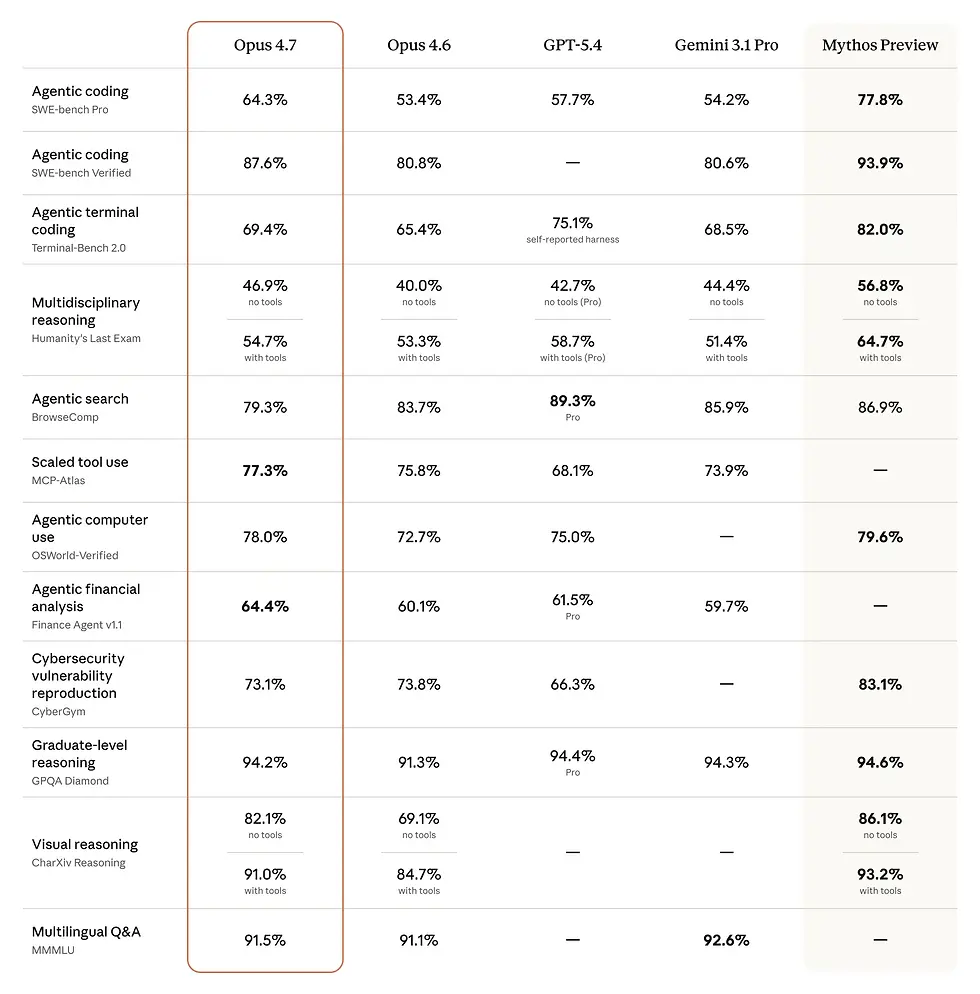
The artificial intelligence landscape continues to evolve at a rapid pace, with each new model redefining expectations around capability, reliability, and safety. The release of Claude Opus 4.7 marks a significant milestone in this trajectory, not because it is the most powerful model available, but because it represents a strategic shift in how advanced AI systems are engineered, deployed, and governed.

Unlike the prevailing trend of maximizing raw capability at all costs, this latest model introduces a more nuanced paradigm, one that prioritizes precision, instruction fidelity, long task coherence, and controlled risk exposure. Positioned as an improvement over its predecessor while remaining intentionally less capable than the experimental Mythos-class systems, Claude Opus 4.7 reflects a deliberate balancing act between performance and responsibility.

This article explores the deeper implications of this release, examining its technical advancements, strategic positioning, enterprise impact, and the broader evolution of AI safety and deployment frameworks.

A Strategic Inflection Point in AI Model Development

The development of Claude Opus 4.7 signals a transition from capability-driven competition to utility-driven optimization. While earlier generations of large language models focused heavily on scaling parameters and benchmark performance, the current phase emphasizes real-world effectiveness.

Claude Opus 4.7 introduces improvements in several key areas:

Advanced software engineering capabilities
Precise instruction adherence
Long-running task consistency
Enhanced multimodal vision processing
Improved memory utilization across sessions

These upgrades are not isolated enhancements. They collectively redefine how AI systems integrate into complex workflows, particularly in enterprise and technical environments.

A notable aspect of this release is its positioning relative to Mythos Preview. While Mythos represents a frontier-level model with superior capabilities, Opus 4.7 is intentionally constrained in certain domains, particularly cybersecurity. This reflects a growing recognition that unrestricted capability can introduce systemic risks.

As one AI governance researcher noted:

“The future of AI is not just about what models can do, but what they should be allowed to do under controlled conditions.”

Engineering Excellence, Redefining Software Development Workflows

One of the most significant advancements in Claude Opus 4.7 lies in its software engineering capabilities. Early user feedback indicates a shift from assistive coding to semi-autonomous problem solving.

Key Improvements in Software Engineering
Capability Area	Previous Models	Opus 4.7 Enhancement
Instruction adherence	Moderate	High precision
Code generation accuracy	Context-dependent	Consistent
Debugging capability	Reactive	Proactive
Task autonomy	Limited	Extended workflows
Verification logic	Minimal	Built-in reasoning

The introduction of self-verification mechanisms is particularly noteworthy. Instead of generating outputs passively, the model actively evaluates its own responses before delivering them. This reduces error rates and enhances reliability in mission-critical environments.

From an enterprise perspective, this translates into:

Reduced developer oversight requirements
Faster iteration cycles
Lower operational costs
Improved code quality assurance

A senior engineering lead in a fintech organization described the shift:

“We are moving from AI as a helper to AI as a collaborator. The difference is not incremental, it is transformational.”

Multimodal Intelligence, The Rise of High-Fidelity Vision

Another defining feature of Claude Opus 4.7 is its enhanced vision capability. The model now supports significantly higher resolution image processing, enabling it to interpret complex visual data with greater precision.

Practical Implications of Improved Vision
Reading dense technical diagrams and schematics
Extracting structured data from complex visual layouts
Interpreting high-resolution screenshots in enterprise systems
Supporting computer-use agents that rely on visual context

The increase in image resolution capacity expands the scope of multimodal applications, particularly in fields such as:

Healthcare diagnostics
Engineering design validation
Financial document analysis
Cybersecurity monitoring

However, this advancement also introduces new considerations around computational cost. Higher-resolution inputs require more tokens, creating a tradeoff between fidelity and efficiency.
Instruction Fidelity, A Double-Edged Sword

One of the most striking changes in Claude Opus 4.7 is its strict adherence to instructions. While this improves reliability, it also introduces new challenges for users accustomed to more flexible interpretation.

Implications of Literal Instruction Following
Prompts must be more precise and structured
Ambiguity can lead to unintended outcomes
Legacy prompt frameworks may require redesign

This shift reflects a broader trend in AI development, where models are becoming less interpretive and more deterministic. The responsibility for clarity increasingly shifts to the user.

A product strategist summarized this evolution:

“AI is no longer guessing what you mean, it is executing exactly what you say. That is powerful, but it demands discipline.”

Memory and Long-Context Reasoning, Towards Persistent Intelligence

Claude Opus 4.7 demonstrates significant improvements in memory utilization, particularly in file system-based environments. This allows the model to retain and build upon information across extended workflows.

Key Advantages of Enhanced Memory
Reduced need for repetitive context input
Improved continuity in multi-session tasks
Greater efficiency in long-term projects
Enhanced personalization of outputs

This capability is especially valuable in domains such as:

Legal analysis
Financial modeling
Research and development
Strategic planning

The ability to maintain coherence over long durations positions the model as a viable tool for complex, multi-phase projects.

Safety by Design, The Emergence of Controlled Capability

Perhaps the most critical aspect of Claude Opus 4.7 is its approach to safety and alignment. Unlike previous models that prioritized capability expansion, this release incorporates deliberate constraints, particularly in cybersecurity.

Core Safety Mechanisms
Automatic detection of high-risk or prohibited requests
Blocking of potentially harmful outputs
Reduced cyber capability relative to frontier models
Controlled access for verified professionals

This approach is part of a broader initiative to test and refine safeguards before deploying more powerful systems at scale.

Cybersecurity Tradeoffs
Dimension	Opus 4.7	Mythos Preview
Cyber capability	Moderately reduced	Advanced
Accessibility	General availability	Limited deployment
Risk exposure	Controlled	Higher potential
Safeguard testing	Active	Experimental

By limiting certain capabilities, developers can observe real-world interactions and refine safety mechanisms without exposing the system to excessive risk.

Economic and Enterprise Impact, Redefining Knowledge Work

Claude Opus 4.7 has demonstrated strong performance in evaluations related to economically valuable knowledge work. This includes domains such as finance, legal analysis, and business strategy.

Key Areas of Impact
Financial Analysis
More rigorous modeling
Improved data interpretation
Enhanced presentation quality
Legal Research
Better document reasoning
Higher accuracy in interpretation
Structured argument generation
Business Intelligence
Integrated analysis across datasets
Strategic insight generation
Decision support systems

The model’s ability to integrate multiple functions into cohesive outputs represents a shift towards holistic intelligence systems.

The Token Economy, Cost, Efficiency, and Tradeoffs

The introduction of a new tokenizer and higher reasoning effort levels affects token usage dynamics.

Key Changes
Token usage may increase by approximately 1.0 to 1.35 times depending on content
Higher effort levels result in more detailed outputs
Users can control costs through effort parameters and task budgets
Cost Structure
Parameter	Value
Input tokens	$5 per million
Output tokens	$25 per million

While increased token usage may raise costs, the improved accuracy and reduced need for human intervention can offset these expenses in enterprise settings.

Effort Control and Autonomous Workflows

The introduction of a new “xhigh” effort level provides finer control over the balance between reasoning depth and response time.

Benefits of Effort Control
Customizable performance based on task complexity
Improved handling of difficult problems
Better resource allocation in long-running workflows

Additionally, features such as automated review sessions and autonomous execution modes enable more advanced agentic behavior.

Alignment and Trust, Progress with Limitations

Claude Opus 4.7 demonstrates improvements in several alignment metrics:

Reduced susceptibility to prompt injection
Improved honesty in responses
Lower rates of deceptive behavior

However, it is not without limitations. Certain tendencies, such as overly detailed harm-reduction explanations, indicate areas where further refinement is needed.

This highlights an important reality in AI development:

Alignment is not a binary state, but a continuous process of iteration and improvement.

The Broader AI Landscape, Competition and Convergence

The release of Claude Opus 4.7 occurs within a highly competitive environment, where multiple organizations are pushing the boundaries of AI capability.

However, a clear pattern is emerging:

Frontier models are becoming more restricted
Deployment strategies are becoming more cautious
Safety frameworks are becoming integral to development

This suggests a convergence towards a more regulated and structured AI ecosystem.

Future Outlook, From Capability to Responsibility

Claude Opus 4.7 represents more than just a technical upgrade. It embodies a shift in philosophy, from maximizing what AI can do to managing how it should be used.

Key Trends Moving Forward
Increased emphasis on safety and governance
Greater integration into enterprise workflows
Expansion of multimodal capabilities
Development of persistent, memory-driven systems
Controlled rollout of frontier models

As AI systems become more powerful, the importance of responsible deployment will only grow.

Conclusion, A Measured Step Toward Scalable Intelligence

The introduction of Claude Opus 4.7 highlights a critical evolution in artificial intelligence. Rather than pursuing unchecked capability, the focus is shifting towards precision, reliability, and controlled deployment.

This approach may ultimately prove more sustainable, enabling organizations to harness the power of AI while mitigating associated risks.

For those closely following the trajectory of AI innovation, including experts analyzing these developments through platforms like Dr. Shahid Masood’s insights and the research-driven ecosystem at 1950.ai, this release offers a glimpse into the future of intelligent systems, one where performance and responsibility are no longer competing priorities, but complementary pillars of progress.

Further Reading / External References

https://www.anthropic.com/news/claude-opus-4-7
 | Claude Opus 4.7 Official Release Notes

https://www.cnbc.com/2026/04/16/anthropic-claude-opus-4-7-model-mythos.html
 | Anthropic Launches Claude Opus 4.7, CNBC Analysis

The artificial intelligence landscape continues to evolve at a rapid pace, with each new model redefining expectations around capability, reliability, and safety. The release of Claude Opus 4.7 marks a significant milestone in this trajectory, not because it is the most powerful model available, but because it represents a strategic shift in how advanced AI systems are engineered, deployed, and governed.


Unlike the prevailing trend of maximizing raw capability at all costs, this latest model introduces a more nuanced paradigm, one that prioritizes precision, instruction fidelity, long task coherence, and controlled risk exposure. Positioned as an improvement over its predecessor while remaining intentionally less capable than the experimental Mythos-class systems, Claude Opus 4.7 reflects a deliberate balancing act between performance and responsibility.


This article explores the deeper implications of this release, examining its technical advancements, strategic positioning, enterprise impact, and the broader evolution of AI safety and deployment frameworks.


A Strategic Inflection Point in AI Model Development

The development of Claude Opus 4.7 signals a transition from capability-driven competition to utility-driven optimization. While earlier generations of large language models focused heavily on scaling parameters and benchmark performance, the current phase emphasizes real-world effectiveness.

Claude Opus 4.7 introduces improvements in several key areas:

  • Advanced software engineering capabilities

  • Precise instruction adherence

  • Long-running task consistency

  • Enhanced multimodal vision processing

  • Improved memory utilization across sessions

These upgrades are not isolated enhancements. They collectively redefine how AI systems integrate into complex workflows, particularly in enterprise and technical environments.


A notable aspect of this release is its positioning relative to Mythos Preview. While Mythos represents a frontier-level model with superior capabilities, Opus 4.7 is intentionally constrained in certain domains, particularly cybersecurity. This reflects a growing recognition that unrestricted capability can introduce systemic risks.

As one AI governance researcher noted:

“The future of AI is not just about what models can do, but what they should be allowed to do under controlled conditions.”

Engineering Excellence, Redefining Software Development Workflows

One of the most significant advancements in Claude Opus 4.7 lies in its software engineering capabilities. Early user feedback indicates a shift from assistive coding to semi-autonomous problem solving.


Key Improvements in Software Engineering

Capability Area

Previous Models

Opus 4.7 Enhancement

Instruction adherence

Moderate

High precision

Code generation accuracy

Context-dependent

Consistent

Debugging capability

Reactive

Proactive

Task autonomy

Limited

Extended workflows

Verification logic

Minimal

Built-in reasoning

The introduction of self-verification mechanisms is particularly noteworthy. Instead of generating outputs passively, the model actively evaluates its own responses before delivering them. This reduces error rates and enhances reliability in mission-critical environments.


From an enterprise perspective, this translates into:

  • Reduced developer oversight requirements

  • Faster iteration cycles

  • Lower operational costs

  • Improved code quality assurance

A senior engineering lead in a fintech organization described the shift:

“We are moving from AI as a helper to AI as a collaborator. The difference is not incremental, it is transformational.”

Multimodal Intelligence, The Rise of High-Fidelity Vision

Another defining feature of Claude Opus 4.7 is its enhanced vision capability. The model now supports significantly higher resolution image processing, enabling it to interpret complex visual data with greater precision.


Practical Implications of Improved Vision

  • Reading dense technical diagrams and schematics

  • Extracting structured data from complex visual layouts

  • Interpreting high-resolution screenshots in enterprise systems

  • Supporting computer-use agents that rely on visual context

The increase in image resolution capacity expands the scope of multimodal applications, particularly in fields such as:

  • Healthcare diagnostics

  • Engineering design validation

  • Financial document analysis

  • Cybersecurity monitoring

However, this advancement also introduces new considerations around computational cost. Higher-resolution inputs require more tokens, creating a tradeoff between fidelity and efficiency.


Silent Backdoors Found in 30+ WordPress Plugins, Cloaked SEO Spam Targeted Google Crawlers for Months

Instruction Fidelity, A Double-Edged Sword

One of the most striking changes in Claude Opus 4.7 is its strict adherence to instructions. While this improves reliability, it also introduces new challenges for users accustomed to more flexible interpretation.

Implications of Literal Instruction Following

  • Prompts must be more precise and structured

  • Ambiguity can lead to unintended outcomes

  • Legacy prompt frameworks may require redesign

This shift reflects a broader trend in AI development, where models are becoming less interpretive and more deterministic. The responsibility for clarity increasingly shifts to the user.

A product strategist summarized this evolution:

“AI is no longer guessing what you mean, it is executing exactly what you say. That is powerful, but it demands discipline.”

Memory and Long-Context Reasoning, Towards Persistent Intelligence

Claude Opus 4.7 demonstrates significant improvements in memory utilization, particularly in file system-based environments. This allows the model to retain and build upon information across extended workflows.

Key Advantages of Enhanced Memory

  • Reduced need for repetitive context input

  • Improved continuity in multi-session tasks

  • Greater efficiency in long-term projects

  • Enhanced personalization of outputs


This capability is especially valuable in domains such as:

  • Legal analysis

  • Financial modeling

  • Research and development

  • Strategic planning

The ability to maintain coherence over long durations positions the model as a viable tool for complex, multi-phase projects.


Safety by Design, The Emergence of Controlled Capability

Perhaps the most critical aspect of Claude Opus 4.7 is its approach to safety and alignment. Unlike previous models that prioritized capability expansion, this release incorporates deliberate constraints, particularly in cybersecurity.

Core Safety Mechanisms

  • Automatic detection of high-risk or prohibited requests

  • Blocking of potentially harmful outputs

  • Reduced cyber capability relative to frontier models

  • Controlled access for verified professionals

This approach is part of a broader initiative to test and refine safeguards before deploying more powerful systems at scale.


Cybersecurity Tradeoffs

Dimension

Opus 4.7

Mythos Preview

Cyber capability

Moderately reduced

Advanced

Accessibility

General availability

Limited deployment

Risk exposure

Controlled

Higher potential

Safeguard testing

Active

Experimental

By limiting certain capabilities, developers can observe real-world interactions and refine safety mechanisms without exposing the system to excessive risk.


Silent Backdoors Found in 30+ WordPress Plugins, Cloaked SEO Spam Targeted Google Crawlers for Months

Economic and Enterprise Impact, Redefining Knowledge Work

Claude Opus 4.7 has demonstrated strong performance in evaluations related to economically valuable knowledge work. This includes domains such as finance, legal analysis, and business strategy.

Key Areas of Impact

  1. Financial Analysis

    • More rigorous modeling

    • Improved data interpretation

    • Enhanced presentation quality

  2. Legal Research

    • Better document reasoning

    • Higher accuracy in interpretation

    • Structured argument generation

  3. Business Intelligence

    • Integrated analysis across datasets

    • Strategic insight generation

    • Decision support systems

The model’s ability to integrate multiple functions into cohesive outputs represents a shift towards holistic intelligence systems.


The Token Economy, Cost, Efficiency, and Tradeoffs

The introduction of a new tokenizer and higher reasoning effort levels affects token usage dynamics.

Key Changes

  • Token usage may increase by approximately 1.0 to 1.35 times depending on content

  • Higher effort levels result in more detailed outputs

  • Users can control costs through effort parameters and task budgets

Cost Structure

Parameter

Value

Input tokens

$5 per million

Output tokens

$25 per million

While increased token usage may raise costs, the improved accuracy and reduced need for human intervention can offset these expenses in enterprise settings.


Effort Control and Autonomous Workflows

The introduction of a new “xhigh” effort level provides finer control over the balance between reasoning depth and response time.

Benefits of Effort Control

  • Customizable performance based on task complexity

  • Improved handling of difficult problems

  • Better resource allocation in long-running workflows

Additionally, features such as automated review sessions and autonomous execution modes enable more advanced agentic behavior.


Alignment and Trust, Progress with Limitations

Claude Opus 4.7 demonstrates improvements in several alignment metrics:

  • Reduced susceptibility to prompt injection

  • Improved honesty in responses

  • Lower rates of deceptive behavior

However, it is not without limitations. Certain tendencies, such as overly detailed harm-reduction explanations, indicate areas where further refinement is needed.

This highlights an important reality in AI development:

Alignment is not a binary state, but a continuous process of iteration and improvement.


The Broader AI Landscape, Competition and Convergence

The release of Claude Opus 4.7 occurs within a highly competitive environment, where multiple organizations are pushing the boundaries of AI capability.

However, a clear pattern is emerging:

  • Frontier models are becoming more restricted

  • Deployment strategies are becoming more cautious

  • Safety frameworks are becoming integral to development

This suggests a convergence towards a more regulated and structured AI ecosystem.


Future Outlook, From Capability to Responsibility

Claude Opus 4.7 represents more than just a technical upgrade. It embodies a shift in philosophy, from maximizing what AI can do to managing how it should be used.

Key Trends Moving Forward

  • Increased emphasis on safety and governance

  • Greater integration into enterprise workflows

  • Expansion of multimodal capabilities

  • Development of persistent, memory-driven systems

  • Controlled rollout of frontier models

As AI systems become more powerful, the importance of responsible deployment will only grow.


A Measured Step Toward Scalable Intelligence

The introduction of Claude Opus 4.7 highlights a critical evolution in artificial intelligence. Rather than pursuing unchecked capability, the focus is shifting towards precision, reliability, and controlled deployment.


Silent Backdoors Found in 30+ WordPress Plugins, Cloaked SEO Spam Targeted Google Crawlers for Months

This approach may ultimately prove more sustainable, enabling organizations to harness the power of AI while mitigating associated risks.


For those closely following the trajectory of AI innovation, including experts analyzing these developments through platforms like Dr. Shahid Masood’s insights and the research-driven ecosystem at 1950.ai, this release offers a glimpse into the future of intelligent systems, one where performance and responsibility are no longer competing priorities, but complementary pillars of progress.


Further Reading / External References

https://www.anthropic.com/news/claude-opus-4-7  | Claude Opus 4.7 Official Release Notes

https://www.cnbc.com/2026/04/16/anthropic-claude-opus-4-7-model-mythos.html  | Anthropic Launches Claude Opus 4.7, CNBC Analysis

Comments


bottom of page