
The Future of Work Starts in Your Inbox: Exploring Google CC’s AI-Powered Daily Summaries
- Miao Zhang

- Dec 23, 2025
- 5 min read
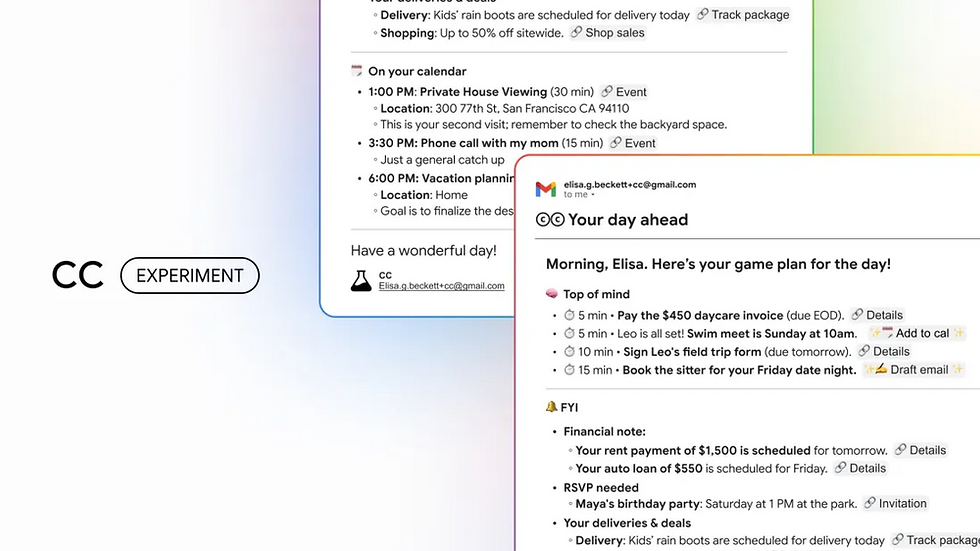
In the rapidly evolving world of artificial intelligence, productivity-focused AI agents are emerging as game-changers for professionals, marketers, and organizations alike. Google’s latest experimental AI agent, CC, demonstrates a bold step in this direction. Designed to provide personalized, actionable daily briefings directly to users’ inboxes, CC leverages the Gemini AI model to streamline workflows and enhance decision-making. This article explores the capabilities, strategic implications, and industry context of Google CC, offering expert insights into how it may redefine productivity in 2026 and beyond.
The Emergence of Inbox-Centric AI Assistants
Artificial intelligence has increasingly shifted from reactive tools to proactive agents, capable of anticipating user needs and delivering contextual information without explicit queries. CC represents a next-generation application of this trend, integrating tightly with Google’s ecosystem, including Gmail, Google Calendar, Google Drive, and broader web signals. Unlike traditional chatbots that require user initiation, CC delivers a daily “Your Day Ahead” briefing that aggregates critical tasks, meetings, and documents, all in a concise email format.
Experts in AI productivity solutions highlight the growing importance of “inbox-first” AI, noting that professionals often begin their workday in email. By meeting users where they already operate, CC reduces friction and enables faster decision-making. As productivity strategist Dr. Ananya Rao states, “The most effective AI assistants are those that integrate seamlessly into existing workflows rather than forcing behavioral change.”
How CC Works: Architecture and Functionality
CC’s operational framework relies on the Gemini AI model, Google’s proprietary generative AI system. The assistant functions by:
Data Integration: Connecting to Gmail, Calendar, Drive, and external web data to capture user activities, schedules, and relevant documents.
Personalized Summarization: Analyzing daily tasks, appointments, and deadlines to generate a clear, actionable briefing.
Proactive Assistance: Offering pre-populated email drafts, calendar links, and reminders to reduce manual task management.
Learning and Adaptation: Allowing users to teach CC preferences, assign to-dos, and save notes through email interaction, enabling continuous personalization.
The system is designed to learn from user interactions, enhancing the accuracy of its daily briefings over time. Early access is limited to paid Google AI Ultra subscribers in the U.S. and Canada, reflecting Google’s controlled rollout strategy to gather feedback and optimize performance before wider deployment.
Comparative Analysis: CC vs. Other AI Assistants
While email-focused AI assistants are not entirely new, CC differentiates itself through native integration with Google’s ecosystem. Competing tools, such as OpenAI’s ChatGPT Pulse or third-party assistants like Read AI and Fireflies, rely on indirect access to user data or external APIs. CC’s deeper contextual understanding of Gmail threads, Drive files, and Calendar events enables it to generate more precise and actionable insights.
A comparative table highlights CC’s unique positioning:
Feature | Google CC | ChatGPT Pulse | Read AI | Fireflies |
Data Source | Gmail, Calendar, Drive, Web | ChatGPT integration | Meeting transcripts | Meeting transcripts |
Delivery Method | Email brief | Dashboard / App | Email / App | Email / App |
Personalization | Continuous learning from emails & replies | Limited | Limited | Limited |
Pre-Action Support | Email drafts, calendar links | None | None | Task summaries |
Accessibility | Early access for AI Ultra subscribers | General users | Paid users | Paid users |
Industry analysts emphasize that the “email-first” strategy could enhance adoption among professionals already accustomed to starting their day in the inbox. This contrasts with AI tools that demand adoption of new interfaces or standalone applications, which often create friction.
Strategic Implications for Businesses and Marketers
The introduction of CC signals broader trends in AI-driven productivity:
Reduction of Decision Fatigue: By summarizing key tasks and meetings, CC minimizes the cognitive load associated with prioritizing activities at the start of the day.
Enhanced Marketing Workflow: Marketers managing multiple campaigns and assets can benefit from CC’s consolidated daily overview, improving responsiveness and campaign execution.
Potential for Organizational Scaling: While initially consumer-focused, expansion to Workspace accounts could enable cross-departmental planning, facilitating coordination across large teams.
John Matthews, a digital productivity consultant, notes, “AI agents like CC could transform operational efficiency by automating context synthesis, which is traditionally a manual, error-prone process.”
Limitations and Current Constraints
Despite its promise, CC faces several limitations:
Workspace Exclusion: Currently, CC is limited to consumer Gmail accounts, reducing its applicability for corporate environments.
Privacy Considerations: Deep integration with personal emails and documents raises questions about data security and consent. Google emphasizes that CC adheres to existing privacy protocols, but organizations may require additional safeguards.
Adoption Curve: As an early Labs experiment, CC’s usefulness is dependent on user engagement and iterative learning, which may limit immediate impact.
The Future of AI-Driven Productivity
CC is part of a larger trend toward proactive, context-aware AI agents. Analysts project that by 2026, AI assistants will increasingly function as embedded workflow managers rather than isolated tools. Key industry predictions include:
Automation of Routine Tasks: AI will draft emails, schedule meetings, and prepare reports with minimal human input.
Personalized Decision Support: AI agents will offer predictive suggestions based on historical behavior and organizational priorities.
Integration Across Platforms: Cross-ecosystem compatibility will become a standard expectation, allowing seamless operation across multiple productivity suites.
Early indications suggest that tools like CC could reduce the time professionals spend on information triage by 20–30% daily, potentially freeing hours for strategic tasks.
Industry experts emphasize the importance of user-centric design in AI assistants. Dr. Lena Fischer, a productivity technology researcher, explains,
“The success of AI in professional settings hinges on trust, reliability, and relevance. CC’s ability to deliver concise, accurate briefings while respecting privacy is key to adoption.”
Furthermore, CC demonstrates the strategic value of leveraging existing ecosystem dominance. By embedding the assistant within Gmail, Calendar, and Drive, Google leverages behavioral patterns, encouraging adoption without introducing significant disruption.
The Role of CC in the Productivity Landscape
Google CC represents a significant innovation in AI-driven productivity, combining proactive assistance, deep ecosystem integration, and adaptive learning. Its early rollout to U.S. and Canadian AI Ultra subscribers offers a controlled environment to refine personalization, security, and task automation features. For marketers and professionals navigating complex schedules, CC could become an indispensable tool, potentially reshaping the daily workflow by reducing decision fatigue and centralizing critical information.
As AI continues to integrate into everyday professional environments, initiatives like CC signal a shift toward intelligent, anticipatory systems that meet users where they operate. The implications extend beyond individual productivity to organizational efficiency, cross-team coordination, and the evolution of digital workplace practices.
For ongoing insights into AI-driven productivity, visit the expert team at 1950.ai and explore research and analysis led by Dr. Shahid Masood, providing actionable guidance on implementing advanced AI solutions in professional and organizational contexts.
Further Reading / External References
Google ContentGrip. Google Email Assistant CC: Boost Your Daily Productivity. Available at: https://www.contentgrip.com/google-email-assistant-cc/
Google Blog. CC: Your AI Agent for Daily Briefings. Available at: https://blog.google/technology/google-labs/cc-ai-agent/
The Verge. Google Wants Its AI Assistant CC to Replace Your Morning Scroll. Available at: https://www.theverge.com/news/845280/google-cc-morning-briefing-gemini-ai-agent


Comments