
Tesla’s Biggest Transformation Yet: 80X More AI Compute, Space-Ready Chips, and Humanoid Robots

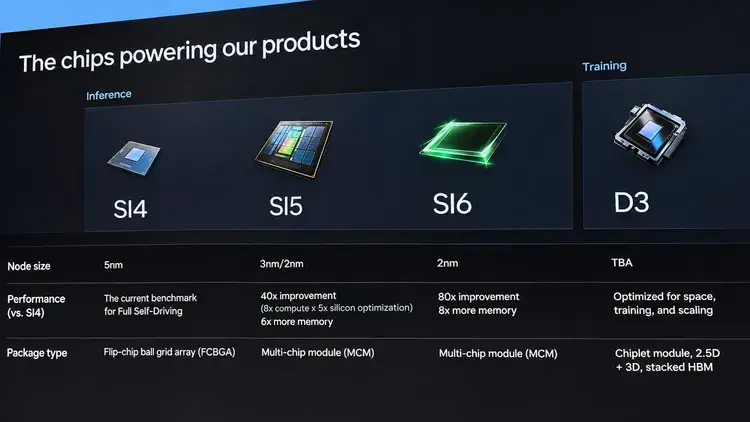
Tesla is undergoing a significant strategic transformation, shifting its manufacturing priorities and technology investments toward artificial intelligence, autonomous transportation, and robotics. Two developments illustrate the scale of this transition: the company's newly disclosed AI accelerator roadmap, featuring a future inference processor expected to deliver up to 80 times the estimated computing performance of its current-generation hardware, and its reported plan to end Cybertruck production in 2027 to make additional factory capacity available for Cybercab robotaxis.
Together, these developments reveal a broader ambition. Tesla increasingly wants to operate not simply as an electric vehicle manufacturer, but as an integrated technology company combining custom semiconductor development, AI software, autonomous vehicles, manufacturing infrastructure, and humanoid robotics.
The company's next-generation SI5 and SI6 processors are intended to support increasingly demanding AI workloads, while the redesigned Dojo D3 training accelerator points toward a different approach to large-scale computing. At the manufacturing level, the planned Cybertruck phaseout reflects a decision to redirect resources toward autonomous mobility.
However, the strategy also raises important questions about execution, investment priorities, hardware scalability, and the commercial viability of autonomous transportation. Tesla's future will depend on whether its technological ambitions can translate into reliable products and sustainable revenue.
Tesla’s New AI Accelerator Roadmap: From AI Chips to Super Intelligence
Tesla has introduced a new naming convention for its AI hardware, replacing the artificial intelligence terminology with the phrase Super Intelligence, or SI. Its existing and upcoming accelerators are being incorporated into this branding, including SI4, SI5, and SI6.
The terminology reflects Elon Musk's broader emphasis on developing increasingly capable AI systems. SpaceXAI is also being renamed SpaceXSI, indicating that the terminology is intended to extend beyond Tesla's semiconductor products.
The more consequential development, however, is the hardware roadmap itself. Tesla is planning substantial increases in processing capacity, memory, and packaging sophistication as its AI workloads become more demanding.
The roadmap includes two main categories:
Inference accelerators: Processors designed to execute trained AI models, including the systems used for autonomous driving and other real-time applications.
Training accelerators: Processors designed to train or refine AI models through computationally intensive operations.
Inference and training have different hardware requirements. Inference systems must deliver responses efficiently, often under strict latency and power constraints. Training systems must support extensive calculations across large datasets and model parameters, frequently using interconnected processors and high-bandwidth memory.
Tesla's roadmap reflects an effort to develop specialized hardware for both sides of this computing process.
SI4, SI5, and SI6: How Tesla Plans to Increase AI Computing Performance
Tesla's fourth-generation inference accelerator, previously referred to as HW4 and AI4, is the baseline for the company's next generations of processors.
According to the supplied roadmap, the processor is manufactured by Samsung Foundry using a 7nm-class process and conventional flip-chip ball grid array packaging. It reportedly uses 16 GB of GDDR6 memory.
Tesla has not officially published a complete set of absolute performance specifications for this chip. Estimates based on Elon Musk's earlier comparison with HW3 place its computing capability between 216 and 576 TOPS, although actual performance depends on the measurement method and supported numerical formats.
The upcoming SI5 and SI6 generations represent substantially more ambitious designs.
Specification | SI4 / HW4 | SI5 / HW5 | SI6 |
Primary application | Inference | Inference | Inference |
Manufacturing process | Samsung 7nm-class | TSMC 3nm / Samsung 2nm-class | 2nm-class |
Architecture | Monolithic | Multi-chip module | Multi-chip module |
Packaging | FCBGA | MCM | MCM |
Memory | 16 GB GDDR6 | 96 GB GDDR6/GDDR7, projected | 144 GB GDDR7, projected |
Estimated performance relative to SI4 | 1X | 40X | 80X |
Estimated compute | 216–576 TOPS | 8,640–23,040 TOPS | 17,280–46,080 TOPS |
Expected status | Production | Nearing production | Development |
These figures are roadmap estimates, not independently established measurements of commercially available processors. Actual performance will depend on hardware configurations, numerical precision, software optimization, power limits, and the workloads being measured.
SI5: Tesla’s Transition to Multi-Chip Architecture
Tesla's fifth-generation inference accelerator, known as SI5, is expected to use manufacturing processes in the 3nm and 2nm classes, with production involving TSMC and Samsung Foundry.
A major architectural change is the move from a conventional monolithic chip toward a multi-chip module design.
Instead of placing all major computing resources on one large silicon die, multi-chip modules combine multiple dies within a package. This approach can improve manufacturing flexibility and allow different components to be optimized for specific functions.
The supplied roadmap estimates a 40-fold performance increase over SI4. Elon Musk has previously attributed the expected improvement to a combination of increased computing capability and silicon optimization.
SI5 is also expected to offer approximately 96 GB of memory, six times the capacity attributed to SI4.
The reported power range of 250W to 800W, depending on the application, illustrates the engineering challenge involved in deploying such hardware. Greater computational capacity requires careful management of power delivery, heat dissipation, packaging, and reliability.
SI6: The Roadmap’s Most Ambitious Inference Processor
Tesla's sixth-generation inference accelerator, SI6, is expected to deliver an estimated 80-fold performance improvement over SI4.
The roadmap associates this processor with approximately 144 GB of memory and a 2nm-class manufacturing process. Its projected computing performance ranges from 17,280 to 46,080 TOPS, depending on the baseline used for comparison.
The reported production timeline is approximately 2029 to 2030.
Tesla has also entered into an agreement with Samsung Foundry covering production of its sixth-generation inference accelerators through 2033. The precise Samsung manufacturing variant has not been established, although possible 2nm-class technologies include automotive-oriented and performance-focused process developments.
An important distinction is that TOPS figures cannot be compared directly without knowing the numerical formats and operating conditions involved. A processor delivering a particular number of operations per second using low-precision arithmetic does not necessarily provide equivalent performance for higher-precision calculations.
This matters when comparing Tesla's projected SI6 with competing accelerators. Nvidia's Rubin platform, for example, has been associated in the supplied reporting with 50 NVFP4 PFLOPS for inference, 35 NVFP4 PFLOPS for training, and 17.5 FP8/FP6 PFLOPS. These figures use different precision categories and should not be treated as directly interchangeable with Tesla's estimated TOPS.
The more meaningful comparison will ultimately involve actual model throughput, latency, energy consumption, software compatibility, and total system cost.
Dojo D3: Tesla Moves Toward Chiplets and Stacked HBM
Another important development is the return of Tesla's Dojo training accelerator program.
The earlier Dojo architecture was built around wafer-scale integration. Rather than relying entirely on conventional individual processor packages, Dojo D1 used a large interconnected silicon structure designed to provide substantial on-chip communication and memory bandwidth.
Its architecture relied heavily on SRAM, a type of memory that offers high speed but relatively limited capacity compared with external memory technologies.
The D1 system connected 25 processors and incorporated approximately 11 GB of SRAM across a wafer, with individual dies containing substantial local memory.
The new Dojo D3 direction is different. Tesla describes it as a chiplet-based accelerator combining 2.5D and 3D packaging with stacked high-bandwidth memory, or HBM.
Why HBM Matters for Large AI Models
Modern AI training requires substantial memory resources. Model parameters, activations, gradients, and intermediate calculations must be stored and transferred during computation.
SRAM provides extremely fast access but is expensive in terms of silicon area. Increasing its capacity can make a processor physically larger and more costly.
HBM addresses a different part of the problem. It uses vertically stacked memory dies connected through high-density interconnects, allowing substantial memory capacity and bandwidth within a compact package.
This is particularly important for AI workloads that move large volumes of data between processors and memory.
Feature | SRAM-Centric Design | Stacked HBM Design |
Access characteristics | Very low latency | High bandwidth |
Capacity | Relatively limited | Higher capacity |
Physical implementation | Integrated into logic dies | Stacked memory dies |
Main advantage | Fast local data access | Greater memory capacity and throughput |
Main challenge | High silicon-area cost | Packaging, power, thermal and integration complexity |
Typical role | On-chip caching and specialized accelerators | Large-scale AI training and data-intensive workloads |
The move toward HBM suggests that Tesla is reconsidering the balance between memory speed, capacity, scalability, and manufacturing cost.
It does not necessarily prove that wafer-scale integration has been abandoned completely. HBM could theoretically be combined with larger interconnected logic structures. However, doing so would introduce additional engineering challenges involving thermal management, manufacturing yields, reliability, and packaging complexity.
Tesla has not yet disclosed Dojo D3's final compute performance, memory capacity, manufacturing process, or development schedule.
Its stated emphasis on scalability, training, and potential space deployment suggests a design intended to support more flexible computing configurations than the earlier wafer-centric approach.
Why Tesla Wants AI Hardware for Space
One of the unusual aspects of the Dojo D3 roadmap is its reference to extraterrestrial deployment.
AI computing in space could eventually support satellite operations, autonomous spacecraft, communications, Earth observation, and other applications requiring onboard processing.
However, space introduces environmental challenges that differ substantially from terrestrial data centers.
Radiation can affect semiconductor devices by changing stored data, disrupting electronic behavior, or damaging components. Systems intended for demanding orbital environments may therefore require radiation-tolerant designs, error correction, redundancy, shielding, and specialized validation.
Thermal management is another major issue. Space does not provide conventional air cooling, so heat must be transferred through conduction and dissipated through radiation.
A high-performance AI accelerator designed for a terrestrial server rack cannot automatically be deployed in orbit without significant changes to its supporting infrastructure.
Tesla's reference to space-optimized computing is therefore an indication of an ambitious application direction, rather than evidence that Dojo D3 is already ready for orbital deployment.
If successfully developed, specialized space-based AI hardware could support more autonomous operations and reduce dependence on constant communication with ground-based computing facilities.
Tesla's Strategic Shift From Cybertruck to Cybercab
While Tesla is expanding its semiconductor ambitions, its vehicle manufacturing strategy is also changing.
The company plans to end Cybertruck production in 2027 and redirect the relevant factory capacity toward manufacturing additional Cybercab robotaxis.
The decision represents a major change in priorities for a vehicle that was originally presented as one of Tesla's most distinctive products.
When the Cybertruck was unveiled in 2019, Tesla promoted an unconventional electric pickup with a stainless-steel exterior and futuristic styling. Elon Musk forecast annual sales of approximately 250,000 units.
The first customer deliveries began in late 2023, following delays of roughly two years.
The model ultimately entered the market at a higher price and with a lower maximum range than originally promised.
The original presentation included a target starting price below $40,000 and a range reaching 500 miles. At launch, the starting price was approximately $60,000, while the range of the most expensive version was more than 100 miles below the earlier target.
The supplied reporting describes total Cybertruck sales over approximately three years as reaching only tens of thousands, significantly below the initial annual sales ambition.
This difference between expectations and market performance helps explain why Tesla may be reassessing the use of its manufacturing capacity.
Why Cybercab Production Could Take Priority
Cybercab is part of Tesla's broader autonomous transportation strategy. The two-seat vehicle is designed around the concept of a robotaxi service rather than conventional private ownership.
At the time of the reported announcement, Cybercab vehicles were already operating on streets in Austin, Texas, and Tesla intended to expand the service to Dallas.
The company also operated Model Y-based robotaxi services in Austin, Houston, Dallas, and three cities in Florida, according to the supplied reporting.
Redirecting manufacturing capacity toward Cybercab could help Tesla increase production of vehicles intended for autonomous fleet operations.
However, the business case depends on more than producing the vehicles themselves. A robotaxi network requires reliable autonomous driving, fleet maintenance, charging infrastructure, operational management, customer support, and compliance with local transportation regulations.
Manufacturing more vehicles does not automatically establish a commercially viable autonomous transportation service.
From Electric Vehicles to an Integrated AI and Robotics Company
The Cybertruck decision is part of a wider reorganization of Tesla's manufacturing priorities.
Earlier in 2026, the company announced plans to end production of the Model S and Model X to make factory space available for Optimus humanoid robots.
These decisions point toward an increasingly concentrated strategic direction built around three connected areas:
Autonomous mobility: Cybercab and robotaxi operations designed to move passengers without conventional human-driven transportation.
Humanoid robotics: Optimus and other robotic systems intended to perform tasks in industrial and potentially consumer environments.
AI computing infrastructure: Custom inference and training processors designed to support autonomous systems and advanced AI workloads.
The connection between these areas is important.
Autonomous vehicles require perception, prediction, planning, and real-time inference. Humanoid robots require similar capabilities, but must operate across a much wider range of physical interactions.
Both can benefit from increasingly powerful AI accelerators, improved model training, and large-scale computing infrastructure.
This creates an opportunity for Tesla to reuse some of its software, hardware, and AI development capabilities across different products.
For example, improvements in object recognition or environmental understanding developed for autonomous driving could inform other robotic applications. Similarly, semiconductor advances designed for vehicle inference could potentially support other edge-computing systems.
However, shared technology does not eliminate the engineering differences between cars, robotaxis, and humanoid robots. Each application has distinct safety, mechanical, environmental, and regulatory requirements.
The Business Risks Behind Tesla's AI and Robotics Ambitions
Tesla's transformation creates significant opportunities, but it also concentrates resources in markets where commercial outcomes remain uncertain.
1. Semiconductor Development and Manufacturing Risk
Developing advanced AI accelerators requires close coordination between chip architecture, manufacturing partners, memory suppliers, packaging specialists, and software developers.
Moving toward 2nm-class processes and advanced multi-chip packaging introduces complex manufacturing challenges. Delays, yield problems, or cost increases could affect the planned deployment schedule.
2. Software and Hardware Integration
High theoretical compute performance does not guarantee superior real-world AI performance.
Tesla must optimize its models, compiler systems, memory management, and software infrastructure to use its hardware effectively. A powerful accelerator can deliver disappointing results if the software stack cannot exploit its capabilities.
3. Robotaxi Commercialization
Autonomous transportation must demonstrate safety and reliability across diverse road conditions. Expanding a service into additional cities also requires operational infrastructure and regulatory acceptance.
The Cybercab strategy therefore depends on proving that autonomous fleet operations can work economically and consistently at scale.
4. Manufacturing Economics
Ending production of established vehicle models creates an opportunity to repurpose factories, but it also involves transition costs and changes in product demand.
Tesla will need to balance its investment in new manufacturing lines against the revenue and margins generated by its existing automotive business.
5. Capital Allocation
Developing custom processors, expanding autonomous transportation, and building humanoid robots all require substantial investment.
The company must decide how to distribute capital among these initiatives while maintaining financial flexibility and delivering commercially successful products.
What Tesla's Transformation Means for the AI Industry
Tesla's strategy reflects a broader shift in the technology industry toward vertically integrated AI systems.
Companies are increasingly seeking control over the entire computing pipeline, from semiconductor design and data processing to AI models and end-user applications.
Custom processors can provide advantages in performance optimization, energy efficiency, and product integration. However, they also create dependence on specialized manufacturing relationships and require sustained investment.
The same principle applies to autonomous vehicles and robotics. Companies that control both the physical platform and the AI software may be able to optimize the entire system more closely than businesses relying on disconnected suppliers.
At the same time, specialized competitors remain important. Semiconductor manufacturers, cloud providers, robotics developers, and autonomous-driving companies continue to contribute technologies that integrated platforms may not be able to reproduce economically.
Tesla's long-term position will therefore depend on its ability to combine internal development with effective partnerships and competitive execution.
Tesla Is Betting Its Future on AI, Autonomy, and Robotics
Tesla's updated AI accelerator roadmap and its planned Cybertruck production phaseout reveal a company increasingly focused on the infrastructure and products needed for autonomous intelligence.
The SI5 and SI6 processors promise major improvements in inference computing, with SI6 targeting an estimated 80-fold performance increase over SI4. Meanwhile, Dojo D3 signals a shift toward chiplet-based architecture and stacked HBM for AI training.
On the manufacturing side, the planned 2027 Cybertruck phaseout would free capacity for Cybercab robotaxis, while the earlier Model S and Model X production decisions reflect a wider move toward Optimus humanoid robots.
These developments are connected by one central ambition: building AI systems that can perceive, reason, and act in the physical world.
Yet the gap between a technology roadmap and a successful commercial product remains substantial. Semiconductor performance must be demonstrated in real workloads, robotaxis must establish reliable operations, and humanoid robots must prove their usefulness beyond controlled demonstrations.
For Dr. Shahid Masood and the expert team at 1950.ai, Tesla's strategy offers an important example of how the future of AI may be shaped by the convergence of advanced chips, autonomous machines, robotics, and large-scale computing infrastructure.
Key Takeaways
Tesla has introduced the Super Intelligence, or SI, branding for its AI accelerator roadmap.
SI5 is projected to deliver 40 times the estimated compute performance of SI4, while SI6 targets 80 times.
SI6 is expected to use a 2nm-class process, multi-chip module packaging, and approximately 144 GB of memory.
Tesla's Dojo D3 training accelerator is moving toward chiplet architecture and stacked HBM, departing from the SRAM-centric approach of the earlier Dojo generation.
Dojo D3 is being developed with potential space applications in mind, although its specifications and deployment schedule remain undisclosed.
Tesla plans to end Cybertruck production in 2027 and redirect factory capacity toward Cybercab robotaxis.
The company is also prioritizing Optimus humanoid robots through changes to its vehicle manufacturing plans.
Tesla's transformation depends on successful semiconductor development, AI software integration, autonomous driving reliability, and disciplined capital allocation.
Future Outlook
The coming years will determine whether Tesla can turn its AI hardware roadmap into a competitive advantage across autonomous transportation and robotics.
The SI6 timeline of 2029 to 2030 places its commercial potential several years away, while Cybercab expansion and Optimus development represent nearer-term tests of the company's ability to turn AI research into operational products.
If these initiatives progress successfully, Tesla could become an important example of a vertically integrated AI and robotics business. If execution falls short, the scale of investment and technological complexity could create substantial financial and operational pressure.
The defining question is no longer simply how many vehicles Tesla can manufacture. It is whether the company can build, power, and deploy intelligent machines at a scale that makes its broader AI ambitions commercially sustainable.
Further Reading / External References
Tesla Unveils AI Accelerator Roadmap, Adopts New 'SI' Branding in 'Super Intelligence' Push, SI6 to Bring 80X More Compute Performance, Dojo 3 Headed to Space
Tesla Plans to End Cybertruck Production in 2027 and Build More Cybercabs


Comments