
Rewriting Quantum Amplification: Two-Mode Josephson Devices Deliver Tunable Coupling and Circulation
- Dr. Shahid Masood

- Jan 8
- 5 min read

Quantum computing has rapidly progressed over the past decade, with superconducting qubits emerging as a leading platform for realizing practical quantum processors. However, the scalability and fidelity of these systems remain constrained by the physical limitations of conventional qubit readout and amplification technologies. Recent breakthroughs in Josephson parametric amplifiers (JPAs) and traveling-wave Josephson devices are redefining the landscape, enabling high-frequency operation, near-quantum-limited amplification, and integrated isolation—all crucial for next-generation quantum architectures.
The Need for High-Frequency Superconducting Qubits
Traditional superconducting qubits operate below 10 gigahertz and require cryogenic temperatures under 20 millikelvin to minimize thermal noise. Raising operating temperatures to around 1 kelvin could facilitate large-scale deployment of quantum devices by relaxing cooling requirements, but thermal photons introduce decoherence at low frequencies. Consequently, there is a growing imperative to design qubits that operate at higher frequencies while maintaining high fidelity.
Josephson parametric amplifiers have emerged as pivotal in this context. By leveraging nonlinear superconducting elements, JPAs enable high-fidelity readout of qubit states even at elevated operational frequencies, while adding minimal noise, approaching the standard quantum limit.
Wireless Josephson Parametric Amplifiers at 20+ GHz
Hao et al. (2026) demonstrated a wireless Josephson parametric amplifier (WJPA) capable of operating above 20 gigahertz. The wireless architecture addresses key challenges associated with high-frequency operation, including impedance mismatches and signal loss.
Key performance metrics include:
Gain exceeding 20 dB
Tunable frequency range of 21–23.5 GHz
Added noise as low as two photons, near the quantum limit of one-half photon
Shyam Shankar, one of the study’s authors, emphasized, “The main impact of the work is to give a positive example that such JPAs are operable at high frequency and can be nearly quantum-limited.” Importantly, this design is agnostic to the Josephson junction material, allowing flexibility for niobium, niobium nitride, or alternative superconductors. The next experimental step is integrating these amplifiers with qubits to achieve high-fidelity readout at higher operational frequencies.

Traveling-Wave Josephson Amplifiers with Built-In Reverse Isolation
While JPAs are effective for single-mode amplification, traveling-wave parametric amplifiers (TWPAs) offer broadband and high-dynamic-range capabilities, essential for multiplexed quantum systems. Superconducting TWPAs amplify microwave signals with minimal added noise, but conventional designs lack directionality. Backward-propagating waves can reflect toward the input, degrading overall performance.
Recent work by Ranadive, Fazliji, and colleagues introduced a traveling-wave parametric amplifier isolator (TWPAI) based on Josephson junctions. By employing second-order nonlinearity to upconvert backward-propagating modes, the device achieves reverse isolation while simultaneously amplifying forward-moving signals. Notable achievements include:
Forward gain of up to 20 dB
Reverse isolation of up to 30 dB
Static 3-dB bandwidth exceeding 500 MHz
Near-quantum-limited added noise
The TWPAI architecture is particularly promising for scalable quantum circuits, as it mitigates one of the primary limitations of traveling-wave amplifiers: the lack of inherent directionality. This innovation provides a pathway toward high-quantum-efficiency microwave readout lines for superconducting qubits.
Counterpropagating Signal Mixing in Josephson Metamaterials
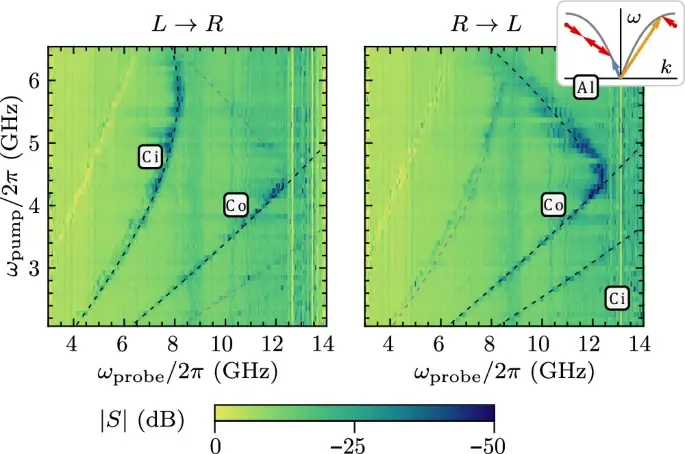
Another frontier in Josephson-based microwave devices is the exploitation of counterpropagating signal interactions. Praquin et al. (2025) explored a traveling-wave Josephson metamaterial capable of mixing a microwave signal with a slower pump wave, converting it into a counter-propagating idler wave. This approach enables an on-chip microwave isolator that can be reconfigured as a reciprocal tunable coupler.
Experimental highlights include:
Isolation exceeding 5 dB in the 5–8.5 GHz range
Isolation up to 10 dB in the 7–8.5 GHz range
Operating bandwidth of approximately 200 MHz, tunable by pump amplitude and frequency
The device’s non-reciprocal operation leverages phase-matched four-wave mixing interactions, akin to optical stimulated Brillouin scattering, where the pump velocity is significantly slower than the signal and idler. This arrangement ensures that backward-propagating idler waves are not converted back to signals, resulting in exponential attenuation along the transmission line.

Device Architecture and Wave Dynamics
The counterpropagating TWPA device is composed of 400 unit cells arranged in series, forming two inner electrodes embedded with Josephson junctions and capacitively coupled to each other and to a ground plane. The Δ mode supports the slow pump wave, while the faster Σ mode carries the signal and idler waves.
Parameters of the unit cells:
Parameter | Value | Role |
Josephson junction inductance LJL_JLJ | 0.94 nH | Defines nonlinear response |
Shunt capacitance CgC_gCg | 0.13 pF | Ground coupling |
Inter-electrode capacitance CiC_iCi | 0.57 pF | Modulates pump wave velocity |
Mode velocity ratio vΣ,0/vΔ,0v_{\Sigma,0}/v_{\Delta,0}vΣ,0/vΔ,0 | ~3 | Enables phase-matched conversion |
Characteristic impedance | ~50 Ω | Minimizes reflections |
By engineering mode velocities and employing hybrid couplers at both ends, the device allows effective separation of the pump from the signals while achieving precise control over non-reciprocal behavior.
Performance Metrics: Circulation and Tunable Coupling
Extensive testing revealed the device supports two operational regimes: circulation and tunable coupling.
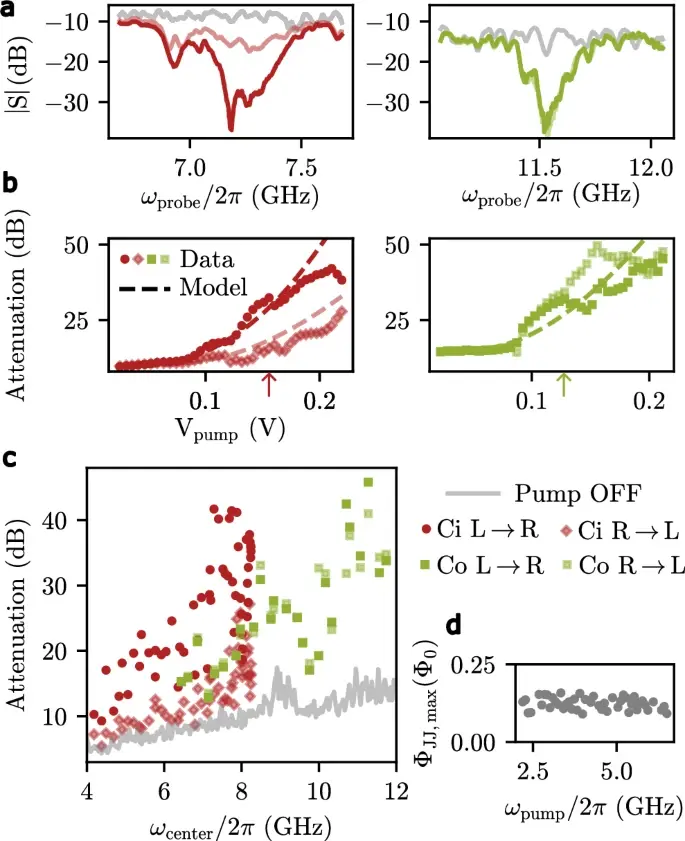
Circulation (Non-reciprocal): Forward-to-backward attenuation ratios reach approximately 10 dB in the 5–8.5 GHz band and 20 dB in the 7–8.5 GHz band. Exponential scaling of attenuation with pump amplitude is observed, consistent with theoretical predictions.
Tunable Coupling (Reciprocal): On/off transmission ratios between 10–20 dB in the 7–12 GHz range are achieved by adjusting pump amplitudes from both ends.
Insertion losses were carefully characterized:
Total ~8.5 dB at 7 GHz without pump
Contributions: hybrid couplers and cables (4.5 dB), defective junction reflection (2 dB), dielectric losses in alumina (2 dB)
Pump activation adds a few dB due to reflected waves
These results underscore the potential of TWPA devices to achieve near-quantum-limited amplification and controlled non-reciprocity, even in the presence of fabrication imperfections.
Theoretical Modeling and Attenuation Dynamics
The attenuation behavior of the device is captured by the expression:
A=2e−αL1+e−2αLA = \frac{2 e^{-\alpha L}}{1 + e^{-2\alpha L}}A=1+e−2αL2e−αL
where α\alphaα scales quadratically with the traveling pump amplitude. Incorporating scattering effects from defective junctions into the model allows accurate predictions of signal attenuation across the line. Deviations from theoretical predictions occur above critical pump amplitudes, corresponding to wideband drops in probe transmission, highlighting nonlinear interactions in the Josephson metamaterial.
Future Directions and Applications
Josephson parametric and traveling-wave devices open new avenues for scalable, high-fidelity quantum computing:
Extended Superconducting Circuits: Multi-mode circuits with built-in isolation and tunable coupling could enable fully directional, quantum-limited amplifiers.
Protected Qubit Architectures: Non-reciprocal circuits provide a platform for fully protected qubits, mitigating decoherence and error propagation.
Simulation of Condensed Matter Systems: TWPA-based circuits can emulate strong magnetic field effects in condensed matter, enabling novel experimental quantum simulations.
Fabrication Optimization: Future designs may incorporate flux-pumped split junctions, coplanar capacitors to reduce dielectric loss, and extended transmission lines to increase dynamic range.
Conclusion
The convergence of high-frequency Josephson parametric amplifiers, traveling-wave amplifiers with integrated reverse isolation, and counterpropagating signal devices represents a major leap forward for quantum computing technology. These advances address fundamental challenges—thermal noise, backward propagation, and limited bandwidth—while providing scalable, tunable, and near-quantum-limited solutions.
For researchers and engineers seeking to design the next generation of quantum systems, these innovations provide both the framework and the inspiration to develop fully directional, high-fidelity amplification networks, enabling reliable operation at higher temperatures and broader frequency ranges.
Read More about the ongoing research and cutting-edge insights from Dr. Shahid Masood and the expert team at 1950.ai, who continue to explore scalable AI-enabled quantum and classical computation systems for future-ready technologies.
Further Reading / External References
Hao, Z., Cochran, J., Chang, Y. C., Cole, H., & Shankar, S. (2026). Wireless Josephson amplifier above 20 GHz. Applied Physics Letters. DOI: 10.1063/5.0300910
Ranadive, A., Fazliji, B., et al. (2025). A traveling-wave parametric amplifier isolator. Nature Electronics. DOI: 10.1038/s41928-025-01489-w
Praquin, M., Giraudo, A., Lienhard, V., Bouwakdh, T., Vanselow, A., Leghtas, Z., & Campagne-Ibarcq, P. (2025). Mixing of counterpropagating signals in a traveling-wave Josephson device. Nature Communications, 16, 11390. DOI: 10.1038/s41467-025-66190-0
Liebendorfer, A. (2026). Josephson parametric amplifier offers increased qubit frequency in quantum computing. AIP SciLights. DOI: 10.1063/10.0042230


Comments