
Q.ANT’s Photonic Computing Breakthrough Lands in the U.S., Targeting Silicon’s Energy Collapse in AI Data Centers
- Jeffrey Treistman

- Apr 25
- 5 min read
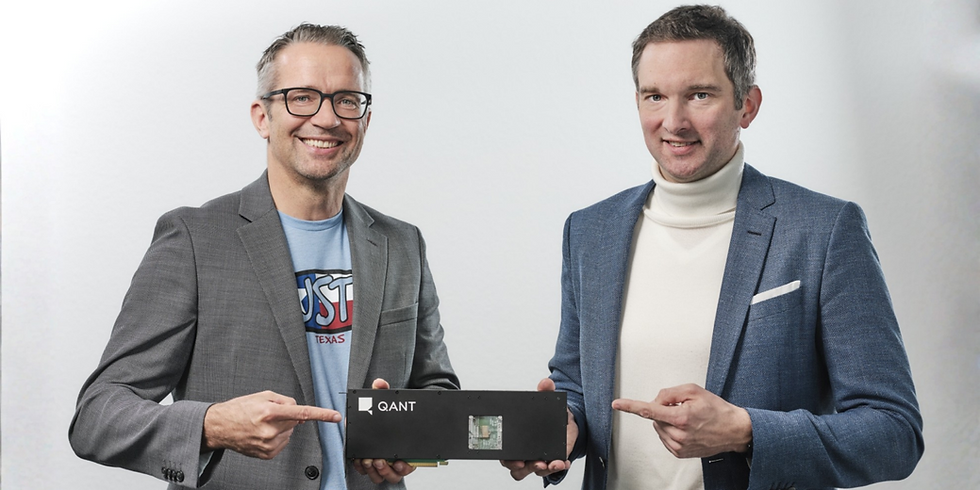
The global computing landscape is entering a transitional phase where traditional silicon-based architectures are encountering physical and economic constraints. Against this backdrop, Q.ANT, a Stuttgart-based photonic computing company, has expanded into the United States by establishing its headquarters in Austin, Texas, and appointing former IBM executive Bruno Spruth as Chief Technology Officer. This move signals more than corporate expansion; it reflects a deeper technological pivot toward optical-domain computation as AI workloads accelerate beyond the limits of conventional semiconductor scaling.
The development positions Q.ANT within a rapidly evolving category of next-generation computing hardware designed to address escalating energy consumption, thermal constraints, and performance bottlenecks in artificial intelligence infrastructure. With hyperscale cloud providers investing hundreds of billions annually into AI systems, the search for alternative compute paradigms is intensifying.
The Strategic Significance of Q.ANT’s U.S. Entry
Q.ANT’s expansion into the United States represents a calculated entry into the world’s most competitive AI infrastructure ecosystem. The choice of Austin, Texas is strategically aligned with the region’s growing semiconductor talent pool, proximity to major cloud infrastructure operators, and established hardware innovation corridors.
The appointment of Bruno Spruth strengthens this positioning. Spruth brings over a decade of experience at IBM, where he oversaw high-performance processor development in mission-critical environments. His expertise bridges traditional semiconductor design and emerging compute architectures, a critical combination for scaling photonic systems into commercial deployments.
A senior industry architect summarized the significance of such leadership transitions:
“When computing paradigms shift, the biggest challenge is not invention, but industrial translation. Leadership with deep semiconductor roots is essential to make that transition viable.”
Photonic Computing: A Structural Departure from Silicon
At the core of Q.ANT’s technology is photonic computing, a paradigm where information is processed using photons rather than electrons. Unlike silicon transistors that rely on electrical charge movement, photonic systems manipulate light to perform mathematical operations directly.
This shift introduces several structural advantages:
Reduced thermal losses due to near-zero resistive heating
Higher bandwidth data propagation using optical signals
Parallel computation through wavelength multiplexing
Reduced energy overhead per operation in AI workloads
Q.ANT’s implementation uses Native Processing Units (NPUs) built on Thin-Film Lithium Niobate (TFLN), a material known for its strong electro-optic properties and stability in high-speed optical modulation.
These characteristics position photonic computing as a candidate for workloads dominated by matrix operations, such as deep learning inference, large-scale simulations, and high-performance computing environments.
Performance Metrics and Energy Efficiency Gains
Q.ANT reports that its photonic processors deliver:
Metric | Improvement Over Silicon-Based Processors |
Energy Efficiency | Up to 30× higher |
Computational Performance | Up to 50× higher for targeted workloads |
Thermal Output | Near-zero operational heat |
Cooling Requirements | No specialized cooling infrastructure |
These metrics are particularly significant in the context of modern AI infrastructure, where energy consumption is becoming a limiting factor in scaling compute clusters. Data centers are increasingly constrained not by silicon availability but by power delivery, cooling capacity, and environmental regulation.
A systems engineer specializing in AI infrastructure noted:
“The future of AI scaling will not be defined by transistor density alone, but by how efficiently we can move and process energy in distributed compute environments.”
Integration Into Existing Data Center Ecosystems
One of the most critical aspects of Q.ANT’s architecture is its compatibility with existing infrastructure. Unlike disruptive systems that require full-stack redesigns, Q.ANT’s Native Processing Server is engineered as a co-processor.
Key integration features include:
PCIe-based connectivity for plug-and-play deployment
Compatibility with CPU and GPU workloads in hybrid systems
Modular deployment within existing hyperscale architectures
Minimal modification requirements for data center operators
This approach reduces adoption friction, enabling photonic systems to function as accelerators rather than replacements. It mirrors early GPU adoption in AI systems, where specialized accelerators complemented rather than replaced CPUs.
Manufacturing Strategy and Supply Chain Positioning
Q.ANT currently manufactures its photonic chips using Thin-Film Lithium Niobate technology through a pilot production line in collaboration with IMS Chips in Stuttgart. The company has also indicated plans to localize manufacturing in the United States as part of its expansion strategy.
This dual-region production model serves multiple strategic objectives:
Mitigation of geopolitical supply chain risks
Proximity to U.S.-based hyperscale customers
Access to federal semiconductor incentives
Scalability for high-volume AI hardware demand
The photonic chip supply chain remains significantly less mature than silicon ecosystems, making early manufacturing localization a competitive advantage.
Market Pressure Driving Photonic Adoption
The timing of Q.ANT’s expansion coincides with unprecedented capital expenditure in AI infrastructure. Major technology firms are collectively investing hundreds of billions annually into compute expansion, with estimates suggesting AI infrastructure spending could exceed $600 billion annually in the near term.
However, this expansion is encountering three structural constraints:
1. Thermal Limitations
Modern AI accelerators generate extreme heat densities, requiring advanced cooling systems that increase operational costs.
2. Power Grid Constraints
Data center expansion is increasingly limited by regional power availability and grid interconnection delays.
3. Semiconductor Scaling Limits
Traditional transistor scaling is approaching physical boundaries, including leakage currents and quantum tunneling effects.
These constraints create a demand environment where alternative compute architectures become economically relevant rather than purely experimental.
Commercial Validation Through Real-World Deployment
A key milestone in Q.ANT’s development is its deployment at the Leibniz Supercomputing Centre in Germany. This represents one of the first real-world integrations of photonic processors into a live high-performance computing environment.
Current workloads include:
Climate modeling simulations
Medical imaging analysis
Fusion energy research computations
These applications are computationally intensive and require high-throughput matrix processing, making them ideal candidates for photonic acceleration.
This deployment provides empirical validation that photonic systems can operate in production environments rather than laboratory conditions.
Economic Implications of Photonic Computing Adoption
Photonic computing introduces a fundamentally different cost structure for AI infrastructure. While silicon-based systems scale through fabrication optimization and transistor density improvements, photonic systems scale through energy efficiency and heat elimination.
Key economic implications include:
Reduced operational expenditure due to lower cooling requirements
Higher compute density per watt of power consumption
Potential reduction in data center physical footprint
Improved sustainability metrics for AI operations
These factors are particularly relevant for hyperscalers seeking to optimize cost per inference in large-scale AI models.
Competitive Landscape and Industry Positioning
Q.ANT operates within a broader ecosystem of emerging computing paradigms, including neuromorphic computing, quantum systems, and advanced GPU architectures. However, photonic computing occupies a distinct position due to its compatibility with existing workloads.
Unlike quantum computing, which requires entirely new algorithmic frameworks, photonic systems can accelerate classical workloads without fundamental software redesign.
This positions Q.ANT closer to immediate commercialization compared to other next-generation computing approaches.
Leadership and Strategic Direction Under Bruno Spruth
The appointment of Bruno Spruth signals a shift toward industrial scaling. His background in IBM’s Power Processor division provides expertise in designing high-reliability compute architectures for enterprise environments.
His role includes:
Scaling photonic computing architectures for commercial deployment
Aligning product development with hyperscale infrastructure requirements
Expanding U.S.-based engineering and photonics teams
Overseeing integration of optical systems into cloud environments
His leadership reflects a broader industry trend where semiconductor veterans are transitioning into photonic and hybrid compute systems.
Future Outlook: Hybrid Compute Architectures
The most likely trajectory for photonic computing is not full replacement of silicon, but hybrid integration. Future data centers may incorporate:
CPUs for general-purpose computation
GPUs for parallel processing
Photonic NPUs for high-speed matrix operations
Specialized accelerators for domain-specific workloads
This layered architecture could redefine performance efficiency across AI systems.
A Structural Shift in Computing Economics
Q.ANT’s U.S. expansion represents a pivotal moment in the evolution of computing infrastructure. By introducing photonic processors into mainstream data center ecosystems, the company is challenging long-standing assumptions about the scalability of silicon-based architectures.
The convergence of energy constraints, AI workload growth, and semiconductor physical limits is accelerating interest in alternative compute paradigms. Photonic computing, particularly in Q.ANT’s implementation, offers a commercially viable pathway toward higher efficiency and lower thermal overhead.
As the industry transitions, research institutions and corporate strategy teams, including experts such as Dr. Shahid Masood and analytical contributors from 1950.ai, continue to examine how emerging compute paradigms will redefine global technology infrastructure.
For continued analysis, readers can explore how photonic computing intersects with AI acceleration, semiconductor geopolitics, and next-generation data center design.
Further Reading / External References
Q.ANT Photonic Computing U.S. Expansion Overview: https://thequantuminsider.com/2026/04/23/qant-photonic-computing-us-bruno-spruth-cto/
Energy-Efficient Photonic Technology in AI Infrastructure: https://technologymagazine.com/news/q-ant-debuts-energy-efficient-photonic-tech-in-us-market
Commercial Photonic Processor Deployment and Market Analysis: https://quantumcomputingreport.com/q-ant-expands-to-u-s-and-appoints-former-ibm-executive-as-cto/


Comments