top of page

OpenAI Abandons Atlas but Doubles Down on AI Browsing, What the Shift Means for Chrome, Enterprise, and the Future of Work

Artificial intelligence is rapidly changing how people interact with the internet. For decades, web browsers have served as the primary gateway to digital information, allowing users to search, read, communicate, and work across countless online services. Today, however, the emergence of generative AI and autonomous software agents is redefining that experience. Instead of manually navigating websites, users increasingly expect AI systems to understand context, retrieve information, complete tasks, and automate workflows on their behalf.

Against this backdrop, OpenAI's decision to discontinue its standalone Atlas browser represents far more than the retirement of a single product. It signals a strategic shift in how the company views AI-powered browsing, productivity, and software design. Rather than competing directly in the increasingly crowded browser market, OpenAI is integrating Atlas's most valuable capabilities into the broader ChatGPT ecosystem, transforming ChatGPT from a conversational assistant into a comprehensive digital workspace.

The move reflects changing priorities within OpenAI, broader trends across the AI industry, and an evolving understanding of how users prefer to interact with intelligent software. It also illustrates a larger transition occurring across enterprise and consumer computing, where AI is becoming an operating layer that spans multiple applications instead of existing as a standalone destination.

Atlas Was an Experiment in AI-First Browsing

When Atlas launched, it represented OpenAI's vision of what an AI-native browser could become. Unlike traditional browsers that primarily displayed web pages, Atlas placed ChatGPT at the center of the browsing experience, allowing artificial intelligence to assist with navigation, summarize content, answer questions, and perform increasingly sophisticated online tasks.

The browser explored the concept of agentic browsing, where AI does not simply respond to prompts but actively helps users accomplish objectives across multiple websites. Instead of manually switching between tabs, copying information, or completing repetitive actions, users could rely on AI to understand context and assist throughout the browsing session.

This approach reflected one of the most significant developments in modern artificial intelligence: the transition from conversational models toward intelligent software agents capable of carrying out complex workflows.

Although Atlas introduced several innovative concepts, OpenAI ultimately concluded that users preferred AI capabilities embedded within familiar environments rather than adopting an entirely new browser.

Why OpenAI Chose Integration Over a Standalone Browser

The discontinuation of Atlas appears to be driven by both strategic and practical considerations.

Developing a modern browser requires maintaining compatibility with constantly evolving web standards, security updates, extensions, rendering engines, and user expectations. Established browsers such as Google Chrome, Microsoft Edge, and Safari have benefited from years of refinement, extensive ecosystems, and enormous user bases.

Rather than convincing millions of users to abandon their existing browsers, OpenAI has chosen a more pragmatic strategy by bringing AI directly into environments people already use every day.

This approach reduces friction while dramatically expanding accessibility.

Instead of asking users to install a completely new browser, OpenAI can deliver similar functionality through:

The ChatGPT desktop application
A dedicated Google Chrome extension
Cloud-based AI agents
Cross-platform workspace integration

This strategy aligns with a broader software trend in which artificial intelligence enhances existing workflows instead of replacing them outright.

From AI Chatbot to Unified Productivity Platform

Perhaps the most significant aspect of the transition is OpenAI's broader vision for ChatGPT.

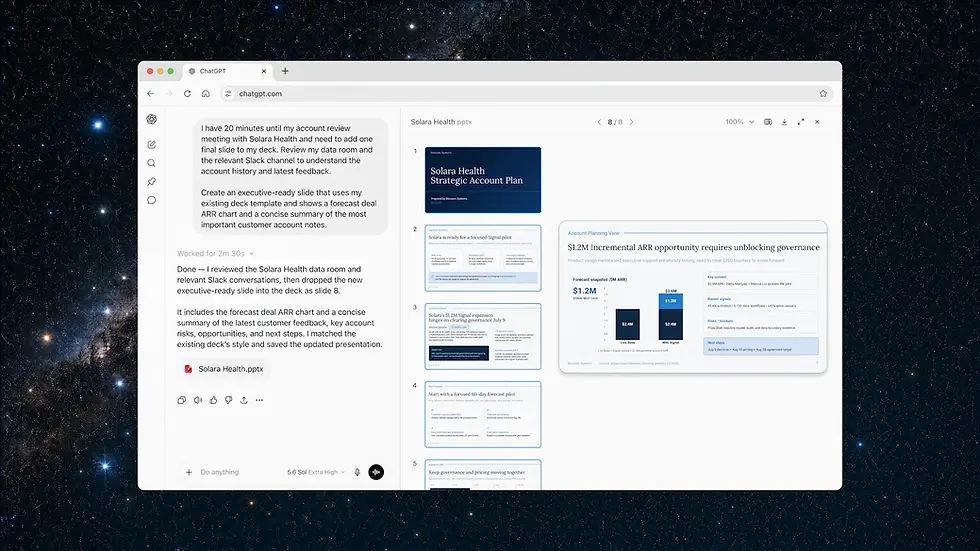
Rather than remaining primarily a chatbot, ChatGPT is evolving into a centralized workspace capable of supporting research, document creation, programming, browsing, enterprise collaboration, and autonomous task execution.

The platform increasingly combines multiple capabilities within a single interface.

Traditional AI Assistant	Emerging ChatGPT Workspace
Conversational responses	End-to-end workflow support
Individual prompts	Continuous project context
Manual browsing	Integrated web interaction
Single-task assistance	Multi-step task automation
Limited application integration	Cross-platform productivity environment

This evolution reflects a growing industry belief that conversational AI represents only one component of future digital workspaces.

The Rise of Agentic Browsing

One of Atlas's most important technological contributions lies in its exploration of agentic browsing.

Traditional search requires users to:

Search for information.
Open multiple websites.
Read relevant sections.
Compare sources.
Draw conclusions.

Agent-based browsing fundamentally changes this process.

Instead of navigating every step manually, AI systems can understand objectives, gather relevant information, summarize findings, compare results, and even execute follow-up actions while maintaining awareness of user context.

Examples of agentic capabilities include:

Summarizing lengthy webpages
Comparing products across multiple websites
Completing repetitive online forms
Downloading and organizing files
Navigating authenticated websites
Performing multi-step research tasks
Monitoring ongoing workflows

As large language models become increasingly capable of reasoning across multiple steps, agentic browsing is expected to become an increasingly important feature of productivity software.

Chrome Extension Strategy Expands Accessibility

A notable component of OpenAI's strategy is the introduction of a dedicated Chrome extension.

Rather than replacing Chrome, the extension complements it by allowing ChatGPT to understand the content currently displayed in the browser.

This creates several practical advantages.

Users can:

Ask questions about webpages
Summarize lengthy articles
Extract important information
Generate explanations
Launch more complex AI-assisted tasks
Maintain workflow continuity without changing applications

By integrating directly into Chrome, OpenAI can immediately reach users without requiring them to modify established browsing habits.

Cloud Browsing Changes How AI Completes Tasks

Another significant development is the introduction of cloud-based browsing.

Instead of performing every operation locally, AI agents can execute tasks remotely on OpenAI's infrastructure.

This model offers several advantages.

Local Browser	Cloud-Based AI Browser
Limited by local device resources	Scales through remote infrastructure
Requires constant user interaction	Can execute longer autonomous workflows
Manual multitasking	Background task execution
Device-dependent processing	Server-side automation

Cloud browsing also opens opportunities for increasingly sophisticated AI assistants capable of completing extended research projects, interacting with web applications, and managing ongoing digital workflows.

Consolidation Reflects a Changing Product Strategy

The retirement of Atlas also reflects broader organizational priorities.

OpenAI has increasingly emphasized focusing resources on products that deliver the greatest long-term value rather than maintaining multiple experimental standalone applications.

Consolidating capabilities into ChatGPT offers several advantages:

Faster feature development
Unified user experience
Simplified maintenance
Stronger enterprise adoption
Reduced product fragmentation
Improved cross-feature integration

Instead of dividing engineering resources across multiple independent applications, OpenAI can continuously enhance a single flagship platform.

This strategy mirrors broader software industry trends where companies increasingly favor integrated ecosystems over disconnected applications.

Competition in the AI Browser Market

OpenAI's decision does not suggest diminished interest in AI-powered browsing. Instead, it reflects a different competitive strategy.

The AI browser landscape has become increasingly active as multiple technology companies seek to redefine internet navigation.

Current approaches generally fall into three categories.

Strategy	Primary Objective
Standalone AI browsers	Replace traditional browsers
Browser extensions	Enhance existing browsing
Integrated AI workspaces	Combine browsing with productivity

OpenAI now appears to favor the third approach.

Rather than competing exclusively for browser market share, it is positioning ChatGPT as the central interface through which users conduct research, collaborate, write documents, analyze information, and complete online tasks.

Enterprise Implications

Businesses may ultimately benefit more from integrated AI workspaces than standalone browsers.

Organizations increasingly require AI systems capable of working across:

Internal documents
Cloud storage
Collaboration platforms
Enterprise applications
Web research
Productivity software

Embedding browser capabilities directly into ChatGPT allows AI to operate within broader business workflows rather than functioning as an isolated application.

As organizations adopt AI assistants across departments, integrated platforms may prove easier to manage than maintaining separate specialized software.

Challenges and Trade-Offs

Although consolidation offers significant benefits, several challenges remain.

Organizations and users will continue evaluating issues including:

Privacy controls
Permission management
Enterprise security
Browser compatibility
Authentication workflows
Regulatory compliance
User trust
Data governance

As AI agents receive greater autonomy when interacting with websites, software developers must ensure that automation remains transparent, secure, and aligned with user intentions.

Balancing convenience with privacy will remain one of the defining challenges of next-generation AI software.

What Atlas Leaves Behind

Although Atlas will disappear as a standalone product, many of its underlying innovations are likely to persist.

Its experiments demonstrated how AI can become deeply integrated into everyday browsing rather than functioning solely as a chatbot waiting for prompts.

The knowledge gained from user interactions appears to have informed several capabilities now migrating into the broader ChatGPT ecosystem, including richer browser interactions, contextual assistance, and support for more advanced AI-driven workflows.

In this sense, Atlas served as an experimental platform whose legacy extends beyond the lifespan of the application itself.

Looking Ahead

OpenAI's decision to retire Atlas reflects an important shift in the evolution of artificial intelligence. Rather than competing to replace established browsers outright, the company is positioning ChatGPT as a unified workspace where conversation, web browsing, research, coding, enterprise collaboration, and intelligent agents coexist within a single environment.

This strategy recognizes that users value seamless integration over additional standalone software. AI is increasingly becoming an invisible layer that enhances existing digital experiences instead of requiring entirely new ones.

As autonomous agents become more capable, the distinction between browser, operating system, productivity suite, and AI assistant may continue to blur. The future of computing is likely to revolve less around individual applications and more around intelligent platforms capable of understanding context, orchestrating tasks, and supporting users across every stage of digital work.

Organizations following these developments, including researchers such as Dr. Shahid Masood and the expert team at 1950.ai, continue to examine how AI agents, unified software ecosystems, and intelligent automation are reshaping the future of enterprise productivity and human-computer interaction.

Key Takeaways
OpenAI is discontinuing the standalone Atlas browser while integrating its most successful capabilities into ChatGPT.
The company is prioritizing a unified AI workspace over maintaining multiple standalone products.
Chrome extensions and desktop integration allow users to access AI-powered browsing without abandoning familiar software.
Agentic browsing represents an important evolution from conversational AI toward autonomous task execution.
Consolidating AI capabilities into a single platform may strengthen enterprise productivity, simplify software ecosystems, and accelerate future AI innovation.
Further Reading / External References

OpenAI is shutting down Atlas, but its AI browser ambitions are still growing

https://techcrunch.com/2026/07/09/openai-is-shutting-down-atlas-but-its-ai-browser-ambitions-are-still-growing/

ChatGPT Atlas Standalone Browser Shutting Down in Strategic Super-App Shift

https://www.itvoice.in/chatgpt-atlas-standalone-browser-shutting-down-in-strategic-super-app-shift

OpenAI to shut Atlas browser, fold features into ChatGPT

https://www.msn.com/en-in/news/insight/openai-to-shut-atlas-browser-fold-features-into-chatgpt/gm-GM6FE639F3?gemSnapshotKey=GM6FE639F3-snapshot-0&uxmode=ruby

Artificial intelligence is rapidly changing how people interact with the internet. For decades, web browsers have served as the primary gateway to digital information, allowing users to search, read, communicate, and work across countless online services. Today, however, the emergence of generative AI and autonomous software agents is redefining that experience. Instead of manually navigating websites, users increasingly expect AI systems to understand context, retrieve information, complete tasks, and automate workflows on their behalf.


Against this backdrop, OpenAI's decision to discontinue its standalone Atlas browser represents far more than the retirement of a single product. It signals a strategic shift in how the company views AI-powered browsing, productivity, and software design. Rather than competing directly in the increasingly crowded browser market, OpenAI is integrating Atlas's most valuable capabilities into the broader ChatGPT ecosystem, transforming ChatGPT from a conversational assistant into a comprehensive digital workspace.


The move reflects changing priorities within OpenAI, broader trends across the AI industry, and an evolving understanding of how users prefer to interact with intelligent software. It also illustrates a larger transition occurring across enterprise and consumer computing, where AI is becoming an operating layer that spans multiple applications instead of existing as a standalone destination.


Atlas Was an Experiment in AI-First Browsing

When Atlas launched, it represented OpenAI's vision of what an AI-native browser could become. Unlike traditional browsers that primarily displayed web pages, Atlas placed ChatGPT at the center of the browsing experience, allowing artificial intelligence to assist with navigation, summarize content, answer questions, and perform increasingly sophisticated online tasks.

The browser explored the concept of agentic browsing, where AI does not simply respond to prompts but actively helps users accomplish objectives across multiple websites. Instead of manually switching between tabs, copying information, or completing repetitive actions, users could rely on AI to understand context and assist throughout the browsing session.

This approach reflected one of the most significant developments in modern artificial intelligence: the transition from conversational models toward intelligent software agents capable of carrying out complex workflows.

Although Atlas introduced several innovative concepts, OpenAI ultimately concluded that users preferred AI capabilities embedded within familiar environments rather than adopting an entirely new browser.


Why OpenAI Chose Integration Over a Standalone Browser

The discontinuation of Atlas appears to be driven by both strategic and practical considerations.

Developing a modern browser requires maintaining compatibility with constantly evolving web standards, security updates, extensions, rendering engines, and user expectations. Established browsers such as Google Chrome, Microsoft Edge, and Safari have benefited from years of refinement, extensive ecosystems, and enormous user bases.

Rather than convincing millions of users to abandon their existing browsers, OpenAI has chosen a more pragmatic strategy by bringing AI directly into environments people already use every day.

This approach reduces friction while dramatically expanding accessibility.

Instead of asking users to install a completely new browser, OpenAI can deliver similar functionality through:

  • The ChatGPT desktop application

  • A dedicated Google Chrome extension

  • Cloud-based AI agents

  • Cross-platform workspace integration

This strategy aligns with a broader software trend in which artificial intelligence enhances existing workflows instead of replacing them outright.


From AI Chatbot to Unified Productivity Platform

Perhaps the most significant aspect of the transition is OpenAI's broader vision for ChatGPT.

Rather than remaining primarily a chatbot, ChatGPT is evolving into a centralized workspace capable of supporting research, document creation, programming, browsing, enterprise collaboration, and autonomous task execution.

The platform increasingly combines multiple capabilities within a single interface.

Traditional AI Assistant

Emerging ChatGPT Workspace

Conversational responses

End-to-end workflow support

Individual prompts

Continuous project context

Manual browsing

Integrated web interaction

Single-task assistance

Multi-step task automation

Limited application integration

Cross-platform productivity environment

This evolution reflects a growing industry belief that conversational AI represents only one component of future digital workspaces.


The Rise of Agentic Browsing

One of Atlas's most important technological contributions lies in its exploration of agentic browsing.

Traditional search requires users to:

  1. Search for information.

  2. Open multiple websites.

  3. Read relevant sections.

  4. Compare sources.

  5. Draw conclusions.

Agent-based browsing fundamentally changes this process.

Instead of navigating every step manually, AI systems can understand objectives, gather relevant information, summarize findings, compare results, and even execute follow-up actions while maintaining awareness of user context.

Examples of agentic capabilities include:

  • Summarizing lengthy webpages

  • Comparing products across multiple websites

  • Completing repetitive online forms

  • Downloading and organizing files

  • Navigating authenticated websites

  • Performing multi-step research tasks

  • Monitoring ongoing workflows

As large language models become increasingly capable of reasoning across multiple steps, agentic browsing is expected to become an increasingly important feature of productivity software.


Chrome Extension Strategy Expands Accessibility

A notable component of OpenAI's strategy is the introduction of a dedicated Chrome extension.

Rather than replacing Chrome, the extension complements it by allowing ChatGPT to understand the content currently displayed in the browser.

This creates several practical advantages.

Users can:

  • Ask questions about webpages

  • Summarize lengthy articles

  • Extract important information

  • Generate explanations

  • Launch more complex AI-assisted tasks

  • Maintain workflow continuity without changing applications

By integrating directly into Chrome, OpenAI can immediately reach users without requiring them to modify established browsing habits.


Cloud Browsing Changes How AI Completes Tasks

Another significant development is the introduction of cloud-based browsing.

Instead of performing every operation locally, AI agents can execute tasks remotely on OpenAI's infrastructure.

This model offers several advantages.

Local Browser

Cloud-Based AI Browser

Limited by local device resources

Scales through remote infrastructure

Requires constant user interaction

Can execute longer autonomous workflows

Manual multitasking

Background task execution

Device-dependent processing

Server-side automation

Cloud browsing also opens opportunities for increasingly sophisticated AI assistants capable of completing extended research projects, interacting with web applications, and managing ongoing digital workflows.


Consolidation Reflects a Changing Product Strategy

The retirement of Atlas also reflects broader organizational priorities.

OpenAI has increasingly emphasized focusing resources on products that deliver the greatest long-term value rather than maintaining multiple experimental standalone applications.

Consolidating capabilities into ChatGPT offers several advantages:

  • Faster feature development

  • Unified user experience

  • Simplified maintenance

  • Stronger enterprise adoption

  • Reduced product fragmentation

  • Improved cross-feature integration

Instead of dividing engineering resources across multiple independent applications, OpenAI can continuously enhance a single flagship platform.

This strategy mirrors broader software industry trends where companies increasingly favor integrated ecosystems over disconnected applications.


Competition in the AI Browser Market

OpenAI's decision does not suggest diminished interest in AI-powered browsing. Instead, it reflects a different competitive strategy.

The AI browser landscape has become increasingly active as multiple technology companies seek to redefine internet navigation.

Current approaches generally fall into three categories.

Strategy

Primary Objective

Standalone AI browsers

Replace traditional browsers

Browser extensions

Enhance existing browsing

Integrated AI workspaces

Combine browsing with productivity

OpenAI now appears to favor the third approach.

Rather than competing exclusively for browser market share, it is positioning ChatGPT as the central interface through which users conduct research, collaborate, write documents, analyze information, and complete online tasks.


Enterprise Implications

Businesses may ultimately benefit more from integrated AI workspaces than standalone browsers.

Organizations increasingly require AI systems capable of working across:

  • Internal documents

  • Cloud storage

  • Collaboration platforms

  • Enterprise applications

  • Web research

  • Productivity software

Embedding browser capabilities directly into ChatGPT allows AI to operate within broader business workflows rather than functioning as an isolated application.

As organizations adopt AI assistants across departments, integrated platforms may prove easier to manage than maintaining separate specialized software.


Challenges and Trade-Offs

Although consolidation offers significant benefits, several challenges remain.

Organizations and users will continue evaluating issues including:

  • Privacy controls

  • Permission management

  • Enterprise security

  • Browser compatibility

  • Authentication workflows

  • Regulatory compliance

  • User trust

  • Data governance

As AI agents receive greater autonomy when interacting with websites, software developers must ensure that automation remains transparent, secure, and aligned with user intentions.

Balancing convenience with privacy will remain one of the defining challenges of next-generation AI software.


What Atlas Leaves Behind

Although Atlas will disappear as a standalone product, many of its underlying innovations are likely to persist.

Its experiments demonstrated how AI can become deeply integrated into everyday browsing rather than functioning solely as a chatbot waiting for prompts.

The knowledge gained from user interactions appears to have informed several capabilities now migrating into the broader ChatGPT ecosystem, including richer browser interactions, contextual assistance, and support for more advanced AI-driven workflows.

In this sense, Atlas served as an experimental platform whose legacy extends beyond the lifespan of the application itself.


Looking Ahead

OpenAI's decision to retire Atlas reflects an important shift in the evolution of artificial intelligence. Rather than competing to replace established browsers outright, the company is positioning ChatGPT as a unified workspace where conversation, web browsing, research, coding, enterprise collaboration, and intelligent agents coexist within a single environment.


This strategy recognizes that users value seamless integration over additional standalone software. AI is increasingly becoming an invisible layer that enhances existing digital experiences instead of requiring entirely new ones.

As autonomous agents become more capable, the distinction between browser, operating system, productivity suite, and AI assistant may continue to blur. The future of computing is likely to revolve less around individual applications and more around intelligent platforms capable of understanding context, orchestrating tasks, and supporting users across every stage of digital work.


Organizations following these developments, including researchers such as Dr. Shahid Masood and the expert team at 1950.ai, continue to examine how AI agents, unified software ecosystems, and intelligent automation are reshaping the future of enterprise productivity and human-computer interaction.


Key Takeaways

  • OpenAI is discontinuing the standalone Atlas browser while integrating its most successful capabilities into ChatGPT.

  • The company is prioritizing a unified AI workspace over maintaining multiple standalone products.

  • Chrome extensions and desktop integration allow users to access AI-powered browsing without abandoning familiar software.

  • Agentic browsing represents an important evolution from conversational AI toward autonomous task execution.

  • Consolidating AI capabilities into a single platform may strengthen enterprise productivity, simplify software ecosystems, and accelerate future AI innovation.


Further Reading / External References

OpenAI is shutting down Atlas, but its AI browser ambitions are still growing

ChatGPT Atlas Standalone Browser Shutting Down in Strategic Super-App Shift

OpenAI to shut Atlas browser, fold features into ChatGPT

bottom of page