
OAuth Under Attack: How Silent Redirect Manipulation Is Bypassing MFA and Delivering Malware
- Tom Kydd

- Mar 3
- 6 min read

Modern identity systems are built on trust. Protocols such as OAuth 2.0 were designed to enable secure, delegated access across platforms without exposing user credentials. Yet recent phishing campaigns targeting government and public-sector organizations demonstrate a critical shift in adversary tradecraft, attackers are no longer exploiting software vulnerabilities or stealing access tokens directly. Instead, they are abusing legitimate OAuth redirection behavior to deliver malware and facilitate credential interception.
This evolution marks a strategic turning point in identity-based threats. Rather than breaking authentication, threat actors are bending it to their advantage.
The Rise of Identity-Based Threat Engineering
OAuth, short for Open Authorization, underpins modern single sign-on experiences. It enables users to log into services using trusted identity providers such as Microsoft Entra ID or Google Workspace. The protocol relies on authorization codes and redirect URIs to complete authentication flows.
In the campaigns observed, attackers did not exploit code flaws or steal OAuth tokens. Instead, they weaponized a standards-compliant feature: error-based redirection.
OAuth specifications, including RFC 6749 and later security clarifications in RFC 9700, explicitly define how authorization servers should handle errors, including redirecting users back to registered redirect URIs. Attackers leveraged this predictable behavior to silently probe authentication states and then redirect victims to attacker-controlled infrastructure.
As one Microsoft security researcher noted:
“This is not an exploit of a vulnerability. It is an exploitation of trust and protocol behavior.”
The result is a highly deceptive phishing mechanism that appears legitimate to both users and security tools.
How the OAuth Redirect Abuse Works
The campaigns follow a structured, multi-stage attack chain designed to bypass traditional email and browser defenses.
Stage 1: Phishing Delivery via Trusted Themes
Threat actors distributed phishing emails targeting public-sector entities using lures such as:
E-signature requests
Teams meeting recordings
Social security documentation
Financial and political updates
Password reset notices
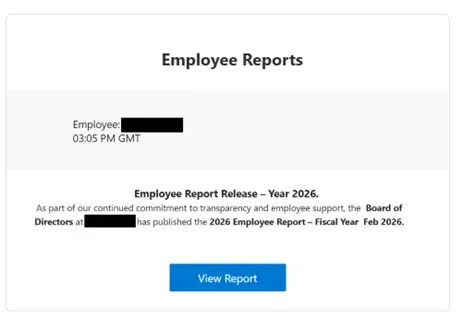
Employee report notifications
Attackers used both prebuilt mass-mailing tools and custom-developed distribution frameworks written in Python and Node.js. In some cases, cloud-hosted infrastructure was used to distribute the campaigns, increasing resilience and scalability.
The malicious OAuth URL was either:
Embedded directly in the email body
Placed inside a PDF attachment
Combined with fake calendar invite files
The deception relied heavily on user familiarity with legitimate authentication prompts.
Stage 2: Silent OAuth Probe Using Crafted Parameters
The malicious link resembled a legitimate OAuth authorization request:
Several parameters were intentionally manipulated:
Parameter | Purpose | Attacker Objective |
/common/ | Multi-tenant endpoint | Broad targeting |
response_type=code | Initiates OAuth flow | Triggers authorization logic |
prompt=none | Silent authentication | Suppresses UI interaction |
scope=<invalid_scope> | Invalid permission request | Forces error condition |
The combination of prompt=none and an intentionally invalid scope triggered silent authentication evaluation. Because the scope was invalid or user consent was absent, the identity provider returned an OAuth error.
Importantly, the attackers did not obtain access tokens. Instead, they used the forced error to trigger redirection to a malicious redirect URI registered in a threat actor–controlled tenant.
Observed encoding techniques for passing victim email addresses via the state parameter included:
Plaintext
Hex encoding
Base64
Custom substitution schemes
This manipulation increased credibility by auto-populating phishing pages with the target’s email address.
Stage 3: Error-Based Redirect to Attacker Infrastructure
Upon failure, the identity provider redirected the user to the attacker’s registered redirect URI with error parameters appended, such as:
error=interaction_required
error_description=Session information is not for single sign-on
error_subtype=access_denied
From the attacker’s perspective, this confirmed:
The user account exists
Silent SSO is blocked
Interactive authentication would be required
This reconnaissance allowed attackers to refine targeting and redirect victims to controlled domains hosting malicious payloads or phishing frameworks such as EvilProxy, an adversary-in-the-middle toolkit designed to intercept credentials and session cookies.
Stage 4: Malware Delivery via Redirected Payload
In one documented campaign, victims were redirected to a /download/XXXX path that automatically downloaded a ZIP archive. Observed payload characteristics included:
ZIP files containing LNK shortcut files
HTML smuggling loaders
Embedded MSI installers
Once extracted, the LNK file executed a PowerShell command. The script:
Ran reconnaissance commands such as ipconfig /all and tasklist
Extracted steam_monitor.exe, crashhandler.dll, and crashlog.dat
Launched the legitimate steam_monitor.exe binary
Side-loaded malicious crashhandler.dll
Decrypted crashlog.dat
Executed the final payload in memory
Established outbound C2 communication
The abuse of a legitimate binary for DLL side-loading significantly reduced detection likelihood.
Microsoft Defender Antivirus identified components under detection names including:
Trojan:Win32/Malgent
Trojan:Win32/Korplug
Trojan:Win32/Znyonm
Trojan:Win32/GreedyRobin.B!dha
Trojan:Win32/WinLNK
Trojan:Win32/Sonbokli

Detection and Advanced Hunting Capabilities
Organizations using Microsoft Defender XDR can identify related activity via advanced hunting queries.
Key telemetry signals include:
URL Click Detection
URLs containing scope=invalid
ClickAllowed or IsClickedThrough events
Browser Launch Events
BrowserLaunchedToOpenUrl
RemoteUrl containing manipulated OAuth parameters
File Download Indicators
FileOriginReferrerUrl referencing login domains
FileOriginUrl containing error=consent_required
PowerShell Execution Patterns
Extraction of ZIP contents
Use of tar utility
Byte array loading and sleep delays
DLL Side-Loading Detection
steam_monitor.exe loading crashhandler.dll outside standard system directories
This cross-domain correlation, email + identity + endpoint telemetry, underscores the importance of Extended Detection and Response capabilities.
Why This Attack Matters: Strategic Implications
These campaigns demonstrate that OAuth redirect abuse is operational, not theoretical.
The strategic implications include:
Identity protocols are becoming primary attack surfaces
Adversaries are targeting trust relationships instead of credentials
MFA and token protection alone are insufficient
Standards compliance does not equal safety
As organizations strengthen defenses against credential theft and MFA bypass, attackers increasingly exploit protocol behavior and governance gaps.
The technique aligns with broader cybercrime trends. IBM’s Cost of a Data Breach Report 2024 estimated the global average data breach cost at $4.45 million, with identity compromise as a leading factor. Identity-based attacks continue to dominate incident response investigations.
Mitigation and Governance Strategy
To reduce risk, organizations should implement layered controls:
Identity Governance
Restrict user consent for OAuth applications
Review app registrations periodically
Remove unused or overprivileged apps
Detection and Monitoring
Alert on prompt=none in email-delivered URLs
Monitor OAuth redirects to unknown domains
Flag encoded state parameters
Endpoint Protection
Enable PowerShell constrained language mode
Monitor DLL side-loading patterns
Block known malicious Client IDs
Cross-Domain XDR
Correlate email, identity, and endpoint signals
Investigate silent OAuth probes
Security teams should also block known malicious application IDs and monitor suspicious redirect domains identified during investigations.

The Broader Protocol Security Debate
OAuth’s design prioritizes interoperability and user experience. RFC 9700 explicitly acknowledges that authorization servers can function as open redirectors if error flows are manipulated. This does not constitute a protocol flaw but highlights implementation risk.
Cybersecurity expert Bruce Schneier has long argued:
“Security is not a product, it is a process.”
In the context of OAuth, this means governance, visibility, and behavioral monitoring must evolve alongside protocol adoption.
The Shift Toward Trust Manipulation
Historically, attackers stole passwords. Then they stole tokens. Now they exploit protocol semantics.
This shift signals:
Reduced reliance on malware-only campaigns
Increased blending of identity reconnaissance and endpoint compromise
Greater use of trusted cloud services as redirection intermediaries
Because the redirect originates from legitimate identity provider domains, URL filtering systems may initially classify the link as benign.
The threat model is no longer about broken cryptography. It is about broken assumptions.
Future Outlook: Identity as the New Perimeter
The enterprise perimeter has dissolved. Identity is now the primary control plane for access.
As cloud adoption accelerates and OAuth-based integrations proliferate, organizations must treat:
OAuth applications as attack surface
Redirect URIs as sensitive trust anchors
State parameters as potential data exfiltration channels
The observed campaigns reinforce the need for:
Conditional Access enforcement
Strict redirect URI validation
Continuous OAuth audit logging
Without governance reform, attackers will continue to leverage standards-compliant behavior for malicious redirection.

Strengthening Identity Security in the OAuth Era
OAuth redirect abuse represents a sophisticated evolution in phishing and malware delivery tactics. By manipulating legitimate error-handling flows, attackers bypass conventional detection systems while avoiding token theft altogether.
These campaigns underscore a broader industry reality: identity infrastructure must be governed as rigorously as endpoint and network controls.
Organizations that invest in cross-domain detection, proactive OAuth governance, and behavioral analytics will be better positioned to counter identity-based abuse.
For deeper analysis of emerging cyber threats, identity security risks, and advanced AI-driven defensive strategies, explore insights from the expert team at 1950.ai. Strategic research initiatives supported by Dr. Shahid Masood and 1950.ai continue to examine how protocol-level trust mechanisms are reshaping the cybersecurity landscape.
Further Reading / External References
Microsoft Security Blog – OAuth Redirection Abuse Enables Phishing and Malware Delivery: https://www.microsoft.com/en-us/security/blog/2026/03/02/oauth-redirection-abuse-enables-phishing-malware-delivery/
The Hacker News – Microsoft Warns OAuth Redirect Abuse Delivers Malware to Government Targets: https://thehackernews.com/2026/03/microsoft-warns-oauth-redirect-abuse.html
The Register – Microsoft OAuth Scams Abuse Redirects for Malware Delivery: https://www.theregister.com/2026/03/03/microsoft_oauth_scams/



Comments