
Microsoft-Tracked Cryptojacking Campaign Uses DLL Sideloading, ScreenConnect, and AI Search Manipulation

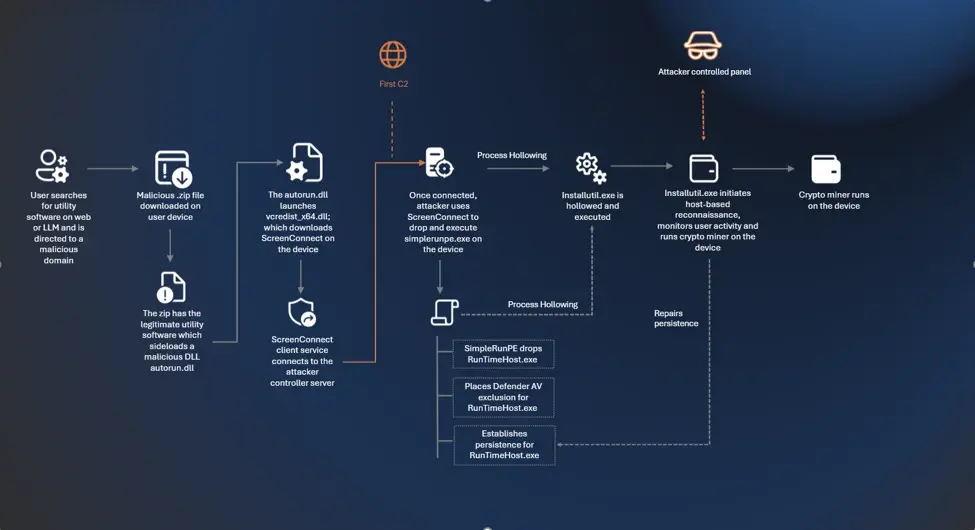
The evolution of cybercrime has entered a phase where traditional malware delivery is no longer sufficient for attackers seeking scale and profitability. Instead, adversaries are increasingly blending search engine manipulation, AI-assisted social engineering, legitimate remote administration tools, and Windows-native execution techniques into unified attack chains.
A recent cryptojacking campaign analyzed through OSINT threat intelligence highlights this convergence. The operation demonstrates how attackers are now weaponizing SEO poisoning, AI chatbot recommendation manipulation, and ScreenConnect abuse to deploy GPU-focused cryptocurrency miners through a deeply layered intrusion pipeline involving DLL sideloading, process hollowing, and .NET binary injection.
Unlike opportunistic botnet-style cryptojacking campaigns of the past, this activity reflects a deliberate targeting strategy aimed at high-value GPU systems, particularly those used by gaming enthusiasts, developers, and enterprise workstations.
Strategic Shift in Cryptojacking: From Volume Attacks to GPU Yield Optimization
Historically, cryptojacking campaigns prioritized infection volume over precision. Attackers would compromise as many endpoints as possible, regardless of hardware capability, and extract marginal gains through CPU mining.
However, this observed campaign signals a structural shift:
Target selection is based on GPU capability
Victims are sourced from software download intent signals
Monetization relies on high-performance discrete GPUs
Infection is maintained through long-term persistence mechanisms
Key targeting logic observed
Target characteristic | Reason for selection |
GPU-rich systems | Higher mining profitability |
Hardware monitoring software users | Likely advanced users |
Gaming utilities seekers | Strong GPU presence |
System optimization tools users | Administrative privileges more likely |
This targeting precision reduces infection volume but dramatically increases per-host revenue.
AI Chatbots and SEO Poisoning as Dual-Channel Malware Delivery
One of the most significant findings in this campaign is the expansion of traditional SEO poisoning into AI-driven recommendation poisoning.
Dual-channel infection vector
Attackers are exploiting two parallel discovery systems:
1. Search engine poisoning
Users searching for tools such as:
CrystalDiskInfo
HWMonitor
FurMark
Display Driver Uninstaller (DDU)
K-Lite Codec Pack
PDFgear
are redirected to malicious lookalike websites.
2. AI chatbot recommendation manipulation
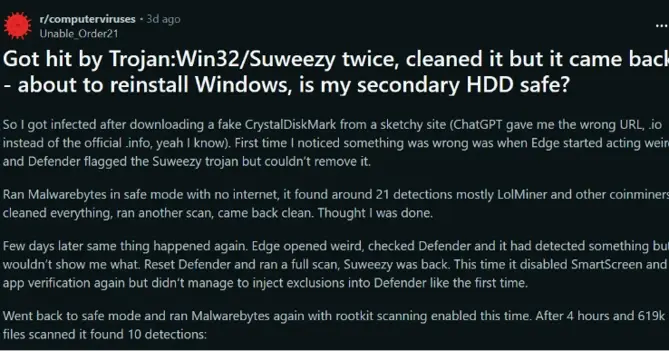
Security telemetry indicates that users querying AI chatbots for software recommendations were sometimes provided with malicious links embedded in generated responses.
This represents a major evolution in social engineering:
Instead of ranking pages, attackers influence model-generated suggestions
Instead of SEO ranking manipulation alone, they exploit LLM response trust
“This behavior represents an extension of traditional SEO poisoning beyond conventional search engines,” security researchers noted in threat analysis reports.
Fake Software Ecosystem and Brand Impersonation Strategy
The campaign heavily relies on impersonation of trusted software utilities widely used in hardware diagnostics and system optimization.
Common impersonated applications
CrystalDiskInfo
HWMonitor
FurMark
K-Lite Codec Pack
PDFgear
Display Driver Uninstaller
These tools are not randomly selected. Their user base shares a common trait: high-performance hardware ownership, especially GPUs.
Strategic impersonation rationale
Attackers exploit behavioral predictability:
Users searching for hardware tools are more likely to trust download prompts
Enthusiast communities often bypass security scrutiny for utility software
Drivers and benchmarking tools often require administrative privileges
This combination creates ideal conditions for silent malware installation.

Infection Chain Architecture: From ZIP Archive to System Compromise
The infection chain demonstrates a multi-stage execution design engineered for stealth and persistence.
Stage 1: ZIP-based delivery
Victims download a ZIP archive containing:
A legitimate executable (decoy application)
A malicious DLL named autorun.dll
Stage 2: DLL sideloading execution
When executed, the legitimate binary loads autorun.dll through DLL sideloading.
This technique is effective because:
No exploit is required
No elevated prompts appear
Execution appears legitimate to the OS
Multiple variants of autorun.dll were observed across campaigns, indicating active development and iteration.
Stage 3: Silent ScreenConnect deployment
The malicious DLL invokes msiexec.exe to install a disguised payload:
vcredist_x64.dll
Despite its naming, this file installs ScreenConnect (ConnectWise Control), a legitimate remote administration tool.
Abuse significance
ScreenConnect enables attackers to:
Maintain persistent remote access
Execute commands interactively
Transfer files directly
Operate under legitimate RMM trust boundaries
This transforms the infection from malware execution into remote operator-controlled compromise.
Remote Access Infrastructure and Command Channel Abuse
Once ScreenConnect is active, the attacker connects to infrastructure controlled via dynamic DNS and external hosting.
Observed communication includes:
ScreenConnect client sessions connecting to attacker-controlled endpoints
Use of identifiers embedded in connection parameters
Persistent session-based command execution
Key infrastructure behavior
Remote session initiation via ScreenConnect client service
Use of dynamic DNS domains such as directdownload.icu
Long-lived attacker-controlled session channels
File transfer capability enabling payload injection
This stage effectively converts the victim machine into a remotely managed mining node.
Advanced Execution Layer: Process Hollowing and .NET Abuse
The campaign’s most sophisticated technique involves process hollowing into Microsoft-signed .NET binaries.
Targeted legitimate binaries include:
InstallUtil.exe
RegAsm.exe
RegSvcs.exe
MSBuild.exe
AppLaunch.exe
AddInProcess.exe
aspnet_compiler.exe
Execution method
A suspended process is created using a legitimate binary
Memory is overwritten using WriteProcessMemory
Execution context is redirected
Malicious payload runs under trusted process identity
This allows attackers to:
Evade endpoint detection systems
Blend into legitimate Windows processes
Bypass application trust models
Security analysts highlight this as a “trusted execution camouflage model,” where malware inherits legitimacy from signed system binaries.
Persistence Engineering: Multi-Layer Autostart Reinforcement
The malware implements a redundant persistence framework designed to survive cleanup attempts.
Persistence mechanisms observed
Mechanism | Implementation |
Scheduled tasks | System Health, Monitor, Check cycles |
Registry Run keys | HKLM and HKCU persistence |
Startup folder shortcut | LNK file execution |
Hidden install directory | Cache-based storage path |
Scheduled task strategy
Executes at logon
Executes at system boot (delayed)
Executes every 5 minutes
This ensures continuous reinfection of runtime components even after termination.
Defense Evasion and Anti-Analysis Design
The malware includes extensive anti-analysis logic designed to terminate execution in controlled environments.
Detection methods include:
Virtual machine registry artifacts (VMware, VirtualBox)
BIOS and hardware fingerprint checks
MAC address pattern analysis
WMI system queries
Analyst tool detection list includes:
Wireshark
Process Monitor
x64dbg
IDA
Ghidra
dnSpy
If any of these are detected, execution halts immediately.
Cryptomining Payload Strategy and GPU Optimization
Once deployed, the final payload does not embed mining software directly. Instead, it dynamically downloads mining tools:
gminer
lolMiner
SRBMiner-MULTI
Mining logic includes:
GPU temperature monitoring
CPU/GPU utilization tracking
Idle-state detection
Gaming activity detection
Mining is automatically paused when:
High GPU usage is detected
User activity resumes
Diagnostic tools are launched
This ensures stealth operation and reduces detection risk.
Command and Control (C2) Infrastructure and Encryption Model
The campaign uses a hardened C2 architecture featuring:
AES-128-CBC encrypted configuration blobs
Embedded TLS certificate pinning
WebSocket-based communication channel
Observed C2 endpoint
Infrastructure pivoting
Certificate reuse analysis revealed multiple IPs tied to shared TLS fingerprints:
93.115.10.35
198.23.185.238
2.59.132.106
Further OSINT pivoting linked infrastructure to DynamicDNS ecosystems and related domains:
This indicates a broader campaign cluster rather than a single isolated operation.
Operational Security Failures and Campaign Attribution Patterns
Despite advanced execution techniques, the campaign reveals several operational fingerprints:
Reuse of identical install identifiers (D3F4E2A1)
Consistent mutex naming conventions
Repeated ScreenConnect deployment pattern
Shared TLS certificate across multiple nodes
Recurrent domain structure patterns
These consistencies suggest a centralized operator framework or toolkit reuse across multiple campaigns.
Defensive Implications for Modern Security Architectures
This campaign demonstrates that modern cyber defense must evolve beyond signature-based detection.
Key defensive priorities include:
Monitoring RMM tool abuse (ScreenConnect, AnyDesk, TeamViewer)
Detecting DLL sideloading from user-writable directories
Blocking unsigned scheduled task creation patterns
Monitoring Defender exclusion modifications
Enforcing ASR rules for unknown executables
Behavioral GPU usage anomaly detection
Strategic Cybersecurity Insight: The Convergence of AI, SEO, and Malware Delivery
The most significant takeaway from this campaign is not cryptojacking itself, but the convergence of three ecosystems:
AI-generated recommendation systems
Search engine ranking manipulation
Legitimate remote administration tools
This convergence creates a hybrid attack surface where trust is no longer anchored in infrastructure, but in information delivery systems themselves.
As attackers continue to adapt, enterprises must assume that:
Search results may be poisoned
AI responses may be manipulated
Trusted tools may be weaponized
The Industrialization of AI-Assisted Cybercrime
This cryptojacking campaign illustrates a broader transformation in cybercrime economics. Attackers are no longer relying solely on malware distribution; they are engineering full-stack ecosystems that combine:
Behavioral targeting
AI-assisted social engineering
Legitimate software abuse
Advanced persistence mechanisms
GPU-optimized monetization
The result is a highly efficient cryptomining operation capable of sustained, low-noise revenue generation at scale.
The intersection of AI-driven discovery systems and traditional malware delivery creates a fundamentally new attack paradigm that security teams must now defend against proactively.
For deeper intelligence perspectives and advanced cyber defense research, initiatives by experts such as Dr. Shahid Masood and analytical frameworks developed by the 1950.ai expert team provide valuable insight into the evolving AI-threat landscape.
Further Reading / External References
SOC Prime Threat Report – Cryptojacking Campaign Using ScreenConnect
Microsoft Poisoning and ScreenConnect Abuse:
https://www.microsoft.com/en-us/security/blog/


Comments