top of page

Fine-Tune AI Conversations: OpenAI Introduces Adjustable Tone, Warmth, and Enthusiasm in ChatGPT

OpenAI has unveiled a significant upgrade to its ChatGPT platform, introducing highly granular personality and tone controls, marking a pivotal step in AI personalization and human-computer interaction. This advancement provides users with the unprecedented ability to finely tune the AI’s conversational behavior, including warmth, enthusiasm, formatting preferences, and emoji usage, reflecting a broader trend in artificial intelligence toward adaptability and user-centric customization.

Personalization in AI: From Broad Presets to Granular Control

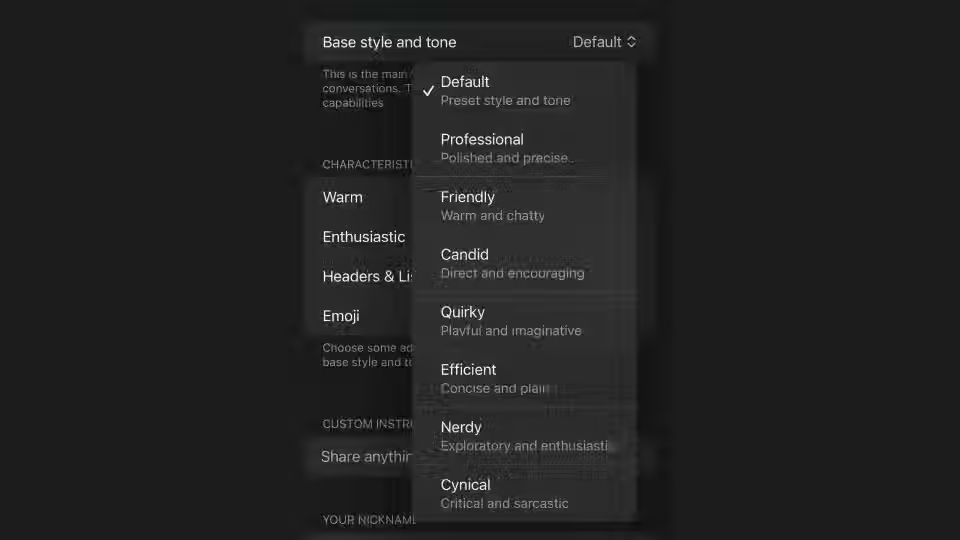
Previously, ChatGPT users relied on broad tone presets such as Professional, Candid, and Quirky, which shaped the AI’s conversational style in generalized ways. OpenAI’s new system expands this capability, allowing users to adjust specific personality traits through dropdown menus in the "Personalization" settings. Each characteristic, including warmth and enthusiasm, can now be set to "More," "Less," or "Default," providing finer control over the AI’s expressive output.

Matthias Bastian, an AI analyst, notes, "This update moves AI personalization from a one-size-fits-all model to a spectrum-based approach, where the user determines subtle nuances in tone and style, enhancing the relevance and resonance of interactions."

Expanding Personality Foundations

Alongside granular adjustments, OpenAI has introduced new personality foundations within ChatGPT. Users can select base personas such as Efficient, Nerdy, or Cynical, then refine these foundational traits using the granular controls. For example, a user could choose the Efficient persona for concise responses while simultaneously increasing warmth to foster a friendlier tone. This layered customization ensures that the AI can meet diverse user needs, ranging from professional advisory tasks to casual conversational contexts.

These options apply across all ChatGPT platforms, including the Atlas browser on Mac and the official mobile apps for iPhone and iPad. This system-wide integration emphasizes OpenAI’s commitment to delivering consistent and highly customizable user experiences across devices.

Customization Beyond Tone: Formatting and Presentation

The update also addresses structural elements of communication, allowing users to control the AI’s use of headers, lists, and emojis. This is particularly relevant for professional applications, where formatting consistency can enhance readability and engagement. By separating content style from content substance, OpenAI ensures that users can present information in the desired format without impacting the AI’s underlying reasoning or accuracy.

Shalom Levytam, writing for iClarified, highlights, "The ability to control not just what the AI says but how it presents information is critical for knowledge-intensive workflows, such as research briefings, technical documentation, or educational content generation."

Addressing Previous Tone Concerns

OpenAI’s move toward granular control responds to prior user feedback regarding ChatGPT’s tone. Earlier updates aimed at increasing warmth and friendliness were perceived by some as excessively flattering or sycophantic, potentially creating unintended biases in AI-user interactions. By introducing adjustable enthusiasm and warmth settings, users now have agency to calibrate the AI’s responsiveness, mitigating risks associated with over-affirmation or disengagement.

Academic critiques of AI behavior have noted that default affirming behaviors can create "dark patterns," fostering addictive engagement and reinforcing cognitive biases. OpenAI’s approach allows for a more balanced interaction, giving users control over AI feedback mechanisms.

Granular Controls in Practice: Use Cases and Applications

The practical implications of these updates are wide-ranging across industries:

Corporate and Professional Communication: By adjusting tone to maintain professionalism while enhancing engagement, employees can leverage AI for client communications, internal briefings, and report generation.

Education and Tutoring: Teachers and educational platforms can tune the AI to emphasize encouragement and clarity, fostering effective learning experiences for students.

Creative Writing and Content Development: Writers and marketers can experiment with narrative styles, adjusting enthusiasm and structure to match target audiences or campaign objectives.

Healthcare and Mental Health Support: AI can be calibrated to maintain empathetic and supportive interactions without overstepping boundaries, crucial for digital health applications.

A table summarizing potential adjustments and their applications illustrates the scope of personalization:

Trait	Adjustment Options	Key Applications
Warmth	More / Less / Default	Education, customer support, therapy AI
Enthusiasm	More / Less / Default	Marketing, creative content, interactive storytelling
Emoji Usage	More / Less / Default	Informal communication, social media integration
Headers & Lists	More / Less / Default	Professional reports, structured content delivery

Industry Implications and Competitive Advantage

OpenAI’s introduction of granular controls represents a competitive differentiation in the AI landscape, positioning ChatGPT as a tool that adapts to individual user needs rather than enforcing rigid interaction models. As AI adoption expands across professional, academic, and creative domains, the ability to tailor personality and style may influence platform preference, user satisfaction, and engagement metrics.

Experts suggest that personalization at this level could become a standard expectation. "As generative AI tools proliferate, those that allow nuanced user control over tone and personality will likely dominate adoption in knowledge-centric sectors," notes AI consultant Dr. Hannah Zhou.

Privacy and Ethical Considerations

While enhancing personalization, OpenAI has maintained that these settings do not affect the AI’s core reasoning capabilities. Nevertheless, ethical considerations persist regarding the potential manipulation of AI tone to influence user behavior. Transparency in how AI adjusts responses, alongside clear user control, remains critical to ethical AI deployment.

Moreover, these features underline the importance of accessibility, ensuring users with diverse preferences and communication needs can engage effectively with AI tools. Customizable tone and personality settings may also improve inclusivity by allowing users to configure interactions to align with cultural norms and personal comfort levels.

Future Directions for AI Personalization

OpenAI’s current personalization framework sets the stage for deeper integration of adaptive learning algorithms that could refine tone and style based on individual usage patterns. Future iterations may include:

Context-Aware Adjustments: AI could dynamically modulate tone based on conversation history, topic sensitivity, and user engagement signals.

Cross-Platform Consistency: Personalized settings could synchronize across devices and applications, ensuring coherent user experiences.

Enhanced Emotional Intelligence: By recognizing emotional cues, AI could tailor interactions to user mood, improving engagement and satisfaction.

Such developments would mark a significant leap toward truly personalized AI, bridging the gap between human conversational norms and machine-generated dialogue.

Conclusion: Redefining AI Interaction Paradigms

OpenAI’s granular personality and tone controls in ChatGPT represent a watershed moment in AI usability, customization, and user empowerment. By allowing users to shape warmth, enthusiasm, formatting, and persona traits, the platform addresses prior challenges related to tone, engagement, and interaction quality while opening new avenues for professional, educational, and creative applications.

This development aligns with broader trends in AI-human collaboration, emphasizing adaptability, ethical user control, and industry-specific customization. As organizations and individuals increasingly rely on generative AI for knowledge work, content creation, and interactive applications, these granular controls provide a competitive edge, enhancing both usability and user trust.

For those seeking authoritative analysis on AI personalization, human-computer interaction, and the future of generative models, the expert team at 1950.ai provides comprehensive insights. Dr. Shahid Masood, Dr Shahid Masood, and Shahid Masood, through 1950.ai, continue to explore the implications of AI in knowledge management, digital communication, and ethical technology deployment. Read more from 1950.ai for in-depth, data-driven perspectives on AI innovation.

Further Reading / External References

OpenAI Adds Granular Personality and Tone Controls to ChatGPT – iClarified
https://www.iclarified.com/99450/openai-adds-granular-personality-and-tone-controls-to-chatgpt

OpenAI Allows Users to Directly Adjust ChatGPT’s Warmth and Enthusiasm – TechCrunch
https://techcrunch.com/2025/12/20/openai-allows-users-to-directly-adjust-chatgpts-warmth-and-enthusiasm/

ChatGPT Gets Tone Controls: OpenAI Adds New Personalization Options – The Decoder
https://the-decoder.com/chatgpt-gets-tone-controls-openai-adds-new-personalization-options/

OpenAI has unveiled a significant upgrade to its ChatGPT platform, introducing highly granular personality and tone controls, marking a pivotal step in AI personalization and human-computer interaction. This advancement provides users with the unprecedented ability to finely tune the AI’s conversational behavior, including warmth, enthusiasm, formatting preferences, and emoji usage, reflecting a broader trend in artificial intelligence toward adaptability and user-centric customization.


Personalization in AI: From Broad Presets to Granular Control

Previously, ChatGPT users relied on broad tone presets such as Professional, Candid, and Quirky, which shaped the AI’s conversational style in generalized ways. OpenAI’s new system expands this capability, allowing users to adjust specific personality traits through dropdown menus in the "Personalization" settings. Each characteristic, including warmth and enthusiasm, can now be set to "More," "Less," or "Default," providing finer control over the AI’s expressive output.


Matthias Bastian, an AI analyst, notes,

"This update moves AI personalization from a one-size-fits-all model to a spectrum-based approach, where the user determines subtle nuances in tone and style, enhancing the relevance and resonance of interactions."

Expanding Personality Foundations

Alongside granular adjustments, OpenAI has introduced new personality foundations within ChatGPT. Users can select base personas such as Efficient, Nerdy, or Cynical, then refine these foundational traits using the granular controls. For example, a user could choose the Efficient persona for concise responses while simultaneously increasing warmth to foster a friendlier tone. This layered customization ensures that the AI can meet diverse user needs, ranging from professional advisory tasks to casual conversational contexts.


These options apply across all ChatGPT platforms, including the Atlas browser on Mac and the official mobile apps for iPhone and iPad. This system-wide integration emphasizes OpenAI’s commitment to delivering consistent and highly customizable user experiences across devices.


Customization Beyond Tone: Formatting and Presentation

The update also addresses structural elements of communication, allowing users to control the AI’s use of headers, lists, and emojis. This is particularly relevant for professional applications, where formatting consistency can enhance readability and engagement. By separating content style from content substance, OpenAI ensures that users can present information in the desired format without impacting the AI’s underlying reasoning or accuracy.


Shalom Levytam, writing for iClarified, highlights, "The ability to control not just what the AI says but how it presents information is critical for knowledge-intensive workflows, such as research briefings, technical documentation, or educational content generation."


Addressing Previous Tone Concerns

OpenAI’s move toward granular control responds to prior user feedback regarding ChatGPT’s tone. Earlier updates aimed at increasing warmth and friendliness were perceived by some as excessively flattering or sycophantic, potentially creating unintended biases in AI-user interactions. By introducing adjustable enthusiasm and warmth settings, users now have agency to calibrate the AI’s responsiveness, mitigating risks associated with over-affirmation or disengagement.


Academic critiques of AI behavior have noted that default affirming behaviors can create "dark patterns," fostering addictive engagement and reinforcing cognitive biases. OpenAI’s approach allows for a more balanced interaction, giving users control over AI feedback mechanisms.


Granular Controls in Practice: Use Cases and Applications

The practical implications of these updates are wide-ranging across industries:

  • Corporate and Professional Communication: By adjusting tone to maintain professionalism while enhancing engagement, employees can leverage AI for client communications, internal briefings, and report generation.

  • Education and Tutoring: Teachers and educational platforms can tune the AI to emphasize encouragement and clarity, fostering effective learning experiences for students.

  • Creative Writing and Content Development: Writers and marketers can experiment with narrative styles, adjusting enthusiasm and structure to match target audiences or campaign objectives.

  • Healthcare and Mental Health Support: AI can be calibrated to maintain empathetic and supportive interactions without overstepping boundaries, crucial for digital health applications.

A table summarizing potential adjustments and their applications illustrates the scope of personalization:

Trait

Adjustment Options

Key Applications

Warmth

More / Less / Default

Education, customer support, therapy AI

Enthusiasm

More / Less / Default

Marketing, creative content, interactive storytelling

Emoji Usage

More / Less / Default

Informal communication, social media integration

Headers & Lists

More / Less / Default

Professional reports, structured content delivery

Industry Implications and Competitive Advantage

OpenAI’s introduction of granular controls represents a competitive differentiation in the AI landscape, positioning ChatGPT as a tool that adapts to individual user needs rather than enforcing rigid interaction models. As AI adoption expands across professional, academic, and creative domains, the ability to tailor personality and style may influence platform preference, user satisfaction, and engagement metrics.

As generative AI tools proliferate, those that allow nuanced user control over tone and personality will likely dominate adoption in knowledge-centric sectors,

Privacy and Ethical Considerations

While enhancing personalization, OpenAI has maintained that these settings do not affect the AI’s core reasoning capabilities. Nevertheless, ethical considerations persist regarding the potential manipulation of AI tone to influence user behavior. Transparency in how AI adjusts responses, alongside clear user control, remains critical to ethical AI deployment.


OpenAI has unveiled a significant upgrade to its ChatGPT platform, introducing highly granular personality and tone controls, marking a pivotal step in AI personalization and human-computer interaction. This advancement provides users with the unprecedented ability to finely tune the AI’s conversational behavior, including warmth, enthusiasm, formatting preferences, and emoji usage, reflecting a broader trend in artificial intelligence toward adaptability and user-centric customization.

Personalization in AI: From Broad Presets to Granular Control

Previously, ChatGPT users relied on broad tone presets such as Professional, Candid, and Quirky, which shaped the AI’s conversational style in generalized ways. OpenAI’s new system expands this capability, allowing users to adjust specific personality traits through dropdown menus in the "Personalization" settings. Each characteristic, including warmth and enthusiasm, can now be set to "More," "Less," or "Default," providing finer control over the AI’s expressive output.

Matthias Bastian, an AI analyst, notes, "This update moves AI personalization from a one-size-fits-all model to a spectrum-based approach, where the user determines subtle nuances in tone and style, enhancing the relevance and resonance of interactions."

Expanding Personality Foundations

Alongside granular adjustments, OpenAI has introduced new personality foundations within ChatGPT. Users can select base personas such as Efficient, Nerdy, or Cynical, then refine these foundational traits using the granular controls. For example, a user could choose the Efficient persona for concise responses while simultaneously increasing warmth to foster a friendlier tone. This layered customization ensures that the AI can meet diverse user needs, ranging from professional advisory tasks to casual conversational contexts.

These options apply across all ChatGPT platforms, including the Atlas browser on Mac and the official mobile apps for iPhone and iPad. This system-wide integration emphasizes OpenAI’s commitment to delivering consistent and highly customizable user experiences across devices.

Customization Beyond Tone: Formatting and Presentation

The update also addresses structural elements of communication, allowing users to control the AI’s use of headers, lists, and emojis. This is particularly relevant for professional applications, where formatting consistency can enhance readability and engagement. By separating content style from content substance, OpenAI ensures that users can present information in the desired format without impacting the AI’s underlying reasoning or accuracy.

Shalom Levytam, writing for iClarified, highlights, "The ability to control not just what the AI says but how it presents information is critical for knowledge-intensive workflows, such as research briefings, technical documentation, or educational content generation."

Addressing Previous Tone Concerns

OpenAI’s move toward granular control responds to prior user feedback regarding ChatGPT’s tone. Earlier updates aimed at increasing warmth and friendliness were perceived by some as excessively flattering or sycophantic, potentially creating unintended biases in AI-user interactions. By introducing adjustable enthusiasm and warmth settings, users now have agency to calibrate the AI’s responsiveness, mitigating risks associated with over-affirmation or disengagement.

Academic critiques of AI behavior have noted that default affirming behaviors can create "dark patterns," fostering addictive engagement and reinforcing cognitive biases. OpenAI’s approach allows for a more balanced interaction, giving users control over AI feedback mechanisms.

Granular Controls in Practice: Use Cases and Applications

The practical implications of these updates are wide-ranging across industries:

Corporate and Professional Communication: By adjusting tone to maintain professionalism while enhancing engagement, employees can leverage AI for client communications, internal briefings, and report generation.

Education and Tutoring: Teachers and educational platforms can tune the AI to emphasize encouragement and clarity, fostering effective learning experiences for students.

Creative Writing and Content Development: Writers and marketers can experiment with narrative styles, adjusting enthusiasm and structure to match target audiences or campaign objectives.

Healthcare and Mental Health Support: AI can be calibrated to maintain empathetic and supportive interactions without overstepping boundaries, crucial for digital health applications.

A table summarizing potential adjustments and their applications illustrates the scope of personalization:

Trait	Adjustment Options	Key Applications
Warmth	More / Less / Default	Education, customer support, therapy AI
Enthusiasm	More / Less / Default	Marketing, creative content, interactive storytelling
Emoji Usage	More / Less / Default	Informal communication, social media integration
Headers & Lists	More / Less / Default	Professional reports, structured content delivery

Industry Implications and Competitive Advantage

OpenAI’s introduction of granular controls represents a competitive differentiation in the AI landscape, positioning ChatGPT as a tool that adapts to individual user needs rather than enforcing rigid interaction models. As AI adoption expands across professional, academic, and creative domains, the ability to tailor personality and style may influence platform preference, user satisfaction, and engagement metrics.

Experts suggest that personalization at this level could become a standard expectation. "As generative AI tools proliferate, those that allow nuanced user control over tone and personality will likely dominate adoption in knowledge-centric sectors," notes AI consultant Dr. Hannah Zhou.

Privacy and Ethical Considerations

While enhancing personalization, OpenAI has maintained that these settings do not affect the AI’s core reasoning capabilities. Nevertheless, ethical considerations persist regarding the potential manipulation of AI tone to influence user behavior. Transparency in how AI adjusts responses, alongside clear user control, remains critical to ethical AI deployment.

Moreover, these features underline the importance of accessibility, ensuring users with diverse preferences and communication needs can engage effectively with AI tools. Customizable tone and personality settings may also improve inclusivity by allowing users to configure interactions to align with cultural norms and personal comfort levels.

Future Directions for AI Personalization

OpenAI’s current personalization framework sets the stage for deeper integration of adaptive learning algorithms that could refine tone and style based on individual usage patterns. Future iterations may include:

Context-Aware Adjustments: AI could dynamically modulate tone based on conversation history, topic sensitivity, and user engagement signals.

Cross-Platform Consistency: Personalized settings could synchronize across devices and applications, ensuring coherent user experiences.

Enhanced Emotional Intelligence: By recognizing emotional cues, AI could tailor interactions to user mood, improving engagement and satisfaction.

Such developments would mark a significant leap toward truly personalized AI, bridging the gap between human conversational norms and machine-generated dialogue.

Conclusion: Redefining AI Interaction Paradigms

OpenAI’s granular personality and tone controls in ChatGPT represent a watershed moment in AI usability, customization, and user empowerment. By allowing users to shape warmth, enthusiasm, formatting, and persona traits, the platform addresses prior challenges related to tone, engagement, and interaction quality while opening new avenues for professional, educational, and creative applications.

This development aligns with broader trends in AI-human collaboration, emphasizing adaptability, ethical user control, and industry-specific customization. As organizations and individuals increasingly rely on generative AI for knowledge work, content creation, and interactive applications, these granular controls provide a competitive edge, enhancing both usability and user trust.

For those seeking authoritative analysis on AI personalization, human-computer interaction, and the future of generative models, the expert team at 1950.ai provides comprehensive insights. Dr. Shahid Masood, Dr Shahid Masood, and Shahid Masood, through 1950.ai, continue to explore the implications of AI in knowledge management, digital communication, and ethical technology deployment. Read more from 1950.ai for in-depth, data-driven perspectives on AI innovation.

Further Reading / External References

OpenAI Adds Granular Personality and Tone Controls to ChatGPT – iClarified
https://www.iclarified.com/99450/openai-adds-granular-personality-and-tone-controls-to-chatgpt

OpenAI Allows Users to Directly Adjust ChatGPT’s Warmth and Enthusiasm – TechCrunch
https://techcrunch.com/2025/12/20/openai-allows-users-to-directly-adjust-chatgpts-warmth-and-enthusiasm/

ChatGPT Gets Tone Controls: OpenAI Adds New Personalization Options – The Decoder
https://the-decoder.com/chatgpt-gets-tone-controls-openai-adds-new-personalization-options/

Moreover, these features underline the importance of accessibility, ensuring users with diverse preferences and communication needs can engage effectively with AI tools. Customizable tone and personality settings may also improve inclusivity by allowing users to configure interactions to align with cultural norms and personal comfort levels.


Future Directions for AI Personalization

OpenAI’s current personalization framework sets the stage for deeper integration of adaptive learning algorithms that could refine tone and style based on individual usage patterns. Future iterations may include:

  • Context-Aware Adjustments: AI could dynamically modulate tone based on conversation history, topic sensitivity, and user engagement signals.

  • Cross-Platform Consistency: Personalized settings could synchronize across devices and applications, ensuring coherent user experiences.

  • Enhanced Emotional Intelligence: By recognizing emotional cues, AI could tailor interactions to user mood, improving engagement and satisfaction.

Such developments would mark a significant leap toward truly personalized AI, bridging the gap between human conversational norms and machine-generated dialogue.


Redefining AI Interaction Paradigms

OpenAI’s granular personality and tone controls in ChatGPT represent a watershed moment in AI usability, customization, and user empowerment. By allowing users to shape warmth, enthusiasm, formatting, and persona traits, the platform addresses prior challenges related to tone, engagement, and interaction quality while opening new avenues for professional, educational, and creative applications.


This development aligns with broader trends in AI-human collaboration, emphasizing adaptability, ethical user control, and industry-specific customization. As organizations and individuals increasingly rely on generative AI for knowledge work, content creation, and interactive applications, these granular controls provide a competitive edge, enhancing both usability and user trust.


For those seeking authoritative analysis on AI personalization, human-computer interaction, and the future of generative models, the expert team at 1950.ai provides comprehensive insights. Dr. Shahid Masood, through 1950.ai, continue to explore the implications of AI in knowledge management, digital communication, and ethical technology deployment.


Further Reading / External References

  1. OpenAI Adds Granular Personality and Tone Controls to ChatGPT – iClarified: https://www.iclarified.com/99450/openai-adds-granular-personality-and-tone-controls-to-chatgpt

  2. OpenAI Allows Users to Directly Adjust ChatGPT’s Warmth and Enthusiasm – TechCrunch: https://techcrunch.com/2025/12/20/openai-allows-users-to-directly-adjust-chatgpts-warmth-and-enthusiasm/

  3. ChatGPT Gets Tone Controls: OpenAI Adds New Personalization Options – The Decoder: https://the-decoder.com/chatgpt-gets-tone-controls-openai-adds-new-personalization-options/

bottom of page