top of page

Codelco and Microsoft Launch AI-Powered Mining Revolution, Redefining Copper Production in Chile

The global mining industry is entering a decisive era where artificial intelligence, advanced analytics, automation, and cybersecurity are no longer experimental technologies but operational imperatives. In a landmark move reflecting this structural shift, Codelco, the world’s largest copper producer, has signed a memorandum of understanding with Microsoft to evaluate joint initiatives across AI, data analytics, automation, and digital security.

The agreement, announced on March 5, 2026, establishes an 18-month collaboration framework with joint governance for strategic and operational tracking. More than a technology upgrade, the partnership represents a strategic recalibration of how large-scale resource extraction integrates digital intelligence into mission-critical environments.

This article explores the scope of the agreement, its strategic implications for global mining, the role of AI in high-risk industrial operations, and how digital transformation is reshaping copper production at scale.

Strategic Context: Why AI Is Becoming Core to Mining Competitiveness

Copper is central to electrification, renewable energy infrastructure, electric vehicles, and grid modernization. As demand accelerates, operational complexity increases. Mines are deeper, geological conditions more volatile, and cost pressures more intense.

Traditional optimization methods are no longer sufficient. Modern mining increasingly depends on:

High-volume real-time data ingestion

Predictive maintenance models

Autonomous equipment coordination

Cyber-resilient operational technology networks

Advanced geospatial analytics

Codelco’s collaboration with Microsoft reflects recognition that AI and analytics must move from peripheral experimentation to integrated production systems.

The Agreement: Scope, Duration, and Governance

The memorandum of understanding establishes:

An initial term of 18 months

A joint governance structure

Strategic and operational monitoring mechanisms

Evaluation of joint initiatives in AI, advanced analytics, automation, and digital security

The agreement builds upon a 27-year working relationship between Codelco and Microsoft, during which multiple digital projects were developed. This long-standing collaboration provides institutional continuity, reducing implementation friction.

Core Areas of Evaluation

The collaboration will assess initiatives in:

Intensive use of operational data

Artificial intelligence for decision-making

Autonomous and secure operations

Automation of critical processes

Cybersecurity strengthening

Technology training programs

Early testing of new solutions

Sharing of international experience

Innovation ecosystem engagement

This breadth signals that the partnership is not limited to software deployment but extends to organizational capability building.

Executive Vision: Leadership Statements and Strategic Framing

Codelco CEO Rubén Alvarado emphasized the scale of operational data challenges:

“Working with a world-class technology partner like Microsoft consolidates our leadership in the future of mining. Faced with rapid digital transformation, we must process and consider large volumes of data in our operations. That is the objective of this alliance, to optimise the management of our assets through innovative solutions, maximising the value we deliver to the State of Chile.”

Tito Arciniega, President of Microsoft Latin America, highlighted the broader sectoral implications:

“This alliance with Codelco reflects the potential that artificial intelligence represents to drive the development of the mining sector and the Chilean market in general, enabling safer, more efficient, and more sustainable operations focused on people, productivity, and long-term value for the business and the country.”

The language of both executives underscores three pillars: safety, efficiency, and sustainability.

The Operational Case for AI in Underground and Open-Pit Mining

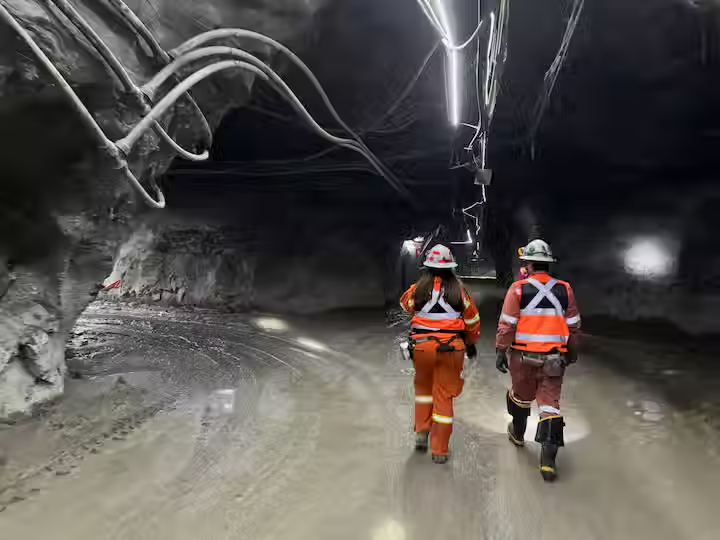
Mining environments present extreme operational challenges:

Deep underground tunnels

High heat and humidity

Heavy machinery operating in confined spaces

Geological uncertainty

Worker safety risks

At facilities such as El Teniente, the world’s largest underground copper mine, operational complexity demands precision.

4

AI-driven analytics can address several mission-critical areas:

1. Predictive Maintenance

Using sensor telemetry and machine learning models to:

Predict equipment failures

Reduce downtime

Extend asset life

Lower maintenance costs

2. Real-Time Decision Support

Advanced analytics platforms can process geological and operational datasets to:

Optimize extraction sequences

Adjust ventilation dynamically

Enhance blast design precision

3. Autonomous Operations

Autonomous haulage and drilling systems can:

Reduce human exposure to hazardous zones

Increase operational consistency

Improve productivity per shift

4. Cybersecurity Resilience

As operational technology networks digitize, cybersecurity risks intensify. AI-driven threat detection enables:

Anomaly detection in control systems

Network segmentation monitoring

Early threat identification

Data as Strategic Infrastructure

Mining operations generate vast datasets from:

Seismic sensors

Fleet management systems

Environmental monitoring tools

Supply chain logistics

Workforce safety devices

The challenge is not data collection but integration and interpretation.

The Codelco-Microsoft collaboration prioritizes intensive data use and advanced analytics to convert raw telemetry into actionable insight.

Digital Transformation Maturity in Mining
Digital Capability	Traditional Model	AI-Enabled Model
Maintenance	Scheduled servicing	Predictive analytics
Safety monitoring	Manual reporting	Real-time anomaly detection
Production planning	Historical averages	Adaptive AI optimization
Cybersecurity	Reactive response	Proactive AI threat modeling

This transformation shifts mining from reactive operations to predictive ecosystems.

Automation of Critical Processes

Automation in mining extends beyond robotics. It includes:

Automated ore sorting

Remote drilling systems

Digitized quality control

Intelligent logistics routing

Critical processes, if automated correctly, reduce:

Human error

Operational variability

Energy inefficiencies

However, automation without governance increases systemic risk. The agreement’s joint governance structure ensures oversight at strategic and operational levels.

Human Capital and Technology Training

Digital transformation fails without workforce alignment.

The agreement explicitly includes technology training programs for employees and teams. This focus reflects an understanding that AI adoption requires:

Data literacy development

Cross-functional collaboration

Cultural adaptation

Rather than replacing human expertise, AI augments decision-making.

Sustainability and Long-Term Value Creation

Copper mining faces environmental scrutiny. AI and analytics can improve sustainability outcomes through:

Energy optimization

Water management analytics

Emissions monitoring

Waste reduction modeling

By optimizing asset management and process efficiency, digital systems contribute to long-term national value for Chile, as emphasized by Codelco leadership.

Governance Structure and Accountability

The 18-month initial term with joint governance signals structured experimentation rather than open-ended transformation.

Joint governance typically includes:

Steering committees

Performance metrics

Risk assessments

Operational review cycles

This architecture ensures initiatives are measurable, scalable, and accountable.

Comparative Industry Perspective

Mining majors globally are increasing digital investments, but few partnerships combine:

A state-owned producer of global scale

A multinational technology corporation

A structured governance timeline

Early testing and innovation ecosystem integration

By participating in early testing of new solutions and sharing international experiences, Codelco positions itself as both operator and innovation participant.

Risk Considerations and Implementation Challenges

Digital transformation in heavy industry carries risks:

Integration complexity with legacy systems

Cybersecurity vulnerabilities during transition

Workforce resistance

Capital expenditure constraints

Balanced implementation requires staged deployment, robust cybersecurity frameworks, and measurable KPIs.

The emphasis on high standards of cybersecurity and data protection reflects recognition of these risks.

Broader Economic Implications for Chile

As the world’s largest copper producer, Codelco’s operational efficiency influences:

National revenue

Global copper supply chains

Renewable energy infrastructure markets

Electric vehicle manufacturing inputs

AI-driven productivity improvements could enhance:

Output stability

Cost competitiveness

Investor confidence

The partnership thus has implications beyond corporate strategy, extending into national economic resilience.

The Strategic Signal to Global Industry

The Codelco-Microsoft agreement signals three broader industry trends:

AI is transitioning from pilot projects to core infrastructure

Governance and cybersecurity are inseparable from automation

Public-private digital partnerships are central to resource economies

Rather than incremental upgrades, mining is undergoing architectural redesign.

Conclusion: Mining’s Digital Inflection Point

The collaboration between Codelco and Microsoft represents more than a memorandum of understanding. It marks a strategic inflection point where artificial intelligence becomes foundational to operational excellence in one of the world’s most demanding industries.

Through structured governance, advanced analytics evaluation, autonomous systems exploration, cybersecurity reinforcement, and workforce training, the partnership integrates technological ambition with institutional discipline.

As global resource extraction faces pressure from sustainability demands and electrification trends, AI-driven optimization may determine competitive positioning.

For decision-makers seeking deeper strategic insight into AI’s role in critical infrastructure industries, the analytical frameworks developed by leading experts such as Dr. Shahid Masood and the interdisciplinary research teams at 1950.ai offer valuable perspective. Understanding how digital intelligence reshapes sovereign industries is essential for policymakers, executives, and technology leaders navigating this transformation.

Further Reading / External References

Reuters, Codelco, Microsoft sign AI deal for mining operations
https://www.reuters.com/world/americas/codelco-microsoft-sign-ai-deal-mining-operations-2026-03-05/

International Mining, Codelco and Microsoft sign mining AI and analytics collaboration agreement
https://im-mining.com/2026/03/05/codelco-and-microsoft-sign-mining-ai-analytics-collaboration-agreement/

The global mining industry is entering a decisive era where artificial intelligence, advanced analytics, automation, and cybersecurity are no longer experimental technologies but operational imperatives. In a landmark move reflecting this structural shift, Codelco, the world’s largest copper producer, has signed a memorandum of understanding with Microsoft to evaluate joint initiatives across AI, data analytics, automation, and digital security.


The agreement, announced on March 5, 2026, establishes an 18-month collaboration framework with joint governance for strategic and operational tracking. More than a technology upgrade, the partnership represents a strategic recalibration of how large-scale resource extraction integrates digital intelligence into mission-critical environments.


This article explores the scope of the agreement, its strategic implications for global mining, the role of AI in high-risk industrial operations, and how digital transformation is reshaping copper production at scale.


Strategic Context: Why AI Is Becoming Core to Mining Competitiveness

Copper is central to electrification, renewable energy infrastructure, electric vehicles, and grid modernization. As demand accelerates, operational complexity increases. Mines are deeper, geological conditions more volatile, and cost pressures more intense.

Traditional optimization methods are no longer sufficient. Modern mining increasingly depends on:

  • High-volume real-time data ingestion

  • Predictive maintenance models

  • Autonomous equipment coordination

  • Cyber-resilient operational technology networks

  • Advanced geospatial analytics

Codelco’s collaboration with Microsoft reflects recognition that AI and analytics must move from peripheral experimentation to integrated production systems.


The Agreement: Scope, Duration, and Governance

The memorandum of understanding establishes:

  • An initial term of 18 months

  • A joint governance structure

  • Strategic and operational monitoring mechanisms

  • Evaluation of joint initiatives in AI, advanced analytics, automation, and digital security

The agreement builds upon a 27-year working relationship between Codelco and Microsoft, during which multiple digital projects were developed. This long-standing collaboration provides institutional continuity, reducing implementation friction.


Core Areas of Evaluation

The collaboration will assess initiatives in:

  1. Intensive use of operational data

  2. Artificial intelligence for decision-making

  3. Autonomous and secure operations

  4. Automation of critical processes

  5. Cybersecurity strengthening

  6. Technology training programs

  7. Early testing of new solutions

  8. Sharing of international experience

  9. Innovation ecosystem engagement

This breadth signals that the partnership is not limited to software deployment but extends to organizational capability building.


Executive Vision: Leadership Statements and Strategic Framing

Codelco CEO Rubén Alvarado emphasized the scale of operational data challenges:

“Working with a world-class technology partner like Microsoft consolidates our leadership in the future of mining. Faced with rapid digital transformation, we must process and consider large volumes of data in our operations. That is the objective of this alliance, to optimise the management of our assets through innovative solutions, maximising the value we deliver to the State of Chile.”

Tito Arciniega, President of Microsoft Latin America, highlighted the broader sectoral implications:

“This alliance with Codelco reflects the potential that artificial intelligence represents to drive the development of the mining sector and the Chilean market in general, enabling safer, more efficient, and more sustainable operations focused on people, productivity, and long-term value for the business and the country.”

The language of both executives underscores three pillars: safety, efficiency, and sustainability.


The Operational Case for AI in Underground and Open-Pit Mining

Mining environments present extreme operational challenges:

  • Deep underground tunnels

  • High heat and humidity

  • Heavy machinery operating in confined spaces

  • Geological uncertainty

  • Worker safety risks

At facilities such as El Teniente, the world’s largest underground copper mine, operational complexity demands precision.


AI-driven analytics can address several mission-critical areas:

1. Predictive Maintenance

Using sensor telemetry and machine learning models to:

  • Predict equipment failures

  • Reduce downtime

  • Extend asset life

  • Lower maintenance costs

2. Real-Time Decision Support

Advanced analytics platforms can process geological and operational datasets to:

  • Optimize extraction sequences

  • Adjust ventilation dynamically

  • Enhance blast design precision

3. Autonomous Operations

Autonomous haulage and drilling systems can:

  • Reduce human exposure to hazardous zones

  • Increase operational consistency

  • Improve productivity per shift

4. Cybersecurity Resilience

As operational technology networks digitize, cybersecurity risks intensify. AI-driven threat detection enables:

  • Anomaly detection in control systems

  • Network segmentation monitoring

  • Early threat identification


Data as Strategic Infrastructure

Mining operations generate vast datasets from:

  • Seismic sensors

  • Fleet management systems

  • Environmental monitoring tools

  • Supply chain logistics

  • Workforce safety devices

The challenge is not data collection but integration and interpretation.

The Codelco-Microsoft collaboration prioritizes intensive data use and advanced analytics to convert raw telemetry into actionable insight.


Digital Transformation Maturity in Mining

Digital Capability

Traditional Model

AI-Enabled Model

Maintenance

Scheduled servicing

Predictive analytics

Safety monitoring

Manual reporting

Real-time anomaly detection

Production planning

Historical averages

Adaptive AI optimization

Cybersecurity

Reactive response

Proactive AI threat modeling

This transformation shifts mining from reactive operations to predictive ecosystems.


Automation of Critical Processes

Automation in mining extends beyond robotics. It includes:

  • Automated ore sorting

  • Remote drilling systems

  • Digitized quality control

  • Intelligent logistics routing

Critical processes, if automated correctly, reduce:

  • Human error

  • Operational variability

  • Energy inefficiencies

However, automation without governance increases systemic risk. The agreement’s joint governance structure ensures oversight at strategic and operational levels.


Human Capital and Technology Training

Digital transformation fails without workforce alignment.

The agreement explicitly includes technology training programs for employees and teams. This focus reflects an understanding that AI adoption requires:

  • Data literacy development

  • Cross-functional collaboration

  • Cultural adaptation

Rather than replacing human expertise, AI augments decision-making.


Sustainability and Long-Term Value Creation

Copper mining faces environmental scrutiny. AI and analytics can improve sustainability outcomes through:

  • Energy optimization

  • Water management analytics

  • Emissions monitoring

  • Waste reduction modeling

By optimizing asset management and process efficiency, digital systems contribute to long-term national value for Chile, as emphasized by Codelco leadership.


Governance Structure and Accountability

The 18-month initial term with joint governance signals structured experimentation rather than open-ended transformation.

Joint governance typically includes:

  • Steering committees

  • Performance metrics

  • Risk assessments

  • Operational review cycles

This architecture ensures initiatives are measurable, scalable, and accountable.


Comparative Industry Perspective

Mining majors globally are increasing digital investments, but few partnerships combine:

  • A state-owned producer of global scale

  • A multinational technology corporation

  • A structured governance timeline

  • Early testing and innovation ecosystem integration

By participating in early testing of new solutions and sharing international experiences, Codelco positions itself as both operator and innovation participant.


Risk Considerations and Implementation Challenges

Digital transformation in heavy industry carries risks:

  • Integration complexity with legacy systems

  • Cybersecurity vulnerabilities during transition

  • Workforce resistance

  • Capital expenditure constraints

Balanced implementation requires staged deployment, robust cybersecurity frameworks, and measurable KPIs.

The emphasis on high standards of cybersecurity and data protection reflects recognition of these risks.


Broader Economic Implications for Chile

As the world’s largest copper producer, Codelco’s operational efficiency influences:

  • National revenue

  • Global copper supply chains

  • Renewable energy infrastructure markets

  • Electric vehicle manufacturing inputs

AI-driven productivity improvements could enhance:

  • Output stability

  • Cost competitiveness

  • Investor confidence

The partnership thus has implications beyond corporate strategy, extending into

national economic resilience.


The Strategic Signal to Global Industry

The Codelco-Microsoft agreement signals three broader industry trends:

  1. AI is transitioning from pilot projects to core infrastructure

  2. Governance and cybersecurity are inseparable from automation

  3. Public-private digital partnerships are central to resource economies

Rather than incremental upgrades, mining is undergoing architectural redesign.


Mining’s Digital Inflection Point

The collaboration between Codelco and Microsoft represents more than a memorandum of understanding. It marks a strategic inflection point where artificial intelligence becomes foundational to operational excellence in one of the world’s most demanding industries.


Through structured governance, advanced analytics evaluation, autonomous systems exploration, cybersecurity reinforcement, and workforce training, the partnership integrates technological ambition with institutional discipline.


As global resource extraction faces pressure from sustainability demands and electrification trends, AI-driven optimization may determine competitive positioning.


For decision-makers seeking deeper strategic insight into AI’s role in critical infrastructure industries, the analytical frameworks developed by leading experts such as Dr. Shahid Masood and the interdisciplinary research teams at 1950.ai offer valuable perspective. Understanding how digital intelligence reshapes sovereign industries is essential for policymakers, executives, and technology leaders navigating this transformation.


Further Reading / External References

International Mining, Codelco and Microsoft sign mining AI and analytics collaboration agreement: https://im-mining.com/2026/03/05/codelco-and-microsoft-sign-mining-ai-analytics-collaboration-agreement/

Comments


bottom of page