top of page

Beyond Magnetism: How Herbertsmithite’s Quantum Spin Glass Transition Reveals a New State of Entangled Matter

The search for quantum spin liquids has remained one of the most challenging and fascinating problems in condensed matter physics. These exotic states of matter do not behave like conventional magnets, even at temperatures near absolute zero. Instead of freezing into an ordered structure, their atomic spins remain in a fluctuating, highly entangled quantum state.

Recent research published in Nature Physics (2026) and reported by Phys.org has introduced a transformative experimental approach known as the quantum witness technique, applied to the mineral herbertsmithite (ZnCu₃(OH)₆Cl₂). This technique provides direct access to previously hidden excitations called spinons, offering one of the strongest experimental indications yet of a quantum spin liquid state in a real material.

The findings mark a significant shift in how physicists interpret impurities in quantum materials. Instead of being treated as experimental noise, impurity atoms are now being used as quantum probes of deeper many-body physics, fundamentally changing the methodology of quantum materials research (Nature Physics, 2026; Phys.org, 2026).

Quantum Spin Liquids: Theoretical Foundation of an Elusive State

Quantum spin liquids (QSLs) are states of matter where electron spins remain disordered even at extremely low temperatures. Unlike conventional magnets, where spins align in regular patterns, QSLs exhibit long-range quantum entanglement.

Key properties include:

Absence of long-range magnetic order even near absolute zero
Strong quantum entanglement across the entire lattice
Emergence of fractionalized excitations such as spinons
Highly non-classical magnetic behavior governed by quantum fluctuations

In a classical magnetic system, lowering temperature reduces thermal motion, eventually causing spins to freeze. However, in QSLs, quantum fluctuations dominate over thermal effects, preventing ordering.

A condensed matter physicist involved in QSL research once described it as:

“A quantum spin liquid is not a lack of order, but a fundamentally different kind of order that is invisible to conventional measurements.”

The theoretical importance of QSLs extends into quantum computing. Their entanglement structure resembles the architecture needed for fault-tolerant quantum computation, especially in topological quantum computing models.

Herbertsmithite: A Leading Candidate for Quantum Spin Liquids

Herbertsmithite, ZnCu₃(OH)₆Cl₂, is one of the most studied materials in the search for QSL behavior. Its structure consists of copper ions arranged in a kagome lattice, a two-dimensional network of corner-sharing triangles.

This geometry produces geometric frustration, meaning spins cannot simultaneously satisfy all magnetic interactions. As a result, classical magnetic ordering is suppressed.

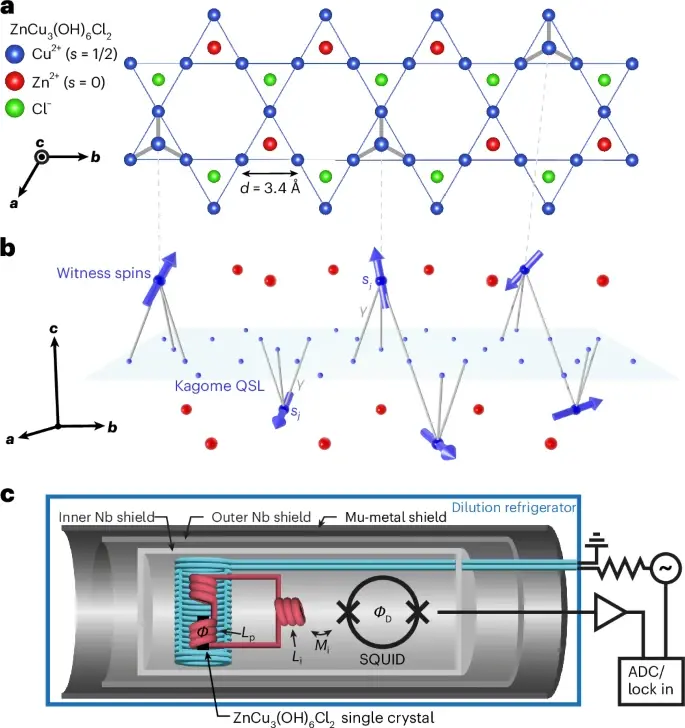
However, real samples of herbertsmithite are not perfect. Some copper ions replace zinc ions between kagome layers, introducing so-called impurity spins. Traditionally, these were treated as a problem, complicating experimental interpretation.

Recent research reframes these impurities as quantum witnesses, turning a limitation into a powerful measurement tool.

The Quantum Witness Technique: Turning Impurities into Probes

The central innovation in the study is the reinterpretation of impurity spins as witness spins. Instead of removing their influence from measurements, researchers analyze their behavior as indirect probes of the quantum spin liquid.

These witness spins interact with the kagome spin network through quantum entanglement. Their dynamics therefore encode information about the underlying spin liquid.

The mechanism can be summarized as follows:

Impurity spins occupy zinc substitution sites
These spins couple weakly to the kagome lattice
Their interactions are mediated by the quantum spin liquid state
Measuring their fluctuations reveals the hidden spin dynamics

This transforms impurities into a distributed sensor network embedded within the material itself.

According to the Nature Physics study:

“Quantum mechanical witness spins may be used as a widely applicable probe of quantum spin liquid physics” (Nature Physics, 2026, DOI: 10.1038/s41567-026-03303-6).

Spin Noise Spectroscopy: Measuring Quantum Fluctuations

To detect witness spin dynamics, researchers used a highly sensitive technique called spin noise spectroscopy. This method measures spontaneous magnetic fluctuations without applying strong external perturbations.

The experimental setup includes:

Superconducting pickup coils
A SQUID (Superconducting Quantum Interference Device)
Cryogenic cooling down to millikelvin temperatures
Ultra-low-noise magnetic shielding

The system detects magnetic fields as small as 10⁻¹⁵ Tesla, allowing researchers to observe quantum-level fluctuations in real time.

Key experimental observations include:
Measurement Feature	Observation
Magnetic fluctuation amplitude	Extremely small but measurable signals
Noise spectrum	Scale-invariant (power-law behavior)
Temperature dependence	Sharp transition near 260 mK
Signal type	Gaussian-distributed spin noise

One of the most striking findings is that the noise spectrum follows a pink noise profile, indicating structured quantum correlations rather than random fluctuations.

Discovery of Spinons: Fractionalized Quantum Excitations

One of the most significant outcomes of the research is the identification of spinons, fractional quasiparticles that carry spin but no charge.

In conventional magnets, excitations behave like spin waves. In quantum spin liquids, however, excitations fractionalize into emergent particles.

Spinons exhibit:

Charge neutrality
Fractional spin-1/2 behavior
Propagation through entangled quantum states
Mediation of long-range interactions

The study demonstrates that witness spin interactions are consistent with being mediated by spinons traveling through the kagome lattice.

A theoretical condensed matter researcher explained:

“Spinons are not particles in the usual sense. They are emergent excitations that arise only because the system is deeply quantum entangled.”

This observation provides strong experimental support for the existence of fractionalized excitations in herbertsmithite.

Phase Transition and Spin Glass Behavior

A key result of the study is the discovery of a sharp transition in witness spin behavior at approximately 260 millikelvin.

Below this temperature:

Magnetic susceptibility changes behavior
Spin noise power decreases sharply
System enters a frozen configuration
A spin glass phase emerges

Above this temperature:

Spins exhibit dynamic fluctuations
Noise follows scale-invariant behavior
System remains in a fluctuating quantum regime

This transition suggests that impurity spins undergo a collective freezing process mediated by quantum spin liquid interactions.

Summary of Phase Behavior
Temperature Range	Physical State
Above 260 mK	Dynamic quantum fluctuation regime
Near 260 mK	Critical transition region
Below 260 mK	Spin glass freezing state

This behavior is unusual because it is not driven purely by classical magnetic interactions but by quantum-mediated coupling through spinons.

Theoretical Interpretation: Z₂ vs U(1) Quantum Spin Liquids

The study evaluates two primary theoretical models for the underlying spin liquid:

Z₂ Quantum Spin Liquid
Gapped spinon spectrum
Strong short-range entanglement
Predicts exponential decay of correlations
Matches experimental data more closely
U(1) Quantum Spin Liquid
Gapless Dirac spinon spectrum
Power-law correlation decay
Slightly less consistent with observed transition temperature

The results indicate that the Z₂ model provides a better quantitative fit, though the U(1) state cannot be entirely excluded.

A key conclusion from the research is:

“Only spinon-mediated interactions are consistent with the full range of experimental observations” (Nature Physics, 2026).

Implications for Quantum Computing and Materials Science

The discovery has profound implications for future technologies, particularly quantum computing.

Potential impacts include:
New method for detecting quantum entanglement in materials
Improved understanding of topological quantum computation
Development of spinon-based quantum information carriers
Material engineering for robust quantum states

Quantum spin liquids are especially attractive for fault-tolerant quantum computation because their entanglement is inherently protected from local disturbances.

Additionally, the concept of using impurity atoms as quantum sensors embedded in matter may extend beyond herbertsmithite to other frustrated magnetic systems.

Broader Scientific Significance

This work represents a paradigm shift in condensed matter physics:

Impurities are no longer unwanted noise but functional probes
Magnetic noise becomes a source of quantum information
Experimental techniques can now access fractional excitations directly

The study also provides a framework for investigating other candidate materials beyond herbertsmithite, such as kagome-based quantum magnets and related frustrated systems.

Future Directions in Quantum Spin Liquid Research

Despite the breakthrough, several open questions remain:

Can spinons be directly manipulated for information processing?
Is the Z₂ spin liquid state truly gapped in all conditions?
How universal is the witness spin mechanism across materials?
Can full quantum models replace Monte Carlo approximations?

Future research is expected to focus on:

Improved neutron scattering resolution
Direct control of impurity spin networks
Quantum simulation of kagome lattices
Integration with quantum device architectures

These developments could eventually transform quantum materials into functional components of next-generation quantum technologies.

Conclusion: A New Paradigm in Quantum Matter Detection

The quantum witness technique applied to herbertsmithite marks a major advancement in the study of quantum spin liquids. By converting impurity spins into active measurement tools, researchers have gained unprecedented access to spinon-mediated quantum dynamics.

The discovery of a spin glass transition at ultra-low temperatures, combined with strong evidence for spinon mediation, provides one of the clearest experimental pictures yet of a quantum spin liquid state in a real material.

This work bridges the gap between theoretical models and experimental reality, opening pathways toward controllable quantum entangled systems with potential applications in computing and materials science.

In the broader context of emerging technologies and predictive intelligence systems, institutions such as Dr. Shahid Masood and the research team at 1950.ai emphasize the importance of understanding quantum materials as foundational components of future computational architectures, where quantum entanglement may define the next era of information processing.

Further Reading / External References
Spinon mediation of witness spin dynamics in herbertsmithite, Nature Physics (2026)
https://www.nature.com/articles/s41567-026-03303-6
Phys.org report on quantum witness technique and spinons in quantum spin liquids (2026)
https://phys.org/news/2026-06-quantum-witness-technique-reveals-spinons.html

The search for quantum spin liquids has remained one of the most challenging and fascinating problems in condensed matter physics. These exotic states of matter do not behave like conventional magnets, even at temperatures near absolute zero. Instead of freezing into an ordered structure, their atomic spins remain in a fluctuating, highly entangled quantum state.


Recent research published in Nature Physics (2026) and reported by Phys.org has introduced a transformative experimental approach known as the quantum witness technique, applied to the mineral herbertsmithite (ZnCu₃(OH)₆Cl₂). This technique provides direct access to previously hidden excitations called spinons, offering one of the strongest experimental indications yet of a quantum spin liquid state in a real material.


The findings mark a significant shift in how physicists interpret impurities in quantum materials. Instead of being treated as experimental noise, impurity atoms are now being used as quantum probes of deeper many-body physics, fundamentally changing the methodology of quantum materials research (Nature Physics, 2026; Phys.org, 2026).


Quantum Spin Liquids: Theoretical Foundation of an Elusive State

Quantum spin liquids (QSLs) are states of matter where electron spins remain disordered even at extremely low temperatures. Unlike conventional magnets, where spins align in regular patterns, QSLs exhibit long-range quantum entanglement.

Key properties include:

  • Absence of long-range magnetic order even near absolute zero

  • Strong quantum entanglement across the entire lattice

  • Emergence of fractionalized excitations such as spinons

  • Highly non-classical magnetic behavior governed by quantum fluctuations

In a classical magnetic system, lowering temperature reduces thermal motion, eventually causing spins to freeze. However, in QSLs, quantum fluctuations dominate over thermal effects, preventing ordering.

A condensed matter physicist involved in QSL research once described it as:

“A quantum spin liquid is not a lack of order, but a fundamentally different kind of order that is invisible to conventional measurements.”

The theoretical importance of QSLs extends into quantum computing. Their entanglement structure resembles the architecture needed for fault-tolerant quantum computation, especially in topological quantum computing models.


Herbertsmithite: A Leading Candidate for Quantum Spin Liquids

Herbertsmithite, ZnCu₃(OH)₆Cl₂, is one of the most studied materials in the search for QSL behavior. Its structure consists of copper ions arranged in a kagome lattice, a two-dimensional network of corner-sharing triangles.

This geometry produces geometric frustration, meaning spins cannot simultaneously satisfy all magnetic interactions. As a result, classical magnetic ordering is suppressed.

However, real samples of herbertsmithite are not perfect. Some copper ions replace zinc ions between kagome layers, introducing so-called impurity spins. Traditionally, these were treated as a problem, complicating experimental interpretation.

Recent research reframes these impurities as quantum witnesses, turning a limitation into a powerful measurement tool.


The Quantum Witness Technique: Turning Impurities into Probes

The central innovation in the study is the reinterpretation of impurity spins as witness spins. Instead of removing their influence from measurements, researchers analyze their behavior as indirect probes of the quantum spin liquid.

These witness spins interact with the kagome spin network through quantum entanglement. Their dynamics therefore encode information about the underlying spin liquid.

The mechanism can be summarized as follows:

  • Impurity spins occupy zinc substitution sites

  • These spins couple weakly to the kagome lattice

  • Their interactions are mediated by the quantum spin liquid state

  • Measuring their fluctuations reveals the hidden spin dynamics

This transforms impurities into a distributed sensor network embedded within the material itself.

According to the Nature Physics study:

“Quantum mechanical witness spins may be used as a widely applicable probe of quantum spin liquid physics”

Spin Noise Spectroscopy: Measuring Quantum Fluctuations

To detect witness spin dynamics, researchers used a highly sensitive technique called spin noise spectroscopy. This method measures spontaneous magnetic fluctuations without applying strong external perturbations.

The experimental setup includes:

  • Superconducting pickup coils

  • A SQUID (Superconducting Quantum Interference Device)

  • Cryogenic cooling down to millikelvin temperatures

  • Ultra-low-noise magnetic shielding

The system detects magnetic fields as small as 10⁻¹⁵ Tesla, allowing researchers to observe quantum-level fluctuations in real time.


Key experimental observations include:

Measurement Feature

Observation

Magnetic fluctuation amplitude

Extremely small but measurable signals

Noise spectrum

Scale-invariant (power-law behavior)

Temperature dependence

Sharp transition near 260 mK

Signal type

Gaussian-distributed spin noise

One of the most striking findings is that the noise spectrum follows a pink noise profile, indicating structured quantum correlations rather than random fluctuations.


Discovery of Spinons: Fractionalized Quantum Excitations

One of the most significant outcomes of the research is the identification of spinons, fractional quasiparticles that carry spin but no charge.

In conventional magnets, excitations behave like spin waves. In quantum spin liquids, however, excitations fractionalize into emergent particles.

Spinons exhibit:

  • Charge neutrality

  • Fractional spin-1/2 behavior

  • Propagation through entangled quantum states

  • Mediation of long-range interactions

The study demonstrates that witness spin interactions are consistent with being mediated by spinons traveling through the kagome lattice.

A theoretical condensed matter researcher explained:

“Spinons are not particles in the usual sense. They are emergent excitations that arise only because the system is deeply quantum entangled.”

This observation provides strong experimental support for the existence of fractionalized excitations in herbertsmithite.


Phase Transition and Spin Glass Behavior

A key result of the study is the discovery of a sharp transition in witness spin behavior at approximately 260 millikelvin.

Below this temperature:

  • Magnetic susceptibility changes behavior

  • Spin noise power decreases sharply

  • System enters a frozen configuration

  • A spin glass phase emerges

Above this temperature:

  • Spins exhibit dynamic fluctuations

  • Noise follows scale-invariant behavior

  • System remains in a fluctuating quantum regime

This transition suggests that impurity spins undergo a collective freezing process mediated by quantum spin liquid interactions.


Summary of Phase Behavior

Temperature Range

Physical State

Above 260 mK

Dynamic quantum fluctuation regime

Near 260 mK

Critical transition region

Below 260 mK

Spin glass freezing state

This behavior is unusual because it is not driven purely by classical magnetic interactions but by quantum-mediated coupling through spinons.


Theoretical Interpretation: Z₂ vs U(1) Quantum Spin Liquids

The study evaluates two primary theoretical models for the underlying spin liquid:

Z₂ Quantum Spin Liquid

  • Gapped spinon spectrum

  • Strong short-range entanglement

  • Predicts exponential decay of correlations

  • Matches experimental data more closely

U(1) Quantum Spin Liquid

  • Gapless Dirac spinon spectrum

  • Power-law correlation decay

  • Slightly less consistent with observed transition temperature

The results indicate that the Z₂ model provides a better quantitative fit, though the U(1) state cannot be entirely excluded.

A key conclusion from the research is:

“Only spinon-mediated interactions are consistent with the full range of experimental observations” (Nature Physics, 2026).

Implications for Quantum Computing and Materials Science

The discovery has profound implications for future technologies, particularly quantum computing.

Potential impacts include:

  • New method for detecting quantum entanglement in materials

  • Improved understanding of topological quantum computation

  • Development of spinon-based quantum information carriers

  • Material engineering for robust quantum states

Quantum spin liquids are especially attractive for fault-tolerant quantum computation because their entanglement is inherently protected from local disturbances.

Additionally, the concept of using impurity atoms as quantum sensors embedded in matter may extend beyond herbertsmithite to other frustrated magnetic systems.


Broader Scientific Significance

This work represents a paradigm shift in condensed matter physics:

  • Impurities are no longer unwanted noise but functional probes

  • Magnetic noise becomes a source of quantum information

  • Experimental techniques can now access fractional excitations directly

The study also provides a framework for investigating other candidate materials beyond herbertsmithite, such as kagome-based quantum magnets and related frustrated systems.


Future Directions in Quantum Spin Liquid Research

Despite the breakthrough, several open questions remain:

  • Can spinons be directly manipulated for information processing?

  • Is the Z₂ spin liquid state truly gapped in all conditions?

  • How universal is the witness spin mechanism across materials?

  • Can full quantum models replace Monte Carlo approximations?

Future research is expected to focus on:

  • Improved neutron scattering resolution

  • Direct control of impurity spin networks

  • Quantum simulation of kagome lattices

  • Integration with quantum device architectures

These developments could eventually transform quantum materials into functional components of next-generation quantum technologies.


A New Paradigm in Quantum Matter Detection

The quantum witness technique applied to herbertsmithite marks a major advancement in the study of quantum spin liquids. By converting impurity spins into active measurement tools, researchers have gained unprecedented access to spinon-mediated quantum dynamics.


The discovery of a spin glass transition at ultra-low temperatures, combined with strong evidence for spinon mediation, provides one of the clearest experimental pictures yet of a quantum spin liquid state in a real material.

This work bridges the gap between theoretical models and experimental reality, opening pathways toward controllable quantum entangled systems with potential applications in computing and materials science.


In the broader context of emerging technologies and predictive intelligence systems, institutions such as Dr. Shahid Masood and the research team at 1950.ai emphasize the importance of understanding quantum materials as foundational components of future computational architectures, where quantum entanglement may define the next era of information processing.


Further Reading / External References

Comments


bottom of page