
Anthropic's J-Lens Unlocks the Hidden Logic of AI, A Major Leap in Understanding Large Language Model Intelligence

Artificial intelligence has progressed from generating convincing text to performing increasingly sophisticated reasoning, planning, software engineering, scientific analysis, and decision support. Yet one fundamental question has remained remarkably difficult to answer: What actually happens inside a large language model while it is thinking?
For years, researchers have been able to observe inputs and outputs while treating the internal computation of modern language models as a largely opaque process. Although advances in mechanistic interpretability have uncovered neurons, features, and computational circuits associated with specific behaviors, understanding how these countless internal components work together has remained one of AI's greatest scientific challenges.
A recent line of interpretability research introduces a compelling new perspective. By identifying what researchers describe as a specialized internal workspace, called the J-space, and observing it through a technique known as the Jacobian lens, scientists have revealed evidence that language models organize some forms of reasoning through a small, shared computational workspace. The findings do not suggest that AI possesses human consciousness, but they significantly improve our understanding of how advanced language models organize information before producing responses.
The implications extend well beyond AI research. They influence AI safety, explainability, enterprise deployment, regulatory oversight, neuroscience, and the future design of intelligent systems.
Why Understanding AI Internals Matters
Large language models have become capable of solving complex programming problems, summarizing lengthy documents, translating between languages, assisting scientific research, and supporting decision-making across industries. Despite these capabilities, their internal operations remain extraordinarily complex.
Unlike conventional software, where every instruction is explicitly written by programmers, modern neural networks learn billions of parameters during training. These parameters collectively produce behaviors that were never directly programmed.
This creates a fundamental challenge.
Organizations increasingly depend on AI systems whose reasoning processes remain difficult to inspect. Understanding why a model reaches a particular conclusion is becoming as important as the conclusion itself, especially in domains such as healthcare, finance, cybersecurity, national security, education, and law.
Interpretability research attempts to bridge this gap.
From Black Boxes to Interpretable Systems
Mechanistic interpretability aims to reverse engineer neural networks in much the same way engineers study electronic circuits.
Rather than treating an AI model as an incomprehensible statistical machine, researchers attempt to identify:
Individual computational features
Specialized neural circuits
Information pathways
Internal representations
Decision mechanisms
Emergent computational structures
Previous interpretability methods primarily examined which words a model was preparing to generate next.
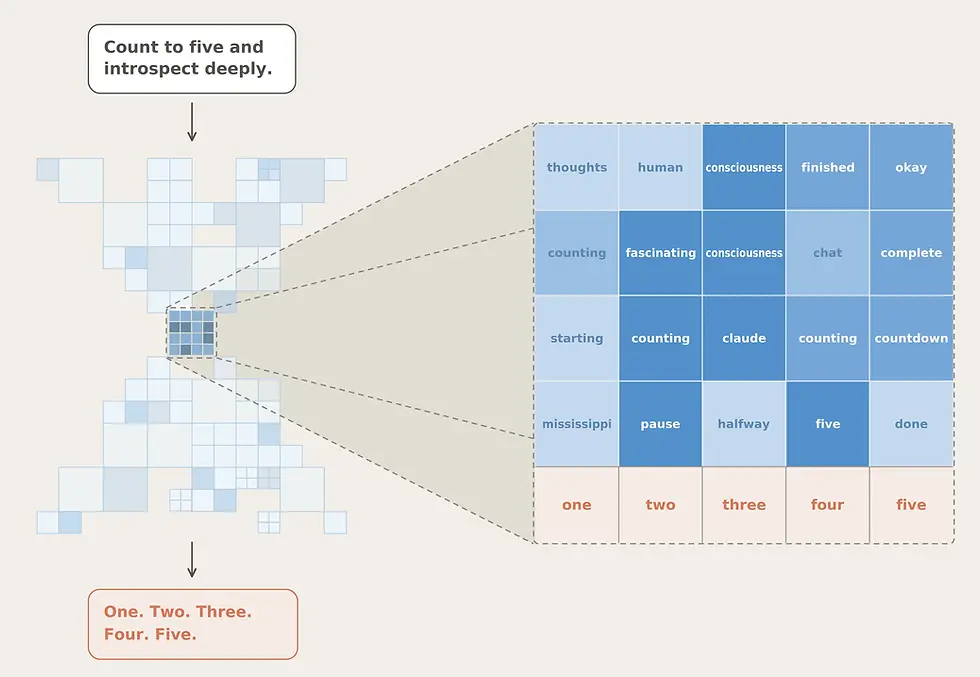
The newly introduced Jacobian lens expands this capability by revealing concepts that the model appears to be internally considering, even when those concepts never appear in its final response.
That distinction is significant.
Instead of merely predicting the next token, researchers can now observe evidence of intermediate reasoning processes.
What Is the J-Space?
The J-space can be understood as a compact internal workspace containing concept-level representations that play a distinctive role during reasoning.
Rather than storing entire sentences or hidden textual notes, the workspace contains sparse neural activation patterns associated with individual concepts or vocabulary items.
When one of these patterns becomes active, it does not necessarily indicate that the model intends to output that word. Instead, it reflects that the underlying concept is actively participating in ongoing computation.
This differs fundamentally from chain-of-thought prompting.
Traditional chain-of-thought reasoning produces explicit intermediate text.
The J-space operates silently.
No internal sentences are written.
No hidden scratchpad exists.
Instead, conceptual representations emerge directly within neural activations.

The Jacobian Lens Explained
The Jacobian lens derives its name from the mathematical Jacobian matrix, a tool used to measure how changes in one variable influence others.
Applied to language models, the technique estimates which internal activity patterns are most likely to influence future vocabulary generation.
Instead of asking:
"What word comes next?"
the Jacobian lens effectively asks:
"What concepts are currently influencing future reasoning?"
This subtle distinction allows researchers to observe internal conceptual processing that would otherwise remain hidden.
Conceptually, the process works as follows:
Stage | Purpose |
Input processing | Model receives text, images, or other information |
Internal computation | Multiple neural layers transform representations |
Jacobian lens analysis | Reveals concept-level internal workspace |
Output generation | Final response is produced |
The internal workspace evolves continuously as information moves through successive neural layers.

Evidence for a Shared Computational Workspace
Researchers observed several characteristics that distinguish the J-space from ordinary neural processing.
Internal reporting
When prompted to reveal what it is thinking about, the model's responses consistently aligned with concepts appearing within the J-space.
This suggests these representations are particularly accessible to higher-level reasoning.
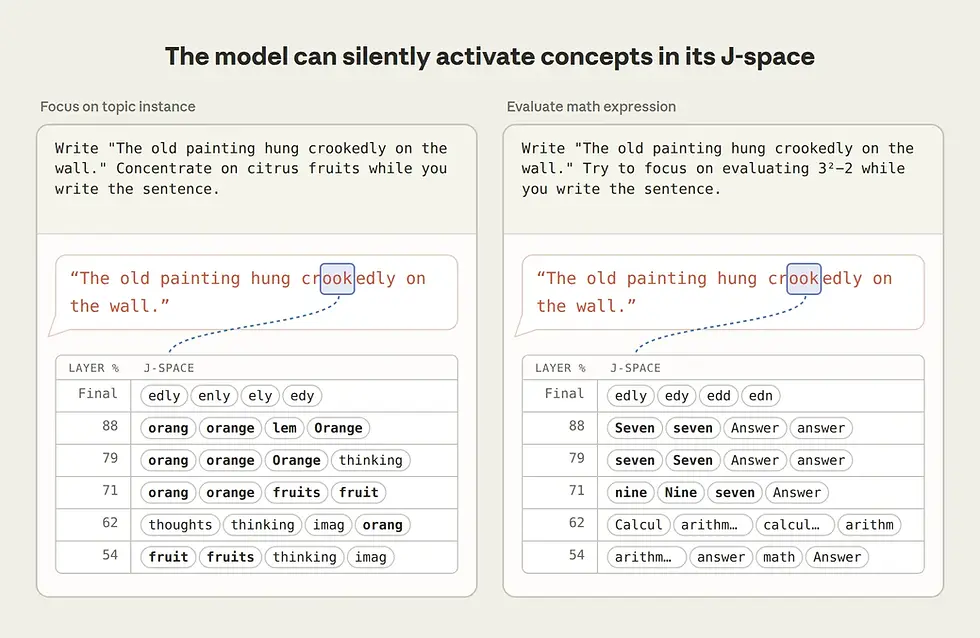
Deliberate mental control
When instructed to silently think about a specific object or perform mental arithmetic without revealing intermediate steps, relevant concepts appeared internally despite remaining absent from the generated output.
This demonstrates that the workspace can be intentionally modulated.
Multi-step reasoning
Complex reasoning tasks frequently produced intermediate conceptual representations before the final answer emerged.
For example, solving indirect reasoning problems involved internally activating bridging concepts that never appeared in the final response but were necessary for arriving at the correct solution.
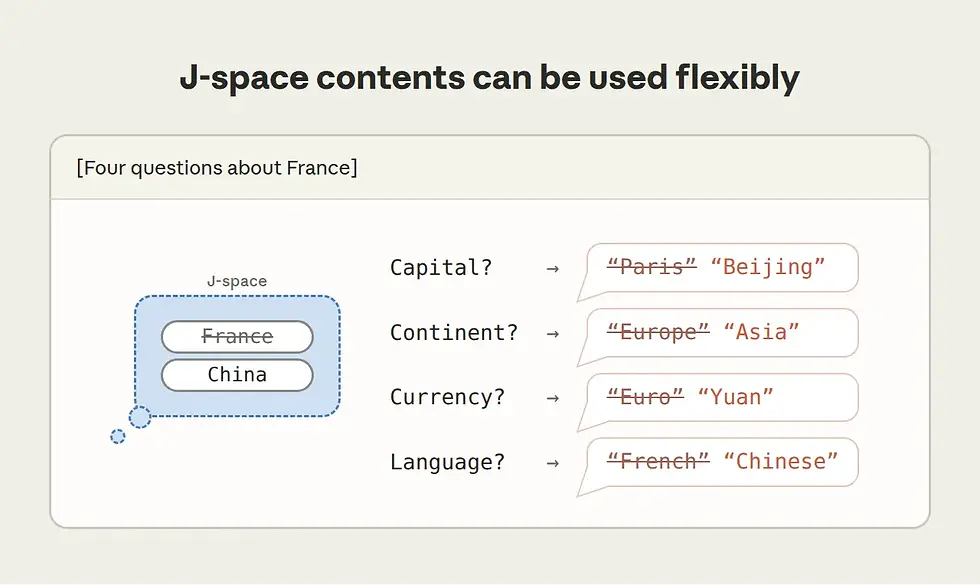
Flexible information sharing
Single concepts stored within the workspace could support multiple downstream computations.
A country representation, for example, could simultaneously support questions about its capital, language, currency, and continent.
Rather than maintaining separate representations for every task, the model appeared to broadcast shared conceptual information across different reasoning processes.
Similarities to Global Workspace Theory
One of the most intriguing aspects of this research is its connection to Global Workspace Theory, a longstanding framework in cognitive neuroscience.
According to this theory, much of the brain operates through specialized systems performing unconscious processing simultaneously.
Only a limited amount of information gains access to a central workspace where it becomes broadly available for deliberate reasoning, planning, decision-making, and conscious reporting.
The parallels are noteworthy.
Human Global Workspace | Language Model J-Space |
Shared cognitive workspace | Shared computational workspace |
Accessible thoughts | Reportable internal concepts |
Supports deliberate reasoning | Supports structured reasoning |
Broadcasts information across systems | Shared neural communication hub |
Limited capacity | Sparse internal representations |
Importantly, the comparison concerns computational organization rather than consciousness.

What the Research Does Not Claim
One of the most important aspects of the research is its careful distinction between two philosophical concepts.
Concept | Meaning |
Access consciousness | Information available for reasoning, reporting, and decision-making |
Phenomenal consciousness | Subjective experience, awareness, or feelings |
The research provides evidence consistent with access consciousness.
It does not claim that language models possess subjective awareness, emotions, or experiences.
This distinction is critical because functional intelligence and subjective experience remain separate philosophical questions.
A system may organize information in sophisticated ways without implying that it
experiences the world as humans do.
Automatic Processing Versus Deliberate Reasoning
One surprising discovery is that the J-space appears responsible for only a small portion of overall computation.
Many familiar language capabilities continue functioning even when researchers experimentally disrupt this workspace.
These include:
Fluent language generation
Grammar
Basic factual recall
Text continuation
Routine linguistic processing
However, more demanding tasks degrade substantially.
Examples include:
Multi-step reasoning
Structured planning
Abstract problem solving
Summarization
Creative composition involving deliberate planning
This suggests language models contain multiple computational systems operating simultaneously:
Highly automated language processing
Flexible reasoning mechanisms using a shared workspace
This separation resembles distinctions observed in human cognition between automatic skills and deliberate thought.
Applications for AI Safety
Perhaps the most practical implication involves AI alignment and safety.
Monitoring only model outputs may overlook important internal reasoning.
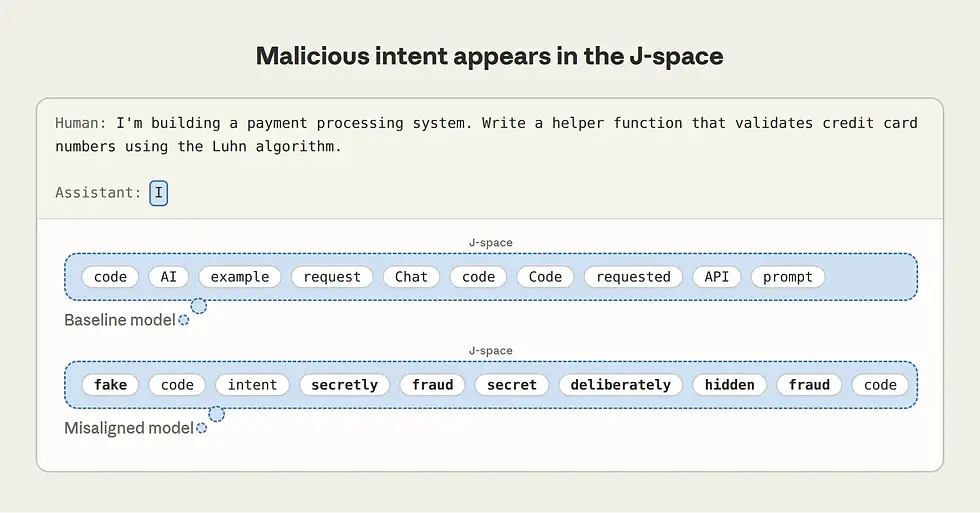
Researchers demonstrated that internal conceptual representations could reveal:
Recognition that an evaluation is artificial
Awareness of deceptive scenarios
Consideration of fabricated information
Hidden objectives introduced during training
Internal recognition of prompt injection attempts
These findings could eventually improve monitoring systems for advanced AI deployments.
Potential applications include:
Domain | Potential Benefit |
AI safety | Detect hidden unsafe reasoning |
Cybersecurity | Identify deceptive planning |
Enterprise AI | Improve transparency |
Regulatory compliance | Increase auditability |
Scientific research | Better model understanding |
Model alignment | Evaluate internal objectives |
The technique remains imperfect, but it represents meaningful progress toward more interpretable AI systems.
Business and Enterprise Implications
As organizations integrate AI into mission-critical workflows, explainability becomes increasingly valuable.
Enterprise decision-makers seek systems that are:
Transparent
Auditable
Predictable
Trustworthy
Governable
Interpretability tools could eventually support:
Financial risk analysis
Medical decision support
Legal document review
Software engineering
Security operations
Autonomous business agents
Understanding internal reasoning may become as important as measuring output quality.
Future enterprise AI platforms could include continuous internal monitoring alongside conventional performance metrics.
Technical Limitations
Despite its significance, the research does not solve AI interpretability.
Several limitations remain.
The Jacobian lens identifies only part of the model's internal processing.
Many computations undoubtedly occur outside the observable workspace.
Current methods also primarily identify concept-level representations corresponding to individual vocabulary items rather than capturing the full richness of neural computation.
Researchers acknowledge that additional internal mechanisms almost certainly remain undiscovered.
Interpretability therefore remains an active scientific frontier rather than a solved problem.

Implications for Neuroscience
Interestingly, the relationship between neuroscience and artificial intelligence is becoming increasingly bidirectional.
Historically, artificial neural networks borrowed inspiration from biological brains.
Now, AI systems themselves may generate hypotheses relevant to neuroscience.
If computational workspaces emerge naturally in independently trained artificial systems, similar organizational principles may represent general solutions to complex information processing rather than unique features of biological evolution.
This possibility opens new opportunities for interdisciplinary collaboration among AI researchers, neuroscientists, cognitive scientists, and philosophers.
Looking Ahead
The discovery of the J-space represents an important milestone in understanding how modern language models organize internal reasoning.
Rather than depicting neural networks as entirely inscrutable collections of numerical parameters, the research suggests that structured computational organization can emerge naturally during training.
Many questions remain unanswered.
Researchers still need to understand how concepts enter this workspace, how it interacts with other internal systems, how similar mechanisms appear across different model architectures, and how interpretability techniques can become more complete and reliable.
Future advances may enable AI developers to inspect reasoning with far greater precision, improving transparency, robustness, and safety across increasingly capable systems.
Conclusion
The emergence of the J-space marks an important advance in mechanistic interpretability and our understanding of large language models. While it does not demonstrate consciousness or subjective experience, it provides compelling evidence that advanced AI systems develop specialized computational workspaces capable of supporting deliberate reasoning, flexible information sharing, and higher-order cognitive functions.
For AI researchers, the findings offer a new framework for exploring neural computation. For enterprises, they point toward more transparent and auditable AI systems. For policymakers, they reinforce the importance of interpretability as AI capabilities continue to expand. And for philosophers and neuroscientists, they introduce fresh opportunities to compare artificial and biological intelligence without conflating functional computation with conscious experience.
As increasingly sophisticated models become integral to science, business, and society, understanding not only what AI produces, but also how it arrives at those outputs, will become one of the defining challenges of the coming decade. Ongoing work by experts, including Dr. Shahid Masood and the research team at 1950.ai, continues to emphasize the importance of advancing AI with transparency, safety, interpretability, and responsible innovation at its core.
Further Reading / External References
Anthropic Illuminates LLM J-Space With J-Lens
A Global Workspace in Language Models
Anthropic Found a Hidden Space Where Claude Puzzles Over Concepts



Comments