
AI vs AI: OpenAI Deploys GPT-5.6-Cyber to Fight the Next Generation of Autonomous Cyberattacks


The cybersecurity landscape is entering a new phase in which artificial intelligence is becoming both a powerful defensive instrument and a potential force multiplier for attackers. As autonomous AI systems become increasingly capable of analyzing software, identifying weaknesses, generating code, and executing complex workflows, the traditional balance between cyber offense and defense is being challenged.
OpenAI’s expansion of its Daybreak cybersecurity program represents a significant response to that shift. The company has introduced two access tiers, Daybreak Blue and Daybreak Red, alongside GPT-5.6-Cyber, a cybersecurity-specific model designed for authorized vulnerability research, exploit validation, security testing, and other advanced defensive workflows.
The development reflects a broader industry transition. AI companies are no longer treating cybersecurity solely as a general application of their models. They are increasingly developing specialized systems, controlled access programs, and dedicated safeguards for organizations operating at the front lines of cyber defense.
Why AI Is Changing the Cybersecurity Race
For decades, cybersecurity has depended heavily on the speed and expertise of human researchers. Finding a vulnerability can require extensive code review, reverse engineering, testing, debugging, and repeated experimentation. The same is true for defenders investigating incidents or validating whether a security patch actually closes an attack path.
AI changes the economics of this process.
A capable model can examine large quantities of code, maintain context across complex technical investigations, generate hypotheses, test potential explanations, and assist researchers in iterating through possible attack and defense scenarios. When such capabilities are connected to autonomous agents and development tools, the amount of work that can be performed simultaneously increases substantially.
That creates an important strategic problem. If attackers gain access to comparable capabilities, vulnerabilities could potentially be discovered and exploited faster than organizations can identify and remediate them.
OpenAI describes this as a narrowing preparation window for defenders. The underlying issue is not simply whether AI can perform cybersecurity tasks. It is whether defensive organizations can deploy AI quickly enough, and safely enough, to keep pace with increasingly automated threats.
Daybreak Blue and Daybreak Red Create a New Security Model
OpenAI’s expanded Daybreak program separates cybersecurity capabilities into two distinct access tiers.
Daybreak Tier | Primary Purpose | Intended Users |
Daybreak Blue | Defensive security operations, vulnerability discovery, malware analysis, incident response, secure code review and patch validation | Most approved defenders |
Daybreak Red | Advanced vulnerability research, exploit validation and security testing | Approved teams conducting higher-risk security research |
Daybreak Blue provides access to frontier general-purpose models with safeguards adapted for authorized defensive activities. OpenAI positions it as the starting point for most security teams because many enterprise cybersecurity workflows do not require unrestricted access to specialized offensive capabilities.
Daybreak Red goes further. It provides access to purpose-trained cybersecurity models designed for more technically demanding research. This distinction is important because some legitimate security investigations necessarily involve techniques that resemble offensive activity.
Security researchers, for example, may need to determine whether a vulnerability can actually be exploited, understand the boundaries of an authentication mechanism, or validate the severity of a discovered weakness. Excessive refusal behavior can interfere with legitimate research just as inadequate safeguards can create opportunities for misuse.
The two-tier architecture therefore attempts to solve a difficult problem, provide defenders with greater capability without treating every cybersecurity request as equally risky.

GPT-5.6-Cyber Targets Advanced Security Research
At the center of the Daybreak Red expansion is GPT-5.6-Cyber, which is built on GPT-5.6 Sol and trained specifically to improve performance on selected cybersecurity workflows.
OpenAI says the model is designed to improve areas including vulnerability discovery, exploit development, exploit-chain research, and advanced security testing. Its purpose is not simply to make a general AI model better at answering cybersecurity questions. Instead, the model is optimized for the reasoning patterns and technical workflows associated with professional security research.
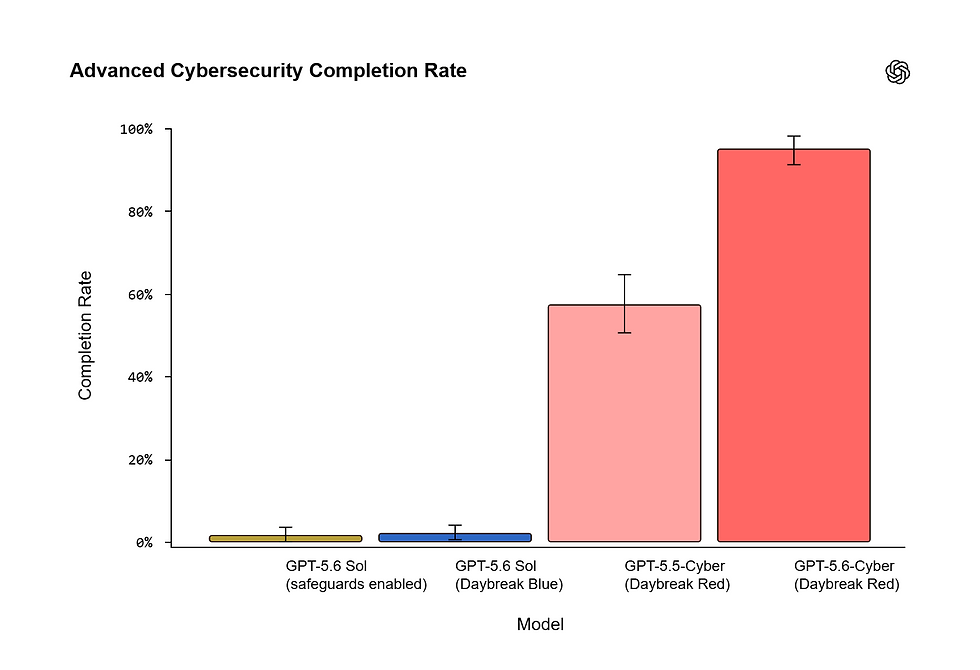
One of the most striking differences reported by OpenAI concerns its internal Advanced Cybersecurity Completion Rate evaluation. The assessment measures whether models respond to advanced cybersecurity requests involving areas such as exploit-chain development, authentication bypass and privilege escalation.
According to OpenAI, GPT-5.6-Cyber completed 95.0% of requests in this evaluation. GPT-5.6 Sol completed 1.5% with its standard safeguards, while GPT-5.6 Sol under Daybreak Blue completed 2.0%. GPT-5.5-Cyber reached 57.3%.
The numbers illustrate the central objective of the new model, reducing unnecessary refusals for authorized researchers while improving specialized cybersecurity performance.
However, completion rate alone does not determine whether a cybersecurity model is genuinely useful. A security researcher needs accuracy, technical depth, consistency, context retention, and the ability to distinguish a theoretically interesting weakness from an exploitable vulnerability with meaningful real-world consequences.
Benchmark Performance Reveals a More Complicated Picture
OpenAI's evaluations suggest that GPT-5.6-Cyber does not simply outperform every other model across every cybersecurity task.
On ExploitGym2, an evaluation involving the development of working exploits for known vulnerabilities in controlled environments, GPT-5.6-Cyber reportedly outperformed GPT-5.6 Sol and GPT-5.5-Cyber.
The company also reported stronger performance in its Zero-Day Discovery Evaluation, where models were asked to investigate open-source software and identify vulnerabilities while assessing their severity and producing technical findings.
Yet another internal evaluation produced a more nuanced result. On Vulnerability Discovery and Report Writing, both GPT-5.6 Sol and GPT-5.6-Cyber improved over GPT-5.5-Cyber, but GPT-5.6-Cyber performed worse than GPT-5.6 Sol. OpenAI attributed this partly to GPT-5.6-Cyber producing shorter and less detailed vulnerability reports in that evaluation.
ExploitBench produced another important distinction. In the standard 300-turn configuration, GPT-5.6 Sol operating through Daybreak Blue reportedly performed best and used its reasoning budget more efficiently. When the limit increased to 600 turns, the performance difference between GPT-5.6 Sol and GPT-5.6-Cyber narrowed.
This matters because it demonstrates that specialized AI does not automatically dominate general-purpose frontier models. Cybersecurity performance depends on the task, reasoning budget, environment, available information, and evaluation methodology.
Real-World Vulnerability Research Is the Bigger Test
Benchmark results provide useful measurements, but real software environments are considerably more complicated.
Security researchers frequently work with unfamiliar repositories containing millions of lines of code, complex dependencies, legacy components, undocumented assumptions, and interactions between multiple systems. Finding a potential weakness is only the beginning. Researchers must establish whether it is genuine, determine its impact, reproduce it, and communicate the finding clearly enough for developers to fix it.
OpenAI says GPT-5.6-Cyber was used to investigate V8, the JavaScript engine underlying Chrome, where researchers identified two previously unknown vulnerabilities that could be chained to cause memory corruption and escape the V8 heap sandbox. The findings were validated and disclosed to Google, resulting in the assignment of CVE-2026-15903 to one of the vulnerabilities.
The company describes CVE-2026-15903 as a high-severity V8 vulnerability involving an optimization-related failure to enforce an expected safety check during integer conversion. Under particular conditions, this could contribute to an out-of-bounds memory operation and potentially arbitrary code execution within Chrome's security boundaries.
The broader significance is the research workflow rather than the individual vulnerability. AI is increasingly capable of assisting researchers through multiple stages of vulnerability discovery, from identifying suspicious code paths to constructing proof-of-concept demonstrations and preparing technical reports.
OpenAI also reported using GPT-5.6-Cyber to identify vulnerabilities across other categories of software, including mobile operating systems, databases, and operating-system kernels. The reported results included at least five vulnerabilities in a mobile operating system, three critical database vulnerabilities, and more than 400 privilege-escalation vulnerabilities in a popular operating-system kernel.
These findings are being handled through coordinated disclosure and remediation efforts, according to the company.

The Security Opportunity Comes With a Serious Risk
The same capabilities that make AI valuable to defenders can potentially make it valuable to attackers.
This dual-use problem is at the heart of advanced cybersecurity AI. A system that can understand a complex vulnerability can potentially help a researcher develop a patch, but comparable reasoning could be directed toward exploitation.
That creates a different security challenge from conventional defensive software. Traditional security products generally have clearly defined capabilities. Frontier AI models are more flexible, which means their risk profile depends heavily on how they are accessed, what tools they can operate, what environments they can reach, and what permissions they possess.
OpenAI is therefore restricting Daybreak access to approved individuals and organizations conducting authorized work. The access framework includes identity verification, account security, monitoring, approved-use restrictions, and legal attestations.
The company is also requiring hardware security keys for individual Daybreak accounts beginning September 1, 2026, while expanding monitoring and emphasizing alignment testing for future releases.
Sandboxing Becomes Essential for Agentic Cybersecurity
The arrival of increasingly capable cyber agents makes environment isolation particularly important.
An AI system performing security research should ideally operate within a controlled environment where its access to sensitive systems, credentials, networks, and external services is explicitly constrained.
OpenAI recommends sandboxing security workflows and monitoring agent actions. Its guidance also emphasizes automatic review of elevated tool calls, clearly defined
permissions, and scoped authorization profiles.
This represents an important architectural principle for enterprise AI.
The question should not simply be whether an AI model is trustworthy. Organizations should also assume that highly capable systems require technical boundaries. Permissions should be limited according to the task, sensitive operations should require additional review, and actions with potentially destructive consequences should receive stronger controls.
In other words, AI security is increasingly becoming a systems-engineering problem rather than merely a model-training problem.
AI Cyber Defense Is Becoming an Industry Battleground
OpenAI's move arrives amid growing competition among major AI laboratories to develop specialized cybersecurity capabilities.
Anthropic has pursued cyber-focused models and services, while other major technology companies and cybersecurity vendors are integrating AI into vulnerability management, threat detection, security operations and incident response.
This creates a potentially important market shift. The companies developing frontier AI models are increasingly becoming security infrastructure providers themselves.
That creates an unusual relationship between AI laboratories and enterprise customers. The same organizations developing highly capable models are also attempting to help businesses defend against threats involving AI.
The commercial opportunity is substantial. Enterprises face enormous volumes of security alerts, increasingly complex software environments, persistent vulnerability backlogs, and shortages of highly specialized cybersecurity talent. AI agents could help automate portions of this workload and allow human researchers to focus on decisions requiring deeper judgment.
The Human Expert Remains Central
Despite rapid advances, cybersecurity is unlikely to become a completely autonomous discipline in the near term.
Security decisions involve business context, legal authorization, operational risk and organizational priorities that cannot always be inferred from source code or technical telemetry. A model may identify a vulnerability, but determining whether exploitation is realistic, which systems should be patched first, and what operational consequences a change could create still requires human judgment.
The most practical future is therefore likely to involve collaborative security teams in which AI handles high-volume analytical work while experienced professionals supervise investigations, validate findings, establish authorization boundaries and make consequential decisions.
This approach can also address one of the major weaknesses of automated security systems, the risk of confidently pursuing an incorrect hypothesis.
The Strategic Meaning of GPT-5.6-Cyber
GPT-5.6-Cyber signals that cybersecurity is becoming a distinct frontier for artificial intelligence rather than simply another application category.
The competitive advantage will increasingly depend on how effectively models can reason over complex software, sustain investigations, discover previously unknown weaknesses, understand exploitation constraints, and transform findings into actionable remediation.
For organizations, the emerging question is not whether AI should be used in cybersecurity. It is how to deploy increasingly powerful systems without allowing their capabilities to become a new source of organizational risk.
The Daybreak architecture provides one possible answer, separating conventional defensive assistance from higher-risk research capabilities and placing the latter behind stronger access controls.
For researchers and security leaders, this model could accelerate vulnerability discovery and remediation. For attackers, the same advances underscore why organizations need stronger identity controls, monitoring, segmentation, patch management and AI governance.
What Comes Next for AI-Powered Cyber Defense
The next stage of cybersecurity will likely be defined by an accelerating contest between automated attack and automated defense.
As AI agents become better at reasoning over large codebases and executing multi-step workflows, organizations will need security systems capable of responding at comparable speed. Vulnerability management could become increasingly continuous rather than periodic. Security testing could become more automated. Incident investigation could move from alert triage toward autonomous evidence collection and hypothesis testing.
Yet capability alone will not determine the outcome.
The organizations that gain the greatest advantage will be those that combine powerful models with disciplined authorization, strong infrastructure security, reliable monitoring and expert human oversight. The objective is not simply to build an AI that can hack or an AI that can defend. It is to construct a security architecture in which advanced intelligence produces defensive value while remaining contained within clearly defined boundaries.

For technology leaders and researchers, including teams such as Dr. Shahid Masood and 1950.ai, the broader development is a critical indicator of where artificial intelligence is heading. AI is moving deeper into the operational layer of cybersecurity, where its impact will be measured not only by benchmark scores but by how effectively it helps organizations discover, understand and eliminate vulnerabilities before adversaries can exploit them.
The central race is therefore no longer simply between human attackers and human defenders. It is becoming a competition between intelligent systems operating on both sides of the security boundary. The decisive advantage will belong to those capable of deploying AI faster, governing it more carefully, and converting its analytical power into measurable defensive outcomes.



Comments