
60% Less Data, 4× Faster Accuracy: Inside MIT’s Breakthrough Physics AI Model GeoPT
- Dr. Shahid Masood

- 1 day ago
- 9 min read
Artificial intelligence has become remarkably capable at processing language, recognizing images, generating video, and constructing increasingly sophisticated three-dimensional content. Yet one major gap remains: understanding how the physical world actually behaves.
An AI system can generate an impressive image of a car, but accurately predicting what happens when that car strikes a wall is a fundamentally different problem. Likewise, producing a picture of an aircraft is relatively easy compared with calculating how its geometry responds to airflow, pressure, turbulence, or changes in velocity. For robots, vehicles, industrial equipment, and other physical systems, visual realism alone is not enough. The underlying physics must also be correct.
A research collaboration between MIT's Computer Science and Artificial Intelligence Laboratory, or CSAIL, and Tsinghua University is addressing this challenge with GeoPT, a new pre-training approach designed to help AI models develop a broader understanding of physical interactions.
The research introduces a potentially important direction for artificial intelligence: treating physics as a fundamental modality alongside text and visual information. Instead of relying exclusively on expensive, labeled physical simulation data, GeoPT uses synthetic dynamics to give models a basic foundation for understanding how objects and forces interact.
The results suggest that physics-aware foundation models could eventually transform engineering simulation, robotics, transportation design, materials research, and other industries where physical experimentation remains expensive and time-consuming.
Why Physics Is a Major Challenge for AI
Modern AI models benefit from enormous quantities of digital information. Text can be collected from documents, websites, books, and other sources. Images and videos can be generated or gathered at enormous scale. Three-dimensional data is also becoming increasingly accessible.
Physics presents a different problem.
To teach a neural network how an object responds to a physical force, researchers often need sophisticated numerical solvers capable of calculating physical properties across many points on a three-dimensional shape. These calculations can be highly accurate, but they are computationally expensive.
The consequence is a data bottleneck.
A model intended to understand aerodynamic behavior, for example, needs exposure to many different geometries, airflow conditions, pressures, velocities, and other variables. Generating high-quality simulation data for every combination can require substantial computational resources.
This creates a fundamental tension between physical accuracy and training scale. AI models generally improve when they receive more diverse data, but conventional physics simulation can make large-scale data generation prohibitively expensive.
GeoPT approaches the problem from another direction. Rather than requiring enormous quantities of specialized labeled simulations from the beginning, it gives the model a more general physical foundation through synthetic interactions.
GeoPT Introduces Synthetic Dynamics
The central idea behind GeoPT is synthetic dynamics, a method for generating simplified but meaningful physical interactions between particles and three-dimensional objects.
The researchers trained GeoPT using approximately 1.3 million synthetic dynamics samples. In these simulations, small spherical particles approach complex 3D surfaces from different directions and at different velocities. When they reach an object, they effectively stop and remain associated with the surface.
This may appear much simpler than a full physics simulation, but its value lies in what the model can learn from the repeated geometric interactions.
The model receives exposure to relationships involving:
Three-dimensional geometry
Direction of movement
Velocity
Surface interactions
Spatial relationships
Contact behavior
Distribution of forces across objects
The objective is not to teach the model every physical phenomenon individually. Instead, synthetic dynamics provide a general representation that can later support more sophisticated physical prediction tasks.
This is important because it separates foundational physical understanding from highly specialized simulation datasets.
A model that learns general relationships between geometry and motion may be better positioned to adapt when confronted with a new object, environment, or physical phenomenon.

From 3D Models to Physical Predictions
GeoPT is designed around a relatively straightforward interaction model. Users can provide a three-dimensional representation of an object, such as an aircraft, truck, battleship, or other structure, and specify information about an applied force, including its direction and velocity.
The system can then produce a spatial representation showing how the object responds.
This approach has potentially broad applications because the same general workflow can be applied to different physical scenarios.
For example, engineers could investigate how:
A vehicle deforms during a collision.
An aircraft responds to airflow.
A boat hull behaves under waves and air forces.
A structure reacts to an applied force.
Light interacts with a three-dimensional object.
A robotic component behaves under changing physical conditions.
The significance is not simply that AI can perform another simulation. The more important development is the possibility of using a common pre-trained model across multiple physical domains.
That is a step toward a general-purpose physics model rather than a collection of isolated simulation systems.
The Performance Advantage Could Be More Important Than the Model Itself
The strongest argument for GeoPT is not merely that it can simulate physical behavior. Its efficiency is potentially transformative.
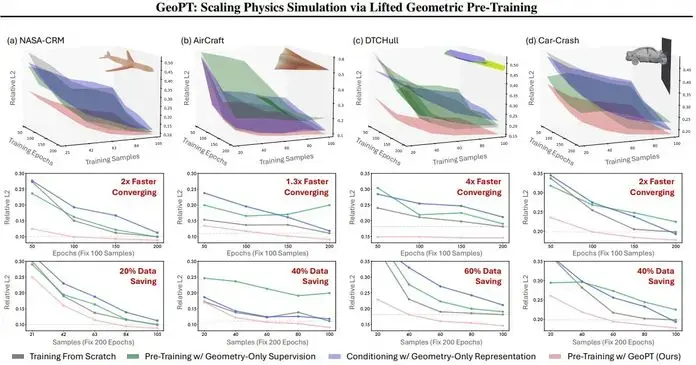
According to the supplied research results, GeoPT can reach peak performance approximately twice as fast as leading models while requiring up to 60% less data.
The advantage becomes especially notable in complex industrial simulations.
In testing involving complex 3D geometries exposed to airflow and surface pressure, GeoPT outperformed state-of-the-art approaches in speed, accuracy, and efficiency. Similar advantages were observed when modeling the response of fighter aircraft to wind.
Boat simulations provided another significant result. When modeling how a boat hull responds to both air and water forces, GeoPT required 60% fewer labeled data while reaching peak accuracy four times faster than leading baseline approaches.
These results point toward a fundamental change in the economics of AI-powered engineering simulation.
If useful physical predictions can be achieved with fewer expensive labeled datasets, organizations could evaluate more design variations without proportionally increasing simulation costs.
More Than Aerodynamics: Cars, Boats, Light, and Robotics
The research becomes even more interesting when considering the variety of tasks tested.
GeoPT was able to predict how different three-dimensional vehicle designs would deform during collisions. Crash simulation is particularly demanding because physical deformation depends on geometry, materials, force distribution, contact points, and other variables.
The system also demonstrated an ability to generalize beyond objects and conditions directly represented in its training experience. One experiment involved predicting how light would interact with a toy rabbit model, despite the system not having been specifically trained on that exact 3D model or the corresponding light physics.
This kind of generalization is critical to the concept of a foundation model.
A specialized model can perform extremely well within the boundaries of its training distribution. A foundation model becomes substantially more valuable when knowledge learned from one class of problems can transfer to another.
For robotics, this could eventually mean generating more physically realistic training environments. For vehicle manufacturers, it could mean rapidly evaluating design alternatives. For aerospace companies, it could support early-stage aerodynamic
analysis before expensive physical testing.
GeoPT and the Emergence of Physics Foundation Models
The broader objective behind the research is considerably larger than a faster simulation tool.
The researchers describe GeoPT as an early step toward a physics foundation model, a general-purpose system capable of learning physical relationships across many different domains.
The idea follows a trajectory already visible elsewhere in AI.
Large language models learned general patterns from enormous quantities of text. Vision models learned representations from images and video. Multimodal systems increasingly combine these capabilities.
Physics introduces another layer.
An AI model may know what a chair looks like from images and understand the word "chair" from text, but neither capability automatically tells the model how much force is required to move the chair, how its center of mass affects stability, or what happens when it falls.
Physical intelligence requires models to understand relationships between objects, forces, time, geometry, motion, and environments.
This is particularly important for robotics. A robot operating in the real world cannot rely solely on visual recognition. It must predict what will happen when it touches an object, pushes something, lifts a load, navigates uneven terrain, or interacts with another moving system.
A physics foundation model could therefore become a core component of future world models for embodied AI.
Why Synthetic Data Could Change Physical AI
One of the biggest barriers to physical AI has been the cost of collecting useful real-world data.
Physical experiments require equipment, laboratories, materials, human supervision, and time. Some experiments are also dangerous or impossible to conduct repeatedly.
Synthetic data offers an alternative.
Computational environments can generate enormous numbers of controlled interactions without physically constructing every object or repeating every experiment. The challenge is ensuring that synthetic information actually teaches models transferable physical principles rather than superficial patterns.
GeoPT's approach is notable because it does not attempt to reproduce every detail of the real world during pre-training. Instead, it extracts a simpler class of interactions that can serve as a physical representation.
If this strategy continues to scale, AI researchers could potentially build increasingly capable models using synthetic physical experiences before fine-tuning them on expensive, domain-specific datasets.
That could reduce the amount of specialized data required for applications such as aerospace, automotive engineering, robotics, and industrial design.

Implications for Engineering and Product Development
The industrial implications are substantial.
Engineering traditionally relies on a combination of mathematical modeling, computational simulation, physical prototypes, laboratory testing, and real-world validation. AI does not eliminate these processes, particularly for safety-critical systems, but it can potentially accelerate the earliest and most iterative stages.
Imagine an engineering team evaluating hundreds or thousands of design variations.
Instead of running a complete high-cost simulation for every candidate, an AI-based physics model could rapidly identify promising configurations. Engineers could then subject the strongest candidates to more rigorous numerical analysis and physical testing.
This creates a layered workflow:
AI prediction → design filtering → high-fidelity simulation → physical validation
Such a process could reduce wasted computational resources and shorten development cycles.
The potential impact extends beyond vehicles. Industrial machinery, consumer products, marine structures, robotics systems, construction components, and other engineered objects could benefit from faster virtual experimentation.
A New Relationship Between AI and Traditional Simulation
GeoPT should not be interpreted as a replacement for established numerical solvers.
Traditional physics engines and numerical methods remain essential because they can provide highly detailed solutions based on known physical laws. AI models introduce a different advantage: speed, generalization, and the ability to learn representations from large collections of examples.
The future is therefore more likely to involve collaboration between AI and conventional simulation rather than outright replacement.
AI can act as a fast approximation layer, while numerical solvers can provide high-fidelity verification. Engineers can use AI to explore a much larger design space and reserve expensive computational or physical experiments for the most important cases.
This hybrid model could become particularly valuable in fields where both speed and accuracy are critical.
The Remaining Challenges
Despite its promising results, physics foundation modeling remains an emerging field.
Physical reality is vastly more complicated than the simplified particle interactions used during GeoPT's pre-training. Real environments involve fluid dynamics, turbulence, heat transfer, material properties, deformation, friction, electromagnetic effects, chemical interactions, and complex boundary conditions.
A model must also know when its prediction is uncertain.
That issue becomes particularly important for safety-critical applications. A fast AI prediction cannot substitute for certification, validation, or engineering judgment when designing aircraft, vehicles, medical devices, or infrastructure.
Future systems will therefore need better uncertainty estimation, stronger validation procedures, broader physical datasets, and increasingly sophisticated integration with established simulation techniques.
The researchers themselves envision scaling GeoPT to more shapes, more physical phenomena, weather modeling, material behavior, and realistic video generation.
The Road Toward AI That Understands the Physical World
The significance of GeoPT extends beyond a single research benchmark.
AI has spent much of its development learning to manipulate symbols, language, pixels, and increasingly complex digital representations. The next frontier is learning the rules that govern physical reality.
A system capable of combining visual understanding with physical prediction could fundamentally change how machines interact with the world.
For robotics, it could improve simulation and training. For transportation, it could accelerate design and testing. For aerospace, it could expand the number of configurations engineers can evaluate. For industrial companies, it could reduce dependence on costly physical prototypes during early development.
The most important question is no longer whether AI can generate realistic representations of physical objects. It is whether AI can develop transferable internal representations of the forces that govern those objects.
GeoPT offers evidence that synthetic physical interactions can help move models in that direction.
Physics Could Become AI's Next Major Modality
The development of GeoPT represents a significant step toward AI systems that do more than recognize and generate information. By learning from synthetic dynamics, the model can build a broader representation of how geometry, motion, and physical interactions relate to one another.
Its reported ability to operate with substantially less labeled data, reach peak performance faster, and process simulations involving more than 100 million mesh points in seconds illustrates the potential economic value of physics-aware AI.
The larger opportunity is the emergence of physics foundation models capable of transferring knowledge across engineering and robotics applications.
For organizations studying the future of artificial intelligence, this development is especially important because the next generation of AI may not be defined solely by larger language models or better image generators. It may be defined by systems that can reason about the physical consequences of actions.
As Dr. Shahid Masood and the expert team at 1950.ai continue to examine the convergence of artificial intelligence, advanced computing, robotics, and emerging technologies, physics-aware foundation models represent a particularly important frontier. The ability to connect digital intelligence with the laws of the physical world could become one of the foundations of the next era of intelligent machines.
Key Takeaways
GeoPT is a physics-oriented pre-training approach developed by researchers at MIT CSAIL and Tsinghua University.
The system uses approximately 1.3 million synthetic dynamics samples involving particle and 3D object interactions.
It can reach peak performance faster while requiring substantially less labeled data than leading approaches.
In boat-hull testing, it used 60% fewer labeled data and reached peak accuracy four times faster than leading baselines.
The model demonstrated applications involving aircraft, vehicles, boats, collisions, airflow, surface pressure, and light.
Researchers see GeoPT as an early step toward physics foundation models.
Such systems could accelerate engineering design, robotics simulation, virtual testing, and physical-world AI.
Conventional numerical solvers and physical experiments will remain important for high-fidelity and safety-critical validation.
The long-term goal is AI capable of combining visual and textual intelligence with transferable understanding of physical reality.
Further Reading / External References
With a feel for physics, AI models simulate a wider range of real-world scenarios: https://news.mit.edu/2026/ai-models-simulate-wider-range-real-world-scenarios-0810
AI models simulate a wider range of real-world scenarios with physics: https://techxplore.com/news/2026-08-physics-ai-simulate-wider-range.html
AI model GeoPT for real-world scenarios: https://root-nation.com/en/news-en/it-news-ua/en-ai-model-geopt-for-real-world-scenarios/


Comments